Introduction to Matrices


What is a Matrix?
Definition: A matrix is a rectangular array of numbers (or symbols) arranged in rows and columns. Elements of a matrix are enclosed in parentheses or square brackets and are referred to by their row and column indices.
For example, the matrix below has nine elements and is of order 3 × 3.

Each element of the matrix M can be denoted by aij, which means the element in the i-th row and j-th column. For example, a23 = 6 in the matrix above.
Order of a Matrix
Order (or dimension): The order of a matrix is given by the number of rows and the number of columns and is written as rows × columns.
Thus the sample matrix M above is of order 3 × 3.
Try yourself: What is the order of a matrix?
Transpose of a Matrix
Definition: The transpose of an m × n matrix A, denoted by AT, is the n × m matrix obtained by interchanging rows and columns of A.
If A = [aij] is m × n, then AT = [bij] is n × m where bij = aji.
Properties of Transpose
- (AT)T = A
- (A + B)T = AT + BT
- (AB)T = BTAT
- (cA)T = cAT for any scalar c
Singular and Nonsingular Matrices
- Singular matrix: A square matrix A is singular if its determinant is zero; that is, |A| = 0. A singular matrix is not invertible.
- Nonsingular (invertible) matrix: A square matrix A is nonsingular if its determinant is non-zero; that is, |A| ≠ 0. A nonsingular matrix has an inverse.
Matrix Addition and Multiplication: Properties
- Commutative property of addition: For any two matrices A and B of the same order, A + B = B + A.
- Associative property of addition: For A, B, C of the same order, (A + B) + C = A + (B + C).
- Non-commutative property of multiplication: In general, matrix multiplication is not commutative; for most A and B, AB ≠ BA.
- Associative property of multiplication: For conformable matrices, (AB)C = A(BC).
- Distributive property: Matrix multiplication distributes over addition: A(B + C) = AB + AC and (A + B)C = AC + BC.
- Compatibility for multiplication: If A is of order m × n and B is of order n × p, then the product AB is defined and has order m × p.
Types of Matrices
- Square matrix: A matrix with the same number of rows and columns (n × n).
- Symmetric matrix: A square matrix A is symmetric if AT = A. Elements are mirrored about the main diagonal.
- Skew-symmetric (or antisymmetric) matrix: A square matrix A is skew-symmetric if AT = -A. Diagonal entries of a real skew-symmetric matrix are zero.
- Diagonal matrix: A square matrix whose off-diagonal entries are zero. Only diagonal entries may be non-zero.
- Identity matrix: Denoted In, it is an n × n diagonal matrix with ones on the main diagonal and zeros elsewhere. For any conformable A, AI = IA = A.
- Orthogonal matrix: A square matrix Q with real entries is orthogonal if Q QT = QT Q = I. Columns (and rows) of Q form an orthonormal set.
- Idempotent matrix: A matrix A is idempotent if A2 = A.
- Involutory matrix: A matrix A is involutory if A2 = I, i.e. A is its own inverse.
Note: Every square matrix A can be uniquely decomposed as the sum of a symmetric and a skew-symmetric matrix:
A = 1/2 (AT + A) + 1/2 (A - AT).
Adjoint (Classical Adjoint) of a Square Matrix
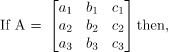
Definition: The adjoint (also called the classical adjoint) of an n × n matrix A, denoted adj(A), is the transpose of the cofactor matrix of A.


Properties of Adjoint
- A · adj(A) = adj(A) · A = |A| In
- adj(AB) = adj(B) · adj(A)
- |adj(A)| = |A|n-1
- adj(kA) = kn-1 adj(A) for scalar k
- |adj(adj(A))| = |A|(n-1)2
- adj(adj(A)) = |A|n-2 A
- If A = [L, M, N] (block notation) then adj(A) = [MN, LN, LM] (block-wise relation for 3×3 block matrices under suitable conditions)
- adj(I) = I
Where n is the order of the square matrix A.
Try yourself: What is the adjoint of a matrix A?
Inverse of a Square Matrix
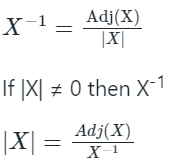
Definition: For a square matrix A of order n, the inverse A-1 (if it exists) is the matrix such that A A-1 = A-1 A = I.
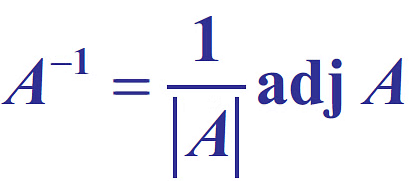 The inverse of a Square Matrix
An inverse exists only when |A| ≠ 0; that is, A must be nonsingular.
Properties of Inverse
- (A-1)-1 = A
- (AB)-1 = B-1 A-1
- Only a non-singular square matrix has an inverse.
Where to use the Inverse Matrix
Systems of linear equations can be written in matrix form as AX = B. If A is invertible, the unique solution is X = A-1 B. This method is particularly useful when A is fixed and several different right-hand sides B must be solved.
Example system (corrected for clarity):
7x + 2y + z = 21
3y - z = 5
-3x + 4y - 2z = -1
If the coefficient matrix is A and the variable vector is X = [x, y, z]T, then X = A-1 B provided |A| ≠ 0.
Trace of a Matrix
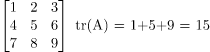
Definition: The trace of a square matrix A, denoted tr(A), is the sum of its diagonal elements.
Property: The trace of a matrix equals the sum of its eigenvalues (counted with algebraic multiplicity).
For example:
Additional Important Concepts (brief)
- Determinant: A scalar associated with a square matrix; used to test invertibility, compute areas/volumes under linear maps and in many formulae (Laplace expansion, product rule |AB| = |A||B|).
- Rank: The rank of a matrix is the maximum number of linearly independent rows (or columns). Rank determines solvability of linear systems (compare rank of augmented matrix and coefficient matrix).
- Row-reduction and Echelon forms: Elementary row operations reduce matrices to row echelon form (REF) or reduced row echelon form (RREF) for solving linear systems and finding rank.
- Linear transformations: Any m × n matrix represents a linear map from Rn to Rm; properties of the matrix correspond to properties of the transformation (invertible ↔ bijective).
- Applications (engineering): Matrices are used in solving circuits (nodal and mesh methods), structural analysis (stiffness matrices), control systems, image processing, computer graphics, data fitting, and modelling networks.
Solved Examples
Q1: For matrices of the same dimension M, N, and scalar c, which one of these properties DOES NOT ALWAYS hold?
(a) (MT)T = M
(b) (cM)T = c(M)T
(c) (M + N)T = MT + NT
(d) MN = NM
Ans: (d)
Sol:
Consider two 2 × 2 matrices M and N (same dimension):
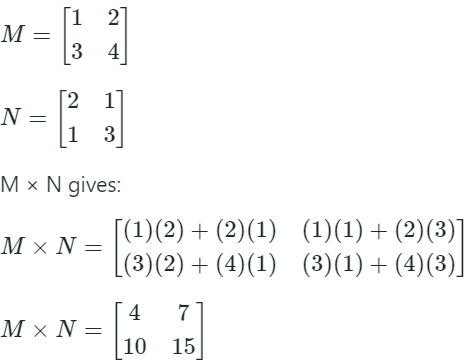
Compute M × N:
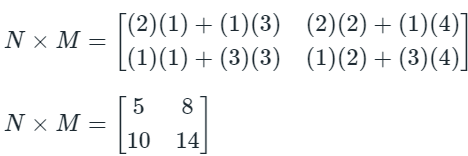
We observe that (M × N)2×2 ≠ (N × M)2×2, even when dimensions are equal.
However, if M and N are both the 2 × 2 identity matrix then (M × N) = (N × M) = I.
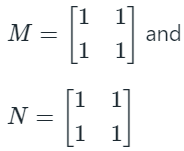
Therefore (M × N)2×2 is not always equal to (N × M)2×2, and option (d) does not always hold.
Q2: For A =
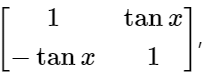
the determinant of ATA-1 is:
(a) sec2 x
(b) cos 4x
(c) 1
(d) 0
Ans: (c)
Sol:
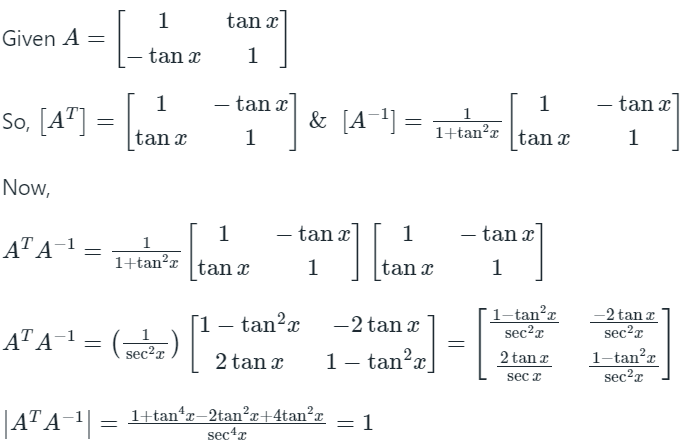
Explanation:
If A is given and invertible then |AT A-1| = |AT| · |A-1|.
Use |AT| = |A| and |A-1| = 1/|A| to obtain |AT A-1| = |A| · (1/|A|) = 1.
Q3: Let X be a square matrix. Consider the following two statements on X.
I. X is invertible.
II. Determinant of X is non-zero.
Which one of the following is TRUE?
(a) I implies II; II does not imply I.
(b) II implies I; I does not imply II.
(c) I does not imply II; II does not imply I.
(d) I and II are equivalent statements.
Ans: (d)
Sol:
If X is invertible then X-1 exists and therefore |X| ≠ 0.
If |X| ≠ 0 then X has an inverse (the adjoint formula A-1 = adj(A)/|A|), so X is invertible.
Hence I implies II and II implies I; both statements are equivalent.
Q4: The matrix P is the inverse of a matrix Q. If I denotes the identity matrix, which one of the following options is correct?
(a) PQ = I but QP ≠ I
(b) QP = I but PQ ≠ I
(c) PQ = I and QP = I
(d) PQ - QP = I
Ans: (c)
Sol:
Given P = Q-1.
Post-multiply by Q:
PQ = Q-1 Q
PQ = I (because Q-1 Q = I)
Pre-multiply by Q:
QP = Q Q-1
QP = I (because Q Q-1 = I)
So, PQ = I and QP = I; option (c) is correct.
FAQs on Introduction to Matrices
| 1. What exactly is a matrix and why do we need it in engineering? |  |
| 2. How do I identify the order of a matrix and what does it actually mean? | |
| 3. What's the difference between square matrices and rectangular matrices for CBSE exams? | |
| 4. Why do I keep getting confused about matrix elements and notation like aij? | |
| 5. Can I actually use matrices to solve real problems or is it just theory for exams? | |