Rank of Matrix

The Rank of a Matrix
You may view an r × c matrix as a collection of r row vectors each of length c, or as a collection of c column vectors each of length r. The concept of rank measures how many of those row or column vectors are linearly independent.
Definition
The rank of a matrix is the maximum number of linearly independent column vectors in the matrix or, equivalently, the maximum number of linearly independent row vectors in the matrix. Both definitions give the same value for any matrix.
Basic bounds and observations
- Rank bound: For an r × c matrix, rank(A) ≤ min(r, c).
- Full rank: A matrix is said to be full rank when its rank equals min(r, c).
- Zero rank: The rank of a matrix is zero only for the zero matrix (all entries zero). If a matrix has at least one non-zero element, its rank is at least 1.
- Transpose equality: rank(A) = rank(AT), so row rank equals column rank.
How to find the rank of a matrix
The two standard methods to determine the rank of a matrix are (i) row-reduction to an echelon form and (ii) finding the largest non-zero minor (largest order of a non-zero determinant of a square submatrix). For practical computations, row-reduction is usually preferred.
Method: Row-reduction (row echelon form)
Elementary row operations do not change the linear relations among rows and therefore do not change the number of linearly independent rows. Transform the matrix to a row echelon form (or reduced row echelon form) using elementary row operations; the number of non-zero rows in that echelon form equals the rank.
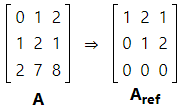
Suppose the row echelon form Aref of matrix A has two non-zero rows. Then rank(A) = 2.
One can check the linear dependence among the original rows. For the matrix illustrated above, Row 3 is a linear combination of Row 1 and Row 2; specifically,
Row 3 = 3 × (Row 1) + 2 × (Row 2).
Hence only two rows are independent and the rank is 2.
Method: Largest non-zero minor
The rank of a matrix equals the order (size) of the largest non-zero square submatrix (minor). In particular, for a square matrix of order n, if det(A) ≠ 0 then rank(A) = n (the matrix is full rank). For rectangular matrices, find the largest k for which some k × k minor has non-zero determinant; that k is the rank.
Full-rank and examples
A matrix is full rank when all its rows (if r ≤ c) or all its columns (if c ≤ r) are linearly independent. Equivalently, rank(A) = min(r, c).
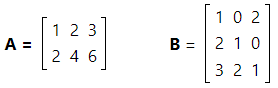
In the first matrix shown in the figure, Row 2 is a scalar multiple of Row 1 (Row 2 = 2 × Row 1). Therefore rows 1 and 2 are linearly dependent and the matrix has rank 1; it is not full rank.
In the second matrix shown, all three rows are linearly independent. Therefore the rank of that matrix is 3 and it is full rank.
Important properties of rank
- rank(A) ≤ min(number of rows of A, number of columns of A).
- rank(A) = rank(AT) (row rank equals column rank).
- Elementary row operations do not change the rank.
- rank(AB) ≤ min(rank(A), rank(B)).
- If A is an n × n matrix and det(A) ≠ 0 then rank(A) = n.
- Rank-nullity theorem: For a matrix A of size m × n viewed as a linear map from Rn to Rm, rank(A) + nullity(A) = n, where nullity(A) is the dimension of the solution space of A x = 0.
Practical computation - stepwise guideline using row reduction
Transform A to an echelon form using elementary row operations and count the non-zero rows. A typical sequence of steps is as follows.
Use a non-zero pivot in the first column; if the entry in the first row is zero swap with a lower row that has a non-zero entry in that column.
Use the pivot row to eliminate entries below the pivot (make them zero) by adding suitable multiples of the pivot row to the rows below.
Move to the next pivot column (to the right) and repeat the selection of a non-zero pivot and elimination below it until the matrix is in row echelon form.
Count the number of non-zero rows in the resulting echelon matrix; this count is the rank of A.
Notes and tips for examinations and computations
- For small matrices compute determinants of principal minors when convenient; for larger matrices, use row-reduction for numerical stability and speed.
- If any row becomes all zeros during row-reduction, it does not contribute to rank.
- Carefully check linear combinations among rows or columns to identify dependencies; expressing one row as a linear combination of others immediately reduces the number of independent rows.
- Remember that column operations can change the column space; prefer row operations when using the row-space approach to compute rank.
Summary
The rank of a matrix is the number of linearly independent rows or columns and is equal to the number of non-zero rows in its row echelon form. It is bounded above by min(r, c) for an r × c matrix, invariant under transposition, and determined either by row-reduction or by the largest non-zero minor. For square matrices, a non-zero determinant implies full rank.
FAQs on Rank of Matrix
| 1. What is the rank of a matrix? |  |
| 2. How is the rank of a matrix calculated? | |
| 3. How does the rank of a matrix relate to its invertibility? | |
| 4. Can the rank of a matrix be greater than its dimensions? | |
| 5. How can the rank of a matrix be used in solving systems of linear equations? | |