Longest Remaining Time First (LRTF) CPU Scheduling Algorithm

Longest Job First Algorithm
In LJF Scheduling,
- Out of all the available processes, CPU is assigned to the process having largest burst time.
- In case of a tie, it is broken by FCFS Scheduling.
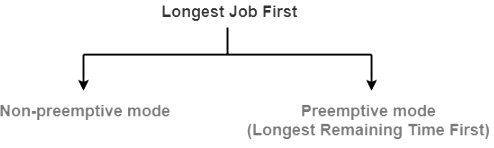
- LJF Scheduling can be used in both preemptive and non-preemptive mode.
- Preemptive mode of Longest Job First is called as Longest Remaining Time First (LRTF).
Advantages-
- No process can complete until the longest job also reaches its completion.
- All the processes approximately finishes at the same time.
Disadvantages-
- The waiting time is high.
- Processes with smaller burst time may starve for CPU.
Problems Based on LJF Scheduling
Problem 1: Consider the set of 5 processes whose arrival time and burst time are given below-
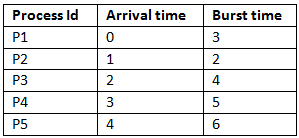
If the CPU scheduling policy is LJF non-preemptive, calculate the average waiting time and average turn around time.
Gantt Chart-
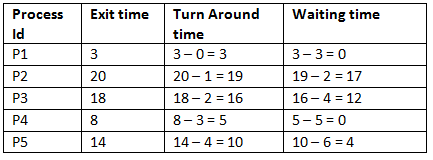
Now, we know-
- Turn Around time = Exit time - Arrival time
- Waiting time = Turn Around time - Burst time
Now,
- Average Turn Around time = (3 + 19 + 16 + 5 + 10) / 5 = 53 / 5 = 10.6 unit
- Average waiting time = (0 + 17 + 12 + 0 + 4) / 5 = 33 / 5 = 6.6 unit
Problem 2: Consider the set of 4 processes whose arrival time and burst time are given below-
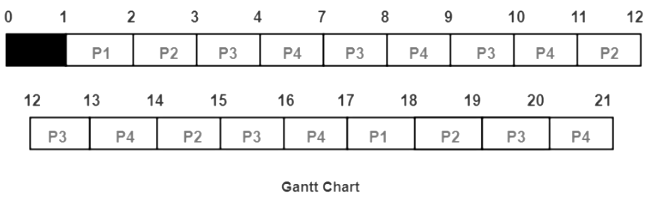
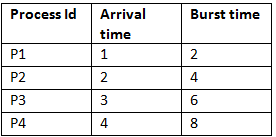 If the CPU scheduling policy is LJF preemptive, calculate the average waiting time and average turn around time.
Gantt Chart-
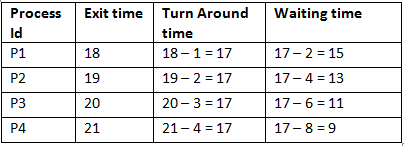
Now, we know-
- Turn Around time = Exit time - Arrival time
- Waiting time = Turn Around time - Burst time
Now,
- Average Turn Around time = (17 + 17 + 17 + 17) / 4 = 68 / 4 = 17 unit
- Average waiting time = (15 + 13 + 11 + 9) / 4 = 48 / 4 = 12 unit
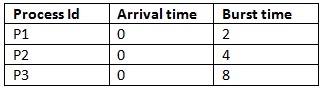
Problem 3: Consider three processes (process id 0, 1, 2 respectively) with compute time bursts 2, 4 and 8 time units. All processes arrive at time zero. Consider the longest remaining time first (LRTF) scheduling algorithm. In LRTF, ties are broken by giving priority to the process with the lowest process id. The average turn around time is-
(a) 13 unit
(b) 14 unit
(c) 15 unit
(d) 16 unit
We have the set of 3 processes whose arrival time and burst time are given below-
Gantt Chart-
Now, we know-
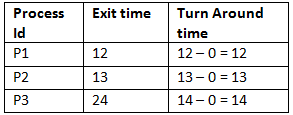
Turn Around time = Exit time - Arrival time
Now,
Average Turn Around time = (12 + 13 + 14) / 3 = 39 / 3 = 13 unit
Thus, Option (a) is correct.



 | Explore Courses for Computer Science Engineering (CSE) exam |  |
 | Get EduRev Notes directly in your Google search | |