Computer Science Engineering (CSE) Exam > Computer Science Engineering (CSE) Notes > Operating System > Deadlock Detection Algorithm
Deadlock Detection Algorithm

Introduction
If a system does not employ either a deadlock prevention or deadlock avoidance algorithm then a deadlock situation may occur. In this case:
- Apply an algorithm to examine state of system to determine whether deadlock has occurred or not.
- Apply an algorithm to recover from the deadlock. For more refer- Deadlock Recovery
Deadlock Avoidance Algorithm/ Bankers Algorithm
The algorithm employs several times varying data structures:
- Available:
A vector of length m indicates the number of available resources of each type. - Allocation:
An n*m matrix defines the number of resources of each type currently allocated to a process. Column represents resource and resource represent process. - Request:
An n*m matrix indicates the current request of each process. If request[i][j] equals k then process Pi is requesting k more instances of resource type Rj.
Now, Bankers algorithm includes a Safety Algorithm / Deadlock Detection Algorithm
The algorithm for finding out whether a system is in a safe state can be described as follows:
Steps of Algorithm:
- Let Work and Finish be vectors of length m and n respectively. Initialize Work= Available. For i=0, 1, ...., n-1, if Requesti = 0, then Finish[i] = true; otherwise, Finish[i]= false.
- Find an index i such that both
a) Finish[i] == false
b) Requesti <= Work
If no such i exists go to step 4.
Work= Work+ Allocationi
Finish[i]= true
Go to Step 2. - If Finish[i]== false for some i, 0<=i<n, then the system is in a deadlocked state. Moreover, if Finish[i]==false the process Pi is deadlocked.
For example,
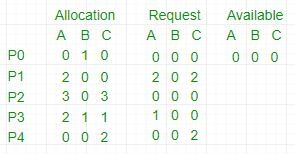
- In this, Work = [0, 0, 0] &
Finish = [false, false, false, false, false] - i = 0 is selected as both Finish[0] = false and [0, 0, 0] <= [0, 0, 0].
- Work =[0, 0, 0] + [0, 1, 0] => [0, 1, 0] &
Finish = [true, false, false, false, false]. - i = 2 is selected as both Finish[2] = false and [0, 0, 0] <= [0, 1, 0].
- Work = [0, 1, 0] + [3, 0, 3] => [3, 1, 3] &
Finish = [true, false, true, false, false]. - i = 1 is selected as both Finish[1] = false and [2, 0, 2] <= [3, 1, 3].
- Work = [3, 1, 3] + [2, 0, 0] => [5, 1, 3] &
Finish = [true, true, true, false, false]. - i = 3 is selected as both Finish[3] = false and [1, 0, 0] <= [5, 1, 3].
- Work =[5, 1, 3] + [2, 1, 1] => [7, 2, 4] &
Finish = [true, true, true, true, false]. - i = 4 is selected as both Finish[4] = false and [0, 0, 2] <= [7, 2, 4].
- Work = [7, 2, 4] + [0, 0, 2] => [7, 2, 6] &
Finish = [true, true, true, true, true].
Since Finish is a vector of all true it means there is no deadlock in this example.
The document Deadlock Detection Algorithm is a part of the Computer Science Engineering (CSE) Course Operating System.
All you need of Computer Science Engineering (CSE) at this link: Computer Science Engineering (CSE)
About this Document

4.68/5 Rating

Apr 30, 2026 Last updated
Related Exams
Document Description: Deadlock Detection Algorithm for Computer Science Engineering (CSE) 2026 is part of Operating System preparation. The notes and questions for Deadlock Detection Algorithm have been prepared according to the Computer Science Engineering (CSE) exam syllabus. Information about Deadlock Detection Algorithm covers topics like and Deadlock Detection Algorithm Example, for Computer Science Engineering (CSE) 2026 Exam. Find important definitions, questions, notes, meanings, examples, exercises and tests below for Deadlock Detection Algorithm.
Introduction of Deadlock Detection Algorithm in English is available as part of our Operating System for Computer Science Engineering (CSE) & Deadlock Detection Algorithm in Hindi for Operating System course. Download more important topics related with notes, lectures and mock test series for Computer Science Engineering (CSE) Exam by signing up for free. Computer Science Engineering (CSE): Deadlock Detection Algorithm
Description
Deadlock Detection Algorithm of Operating System covers all the important topics, helping you prepare for the Computer Science Engineering (CSE) exam on EduRev.
Information about Deadlock Detection Algorithm
In this doc you can find the meaning of Deadlock Detection Algorithm defined & explained in the simplest way possible. Besides explaining types of Deadlock Detection Algorithm theory, EduRev gives you an ample number of questions to practice Deadlock Detection Algorithm tests, examples and also practice Computer Science Engineering (CSE) tests
 | Explore Courses for Computer Science Engineering (CSE) exam |  |
 | Get EduRev Notes directly in your Google search | |
Related Searches
Sample Paper, Deadlock Detection Algorithm, Free, Summary, Previous Year Questions with Solutions, Deadlock Detection Algorithm, shortcuts and tricks, practice quizzes, mock tests for examination, Exam, past year papers, Objective type Questions, Important questions, study material, Semester Notes, MCQs, Extra Questions, ppt, video lectures, Viva Questions, Deadlock Detection Algorithm, pdf ;