Work, Power & Energy

Work
Work is done when a force causes a body to move from one location to another. Work is the mechanical effect of a force acting through a distance. The straight-line distance through which the point of application of the force moves is the displacement.
If the force and the displacement are in the same direction and both have constant magnitudes, the scalar work done W is
W = F d
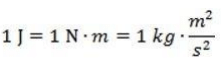
Here F is the magnitude of the force (in newtons, N) and d is the magnitude of the displacement (in metres, m). The SI unit of work is the joule (J), which is equivalent to one newton-metre (N·m).
Force and displacement are vector quantities in general. Only the component of the force along the direction of displacement contributes to the work. Using vectors, the work done by a constant force F when the point of application undergoes displacement d is the scalar (dot) product
W = F · d = F d cos θ
where θ is the angle between the force and displacement vectors. If θ = 90°, W = 0 (no work is done by the force perpendicular to the displacement).

When work is done against gravity to lift a body of mass m through a vertical height h, the magnitude of the work done (assuming constant g) is
W = m g h
This expression gives the increase in gravitational potential energy of the body when it is raised by height h (with respect to the chosen reference level).
Energy
Energy is the capacity of a body or system to do work. Energy is a scalar quantity: it has magnitude only. The SI unit of energy is the joule (J).
Potential energy
Potential energy is the energy associated with the position or configuration of a system in a force field or due to its deformation. Common forms encountered in engineering mechanics are gravitational potential energy and elastic potential energy.
- Gravitational potential energy of a body of mass m at height h above a chosen reference is Ug = m g h. The value depends on the choice of zero level for potential energy.
- Elastic potential energy stored in a spring (linear elastic) displaced by amount x from equilibrium is Us = 1⁄2 k x², where k is the spring constant (units N·m⁻¹).
A force is called conservative if the work done by the force in moving a particle between two points is independent of the path taken. For a conservative force F, one can define a potential energy function U such that the work done by the force when the particle moves from point 1 to point 2 equals U(1) - U(2), or equivalently
W1→2 = -ΔU = U(1) - U(2)
Kinetic energy
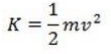
Kinetic energy of a particle of mass m moving with speed v is defined as
K = 1/2 m v²
This is a scalar quantity and is always non-negative. The unit is the joule (J). The work-energy theorem states that the net work done on a particle equals the change in its kinetic energy. The theorem can be shown as follows (derivation for a particle acted on by a constant mass):
Consider a particle of mass m subject to a net force F along its direction of motion.
Begin with Newton's second law: F = m a.
Displacement in a small time dt is ds = v dt.
Infinitesimal work done by the net force is dW = F · ds.
Substitute for acceleration and ds:
F = m (dv/dt)
dW = m (dv/dt) v dt
dW = m v dv
Integrate between initial speed v₁ and final speed v₂:
W = ∫v₁v₂ m v dv
W = 1/2 m v² |v₁v₂
W = 1/2 m v₂² - 1/2 m v₁²
Therefore W = ΔK, which is the work-energy theorem.
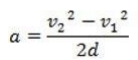
The standard kinematic relation often used in such derivations is
v² = v₀² + 2 a (x - x₀)

Solving for acceleration a from that relation and substituting into force expressions is a common route to relate work and change in kinetic energy.
Using F = m a and W = F d for a constant force in the direction of displacement gives the same result after algebraic substitution and integration.
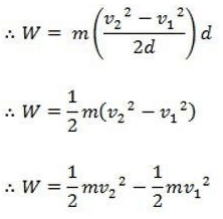
Thus, the net work done by the sum of forces acting on a particle equals the change in its kinetic energy:
W = K₂ - K₁ = ΔK
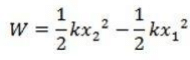
Work done on a spring (linear)
Hooke's law for a linear spring can be written with sign convention as F = -k x, where the force exerted by the spring opposes displacement from equilibrium. The magnitude of the restoring force is |F| = k |x|; the input expression F = k x is the magnitude form when direction is treated separately.
The work required to move the free end of the spring from position x₁ to x₂ is
W = ∫x₁x₂ F(x) dx
Using the restoring force with sign,
W = ∫x₁x₂ (-k x) dx
W = -1/2 k x² |x₁x₂
W = -1/2 k (x₂² - x₁²)
If work is done by an external agent to stretch the spring quasistatically from x₁ to x₂, the external agent must do positive work equal in magnitude to the increase of the spring potential energy, namely 1/2 k (x₂² - x₁²). The potential energy stored in the spring at displacement x is Us = 1/2 k x².
Conservation of mechanical energy
When only conservative forces (such as gravity and ideal springs) act on a particle, the sum of kinetic and potential energy, the mechanical energy E = K + U, remains constant:
ΔK + ΔU = 0 or K₁ + U₁ = K₂ + U₂
Non-conservative forces (for example friction or air drag) do work that converts mechanical energy into other forms (thermal, internal), and such work equals the change in mechanical energy:
Wnc = ΔK + ΔU
Power
Power is the rate at which work is done or the rate at which energy is transferred. If an amount of work W is done in time t, the average power P̄ is
P̄ = W / t
The SI unit of power is the watt (W), where
1 W = 1 J s⁻¹
The instantaneous power delivered by a force acting on a particle moving with velocity v is
P = dW/dt = F · v
For a constant force acting on a body moving with constant velocity in the force direction, this reduces to P = F v. In general for vector quantities the dot product expresses that only the force component parallel to the instantaneous velocity contributes to power.
Units and dimensional checks
- Work, energy: joule (J) = N·m = kg·m²·s⁻².
- Power: watt (W) = J·s⁻¹ = kg·m²·s⁻³.
Summary
Work measures force acting through displacement; energy is the capacity to do work and appears as kinetic and potential forms; the work-energy theorem relates net work to change in kinetic energy; conservative forces permit definition of potential energy and conservation of mechanical energy; power quantifies the rate of doing work. These concepts and relations (including W = F·d, K = 1/2 m v², U = m g h, U = 1/2 k x², and P = F·v) form the foundation of work, energy and power analyses in engineering mechanics.
FAQs on Work, Power & Energy
| 1. What is work in physics? |  |
| 2. How is power related to work? | |
| 3. What is the difference between work and energy? | |
| 4. What are the different forms of energy? | |
| 5. How is energy related to power? | |