NCERT Exemplar Solutions: Friction

Multiple Choice Questions
Q.1. Whenever the surfaces in contact tend to move or move with respect to each other, the force of friction comes into play
(a) only if the objects are solid.
(b) only if one of the two objects is liquid.
(c) only if one of the two objects is gaseous.
(d) irrespective of whether the objects are solid, liquid or gaseous.
Ans: (d) irrespective of whether the objects are solid, liquid or gaseous
Explanation: Friction occurs in solids, liquids and gases. It opposes the relative motion between surfaces or layers and acts whenever there is a tendency for motion.
Q.2. In Fig.12.1, a boy is shown pushing the box from right to left. The force of friction will act on the box
(a) from right to left (←)
(b) from left to right (→)
(c) vertically downwards (↓)
(d) vertically upwards (↑)
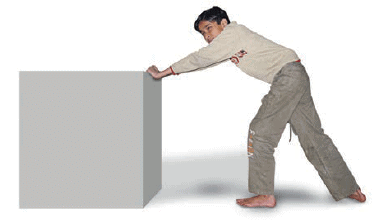
Ans: (b) from left to right (→)
Explanation: Friction always acts opposite to the direction of motion or to the direction in which motion is being attempted. Since the boy pushes the box from right to left, friction acts from left to right.
Q.3. To sharpen the blade of a knife by rubbing it against a surface, which of the following will be most suitable?
(a) stone
(b) plastic block
(c) wooden block
(d) glass block
Ans: (a) stone
Explanation: A stone is abrasive and produces large friction against the knife edge. This abrasion removes small amounts of metal from the blade and sharpens it.
Q.4. A toy car released with the same initial speed will travel farthest on
(a) muddy surface
(b) polished marble surface
(c) cemented surface
(d) brick surface
Ans: (b) polished marble surface
Explanation: A polished marble surface offers the least friction among the given surfaces, so the toy car loses the least kinetic energy to friction and therefore travels the farthest.
Q.5. If we apply oil on door hinges, the friction will
(a) increases
(b) decreases
(c) disappear altogether
(d) will remain unchanged
Ans: (b) decreases
Explanation: Oil acts as a lubricant and forms a thin layer between moving surfaces, reducing the contact and so decreasing friction.
Q.6. Which of the following statements is incorrect?
(a) Friction acts on a ball rolling along the ground.
(b) Friction acts on a boat moving on water.
(c) Friction acts on a bicycle moving on a smooth road.
(d) Friction does not act on a ball moving through air.
Ans: (d) Friction does not act on a ball moving through air.
Explanation: A ball moving through air experiences air resistance, which is a type of fluid friction. Thus friction (air resistance) does act on the ball.
Q.7. A boy rolls a rubber ball on a wooden surface. The ball travels a short distance before coming to rest. To make the same ball travel longer distance before coming to rest, he may
(a) spread a carpet on the wooden surface.
(b) cover the ball with a piece of cloth.
(c) sprinkle talcum powder on the wooden surface.
(d) sprinkle sand on the wooden surface
Ans: (c) sprinkle talcum powder on the wooden surface
Explanation: Talcum powder reduces the contact between the ball and the surface and so reduces friction. With less friction opposing its motion, the ball will roll farther.
Q.8. In a large commercial complex, there are four ways to reach the main road. One of the paths has loose soil, the second is laid with polished marble, the third is laid with bricks and the fourth has a gravel surface. It is raining heavily and Paheli wishes to reach the main road. The path on which she is least likely to slip is
(a) loose soil.
(b) polished marble.
(c) bricks.
(d) gravel.
Ans: (d) gravel
Explanation: Gravel has a rough, irregular surface that provides good grip under wet conditions. It offers higher friction than polished marble or loose soil, so Paheli is least likely to slip on gravel.
Very Short Answer Questions
Q.1. Two blocks of iron of different masses are kept on a cemented floor as shown in Fig.12.2. Which one of them would require a larger force to move it from the rest position?
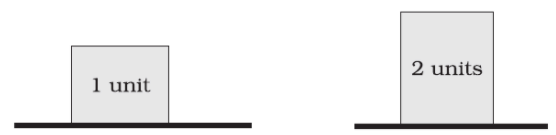
Ans: The heavier block will require the larger force.
Q.2. Will force of friction come into play when a raindrop rolls down a glass window pane?
Ans: Yes, frictional force (between the raindrop and the glass) comes into play when a raindrop rolls down a glass window pane.
Q.3. Two boys are riding their bicycles on the same concrete road. One has new tyres on his bicycle while the other has tyres that are old and used. Which of them is more likely to skid while moving through a patch of the road which has lubricating oil spilt over it?
Ans: The bicycle with worn-out tyres is more likely to skid.
Q.4. Fig.12.3 shows two boys applying force on a box. If the magnitude of the force applied by each is equal, will the box experience any force of friction?
Ans: No. If equal and opposite forces are applied and there is no tendency for the box to move, the net frictional force will be zero.
Q.5. Imagine that an object is falling through a long straight glass tube held vertical; the air has been removed completely from the tube. The object does not touch the walls of the tube. Will the object experience any force of friction?
Ans: No. If there is no air (no fluid) and the object does not touch the tube walls, there is no medium or contact to produce friction.
Short Answer Questions
Q.1. You might have noticed that when used for a long time, slippers with rubber soles become slippery. Explain the reason.
Ans: With prolonged use the rubber soles become smooth as their roughness wears away. This reduces the friction between the sole and the floor, so the slippers become slippery.
Q.2. Is there a force of friction between the wheels of a moving train and iron rails? If yes, name the type of friction. If an air cushion can be introduced between the wheel and the rail, what effect will it have on the friction?
Ans: Yes. The friction between the wheel and the rail is called rolling friction. If an air cushion were introduced between wheel and rail, contact would reduce and the friction would decrease.
Q.3. Cartilage is present in the joints of our body, which helps in their smooth movement. With advancing age, this cartilage wears off. How would this affect the movement of joints?
Ans: As cartilage wears off, the smooth surfaces become rougher and friction increases. This makes joint movement more difficult and often causes pain.
Q.4. While playing tug of war (Fig.12.4), Preeti felt that the rope was slipping through her hands. Suggest a way out for her to prevent this.
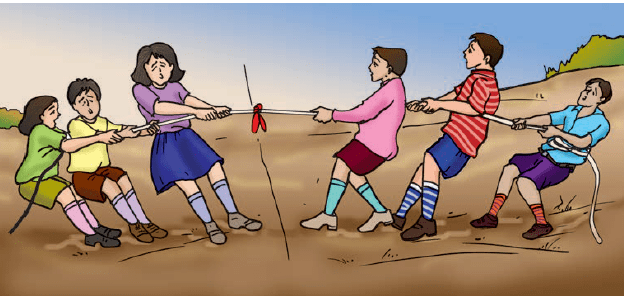
Ans: She may rub soil or chalk on her hands to increase the friction between the rope and her hands, or wear gloves to improve grip.
Q.5. The handle of a cricket bat or a badminton racquet is usually rough. Explain the reason.
Ans: A rough handle increases friction between the hand and the handle. This improved grip prevents the bat or racquet from slipping during play.
Q.6. Explain why the surface of mortar and pestle (silbatta) used for grinding is etched again after prolonged use?
Ans: The etched or rough surface increases friction between the mortar and pestle and the material being ground, making grinding more effective; hence it is re-etched after prolonged use.
Q.7. A marble is allowed to roll down an inclined plane from a fixed height. At the foot of the inclined plane, it moves on a horizontal surface (a) covered with silk cloth (b) covered with a layer of sand and (c) covered with a glass sheet. On which surface will the marble move the shortest distance. Give the reason for your answer.
Ans: The marble will move the shortest distance on the surface covered with sand because sand offers the greatest frictional resistance to its motion.
Q.8. A father and son pushed their car to bring it to the side of the road as it had stalled in the middle of the road. They experienced that although they had to push with all their might initially to move the car, the push required to keep the car rolling was smaller, once the car started rolling. Explain.
Ans: Initially they had to overcome static friction and get the car moving. Once the car was rolling, they only had to overcome rolling friction (and some air resistance), which is much smaller than static friction, so the required push was less.
Long Answer Questions
Q.1. When the cutting edge of a knife is put against a fast rotating stone to sharpen it, sparks are seen to fly. Explain the reason.
Ans: Friction between the knife edge and the rotating stone generates heat. Small particles of metal are removed from the blade; these hot metal particles glow as sparks when they are heated rapidly by the frictional heating.
Q.2. We have two identical metal sheets. One of them is rubbed with sandpaper and the other with ordinary paper. The one rubbed with sandpaper shines more than the other. Give reason.
Ans: Sandpaper is abrasive and removes the dull, oxidised top layer of the metal more effectively than ordinary paper. This reveals the brighter metal underneath, so the sheet rubbed with sandpaper shines more.
Q.3. While travelling on a rickshaw, you might have experienced that if the seat cover is very smooth, you tend to slip when brakes are applied suddenly. Explain.
Ans: A very smooth seat cover gives less friction between the seat and your body. When brakes are applied suddenly, there is a sudden relative motion tendency between you and the seat, and due to low friction you are more likely to slip.
Q.4. Two friends are trying to push a heavy load as shown in Fig.12.5. Suggest a way which will make this task easier for them.
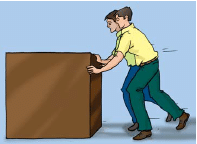
Ans: They can place rollers or cylindrical logs under the heavy load. Rolling friction is much smaller than sliding friction, so the load will be much easier to move.
FAQs on NCERT Exemplar Solutions: Friction
| 1. What is friction and why is it important in our daily life? |  |
| 2. What are the different types of friction? | |
| 3. How does surface texture affect friction? | |
| 4. What factors affect the amount of friction between two surfaces? | |
| 5. How can friction be reduced in mechanical systems? | |