NCERT Exemplar Solutions: Some Natural Phenomena

Multiple Choice Questions
Q.1. An electroscope is a device which is used to find if an object is
(a) charged
(b) magnetic
(c) free of cracks
(d) hot
Ans: (a)
Explanation:An electroscope is a device which is used to find whether the object is charged or not. It consists of two thin metallic strips held together and connected to a metal clip. When a charged body is brought near or in contact with the clip, charge is transferred to the strips and they repel each other, showing that the object is charged.
Q.2. Electric current is to be passed from one body to another. For this purpose, the two bodies must be joined by
(a) cotton thread
(b) plastic string
(c) copper wire
(d) rubber band
Ans: (c)
Explanation:Copper is a good conductor of electricity so it will allow electric current to pass between the two bodies. Plastic, rubber and cotton are poor conductors (insulators) and will not allow current to pass easily.
Q.3. The movement of the earth's plates causes
(a) cyclones
(b) lightning
(c) earthquakes
(d) thunderstorms
Ans: (c)
Explanation:When the earth's plates move or slide past one another they cause vibrations in the ground called earthquakes. Cyclones, lightning and thunderstorms are caused by atmospheric conditions, not by plate movement.
Q.4. Two charged objects are brought close to each other. Choose the most appropriate statement from the following options:
(a) they may attract
(b) they may repel
(c) they may attract or repel depending on the type of charges they carry
(d) there will be no effect
Ans: (c)
Explanation:Like charges (both positive or both negative) repel each other, while unlike charges (one positive and one negative) attract each other. So the force depends on the type of charges present.
Q.5. Which of the following is not likely to cause Tsunami?
(a) A major nuclear explosion undersea
(b) Earthquake
(c) Volcanic eruption
(d) Lightning
Ans: (d)
Explanation:Tsunamis are caused by large disturbances under or near the sea, such as earthquakes, underwater volcanic eruptions or large explosions. Lightning occurs in the atmosphere and does not disturb the sea floor, so it is not likely to cause a tsunami.
Q.6. The earth's plate responsible for causing earthquakes is
(a) the crust of the earth
(b) the mantle of the earth
(c) the inner core of the earth
(d) the outer core of the earth
Ans: (a)
Explanation:Earthquakes generally occur due to sudden movements of the earth's outermost layer, the crust, where different plates meet and interact. These movements release energy causing the ground to shake.
Q.7. Consider the list of terms given below:
(i) Seismic Zone
(ii) Fault Zone
(iii) Mantle
(iv) Inner Core
The boundaries of the earth's plate are known as
(a) (i) & (ii)
(b) (i) & (iii)
(c) (iii) & (iv)
(d) (ii), (iii) & (iv)
Ans: (a)
Explanation:Plate boundaries are weak regions where earthquakes are likely. These regions are often described as fault zones and seismic zones. The mantle and inner core are internal layers and are not the plate boundaries themselves.
Q.8. The outermost layer of earth is called
(a) mantle
(b) outer core
(c) crust
(d) inner core
Ans: (c)
Explanation:The outermost solid layer of the Earth is called the crust. Below the crust lie the mantle and then the core (outer and inner).
Q.9. Major earthquakes are less likely to occur in
(a) North East India
(b) Rajasthan
(c) Rann of Kutch
(d) Orissa
Ans: (d)
Explanation:Major earthquakes are less likely in Orissa compared with regions like the Himalayas, North-East India, Rann of Kutch and parts of Rajasthan, which lie closer to active plate boundaries or fault zones.
Q.10. Consider the list of terms given below
(i) Tsunami
(ii) Landslide
(iii) Floods
(iv) Lightning
Earthquakes can cause
(a) (i), (ii) & (iii)
(b) (ii) & (iv)
(c) (ii), (iii) & (iv)
(d) (iii) & (iv)
Ans: (a)
Explanation:Earthquakes can trigger tsunamis (if undersea), cause landslides on slopes and can lead to floods by damaging dams or changing river courses. Lightning is not caused by earthquakes.
Very Short Answer Questions
Q.11. State whether the following are True or False.
(a) Earthquakes occur all the time all over the world.
Ans: True
Explanation: Small tremors occur frequently at different places because the earth's plates are always moving. Major earthquakes are less common.
(b) The plates of the outermost layer of the earth are always in continuous motion.
Ans: True
Explanation: The plates move very slowly over long periods of time due to forces inside the Earth, so they are in continuous motion.
(c) Tremors on the earth can also be caused by the eruption of a volcano.
Ans: True
Explanation: Volcanic eruptions involve sudden movements and explosions that can cause ground shaking and local tremors.
(d) The process of electric discharge cannot occur between clouds and the earth.
Ans: False
Explanation: Electric discharge does occur between clouds and the earth; this process is observed as lightning.
(e) Bathing outdoors should be avoided during a thunderstorm.
Ans: True
Explanation: Water conducts electricity and being outdoors or in water during a thunderstorm increases the risk of being struck by lightning, so it is unsafe to bathe outdoors then.
Q.12. Is it possible to predict the occurrence of an earthquake?
Ans: No, it is not possible to predict the occurrence of an earthquake.
Explanation: Current science cannot predict the exact time and place of an earthquake; only areas at risk and probability over long periods can be estimated.
Q.13. If a charged plastic straw is brought near another uncharged plastic straw, what will happen?
Ans: They will attract each other.
Q.14. The aluminium strips in an electroscope as shown in fig. 15.1 are replaced by plastic strips and a charged body is brought in contact with the metal clip. What will happen?
Ans: Divergence of strips will not take place.
Q.15. Plastic straws A and B are rubbed with a dry cotton cloth. What will happen if they are brought near each other?
Ans: They will repel each other.
Short Answer Questions
Q.16. During the construction of a building, the lightning conductor was left hanging in the air by mistake. Would the lightning conductor be still effective? Explain.
Ans: It will not be effective because the conductor is not properly connected to the earth; without an earthed path the electric charge cannot be safely conducted away, so the conductor cannot protect the building.
Q.17. If air and cloud were good conductors of electricity, do you think lightning could occur? Explain.
Ans: No. If air and clouds were good conductors, electric charges would not separate and accumulate; separation of charges is necessary for lightning, so lightning would not occur.
Q.18. Identify the lightning conductor and the copper plate in Fig. 15.2.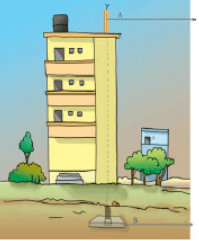
Ans: A is the lightning conductor and B is the copper plate.
Q.19. If the materials used for constructing a building were good conductors, do you think lightning will strike the building? Will the lightning conductor be still required to be installed in the building?
Ans: If the building is made of good conductors and those conductors provide a safe path to the earth (proper earthing), a separate lightning conductor may not be required. Proper grounding is essential to ensure charges are safely conducted to the earth.
Q.20. You might have observed on a dry day that when you touch the screen of a television or computer monitor (with a picture tube), you get a slight shock. Why does it happen?
Ans: A small electric charge gets accumulated on the screen. When you touch it, the charge discharges through your body to the ground, producing a slight shock.
Q.21. Explain how does lightning conductor protect a building from getting struck by lightning.
Ans: A lightning conductor provides a low-resistance path for the electric charge to flow from the top of the building to the earth. This prevents large charges from building up on the structure and reduces the chance of destructive lightning strikes.
Q.22. In an electroscope, if a negatively charged body is brought in contact with the metal clip, the strips of the electroscope diverge. If now another charged object carrying an equal amount of positive charge is brought in contact with the clip, what will happen?
Ans: The positive charge will neutralise the earlier negative charge on the electroscope. As a result, the net charge becomes smaller or zero and the aluminium strips will come back together (collapse) to their original position.
Q.23. The strips of an electroscope diverge when a charged body is brought in contact with the metal clip. Now the clip is touched gently by our hand. What will happen to the strips? Explain.
Ans: When we touch the metal clip, the charge on the electroscope flows from the strips through our body to the earth, discharging the electroscope. The strips lose their charge and return to the original (non-diverged) position.
Long Answer Questions
Q.24. Explain how lightning takes place?
Ans: During a thunderstorm, strong upward and downward air currents inside clouds cause water droplets and ice particles to move and collide. This motion separates electric charges: positive charges build up near the top of the cloud and negative charges collect near the lower part. Positive charges also accumulate on the ground below the cloud. When the potential difference between the cloud and the ground (or between different parts of the cloud) becomes large enough, the insulating air breaks down and a sudden flow of charge occurs. This rapid flow produces a bright flash of light and a sharp sound called lightning and thunder respectively.
Q.25. Mention three precautions that you will take to protect yourself if an earthquake strikes when you are inside the house.
Ans:
- Take shelter under a sturdy table and stay there until the shaking stops.
- Stay away from tall and heavy objects that may fall on you, such as shelves and cabinets.
- If you are in bed, do not get up; protect your head with a pillow.
Q.26. Explain why it is safer to use a wireless telephone instead of a landline telephone during lightning.
Ans: During lightning, electric charges can travel along wires. A landline telephone is connected to external wires that may carry sudden surges from a lightning strike, which can be dangerous. A wireless (mobile) telephone is not connected by a wired path to the outside and so does not provide a direct conductor for lightning to travel through the user, making it safer to use in such situations.
Q.27. What precautions would you take if lightning occurs while you are outside the house?
Ans:
- Stay away from open vehicles such as motorbikes, tractors and open-top vehicles.
- Do not take shelter under isolated tall trees, small shelters in parks or on elevated places.
- Do not carry or use an umbrella during lightning.
- Stay away from metal poles and other large metal objects.
- Squat low on the ground with your hands on your knees and head between your hands to make yourself a smaller target.
Ans: If the metal clip is replaced by an ebonite rod (an insulating material), charge brought in contact will not be able to pass to the aluminium strips. Since the ebonite does not conduct, the strips will not receive charge and therefore will not diverge.
FAQs on NCERT Exemplar Solutions: Some Natural Phenomena
| 1. What are some examples of natural phenomena? |  |
| 2. How are natural phenomena formed? | |
| 3. Can natural phenomena be predicted or controlled? | |
| 4. How do natural phenomena impact human life? | |
| 5. What precautions can be taken to minimize the risks associated with natural phenomena? | |