Q.1. Displacement of a particle is proportional to square of the time elapsed. How does it's acceleration vary with time?
Ans: s = kt2 (k is a constant)

α ∝ t0 or a ≠ f (t) α is independent of time.
Q.2. Velocity of a particle is given by v = 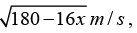 where x is displacement. Find the acceleration of the particle.
Ans:
v = 
 ⇒ α = -8 m/s
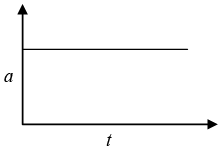
Q.3. Distance s moved by a particle at any moment is given by s = 1/2vt where v is velocity at time t. Then acceleration of the particle varies with time as, a = ktn, Find the value of k and n. Also, draw α - t graph.
Ans:
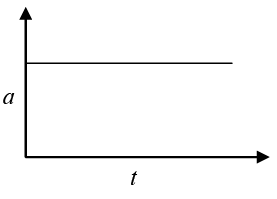

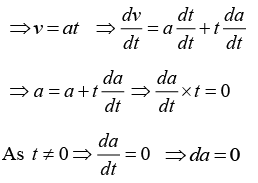
α = constant α = ktn = 1.t0
k = 1. n = 0
Q.4. A chain of length l and mass m lies in a pile on the floor. If its end A is raised vertically at a constant speed v0, express in terms of the length y of chain which is off the floor at any given instant
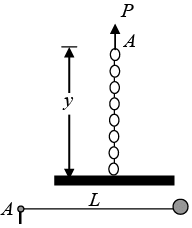 (a) The magnitude of the force P applied to end A .
(b) Energy lost during the lifting of the chain.
Ans: (a) Chain has a constant speed. Therefore, net force on it should be zero. Thus,
P = Weight of length y of chain + thrust force
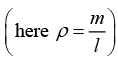
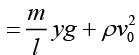
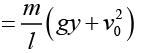
(b) Energy lost during the lifting = work done by applied force - increase in mechanical energy of chain

Q.5. A particle starts from rest, has velocity at any instant v = k√x , k is a constant. Draw its v - t, x- t and a - t graph.
Ans:
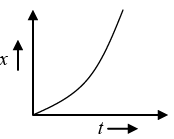
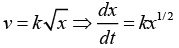
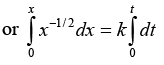
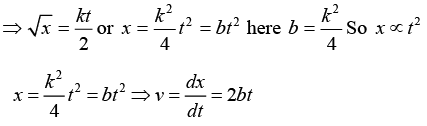
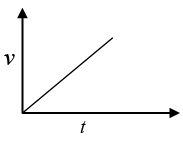
and acceleration α dv/dt ⇒ α = 2b
so α is a constant
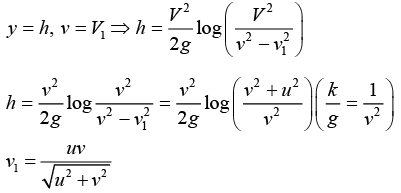
Q.6. A particle is projected with velocity u in a medium which has resistance varying with square of velocity. With what velocity it will return to same point if it's terminal velocity is vT ?
Ans:


log (g + kv2) = -2kx + A at x = 0, v = u
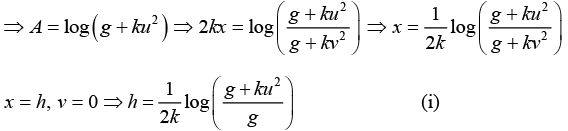
For downward motion of the particles

when v =  (terminal velocity v)
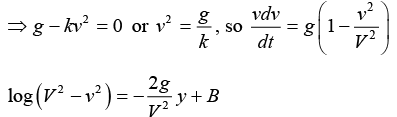
y = 0, v = 0 ⇒ B = logV2
This gives y 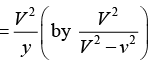
Q.7. For a particle, acceleration is given by α = 3t2 + 2t + 2 (t is in sec, α in m/s2). If it starts with a velocity of 2 m/s at t = 0 , what is it's velocity at the end of 3 sec?
Ans: α = 3t2 + 2t + 2 ⇒ dv/dt = 3t2 + 2t + 2
Integrating  v = 44m/sec
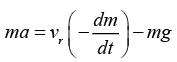
Q.8. A rocket is moving vertically upward against gravity. Its mass at time t is m = m0 - μt and it expels burnt fuel at a speed u vertically downward relative to the rocket. Derive the equation of motion of the rocket but do not solve. Here, μ is constant.
Ans:
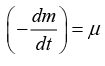
Fnet = thrust force - weight
∴
Q.9. A uniform rope of mass m per unit length, hangs vertically from a support so that the lower end just touches the tabletop shown in figure. If it is released, show that at the time a length y of the rope has fallen, the force on the table is equivalent to the weight of a length 3 y of the rope.
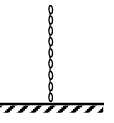 Ans: v =
  where v is the speed of the chain at this moment
The force downwards
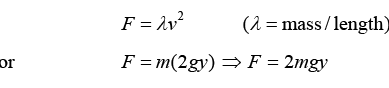
F = λv2 (λ = mass/length)
or F = m(2gy) ⇒ F = 2mgy
y length is lying on table, so its weight
W = (ym) g
Total force on table = F + W = (3mgy ) = weight of a length 3 y of the rope
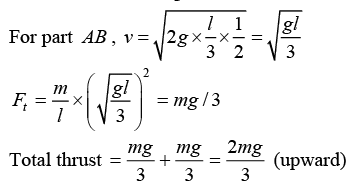
Q.10. A uniform chain of length l hangs on a thread and touches ground at it's lower end. Find the force exerted by the ground on the chain when one third of chain is on ground.
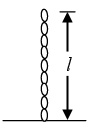 Ans: As Ft = vr dm/dt
 mass/length
F = λv2
For part BC , W = mg/3 (downward)
Q.11. Sand drops from a stationary hopper at the rate of 5kg/s on to a conveyor belt moving with a constant speed of 2m/s. What is the force required to keep the belt moving and what is the power delivered by the motor, moving the belt?
Ans: Relative velocity of sand is 2m/s in backward direction. Since mass is increasing, therefore thrust force is in the direction of relative velocity (backward).
Thrust force  = (5)(2) = 10N (backward)
∴ Force needed (Fext) to move the belt with constant velocity (Fnet = 0) is
Fext = F = 10 N (In forward direction)
P = Fextv = 20W
Q.12. A jet of water strikes a flat stationary plate with 500 gm of water per second at a speed of 1 m / sec . After striking water flows parallel to plate, find the force exerted on the plate.
Ans:
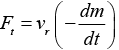 = 1 x 0.5 N = 0.5 N
Q.13. Find the mass of rocket as a function of time, if it moves with a constant acceleration a , in absence of external force. The gas escapes with a constant velocity u relative to the rocket and its mass initially was m0.
Ans:
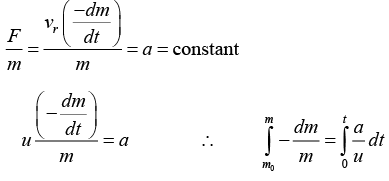
Solving this equation we get, m = m0e-at/u
Q.14. A rocket of initial mass m0, has a mass of m0 exp-t/3 at time t . It is launched vertically upwards and burnt gases come at a speed u relative to rocket.
(a) Find thrust force of rocket at t = 1.
(b) Find the speed of rocket at t = 1 sec
Ans: (a)

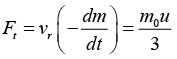
(b) v = u - gt + vr In m0/m ⇒ m = m0 - m0/3 = 2m0/3
u = 0, t = 1sec ⇒ v = 0 - g x 1 + u In 3/2 = - g + u In (3/2)