Chapter Notes: Perimeter and Area

Perimeter
Aditya jogs four times around a rectangular park every day. How much distance does he jog every day? Mrs Saini is stitching a lace around a square handkerchief for her granddaughter. How much lace does she need? All these questions asking for the distance around a plane figure are answered by the concept of perimeter.
What is Perimeter?
The word perimeter comes from two Greek words: peri, meaning around and metron, meaning measure. The perimeter of a plane figure is the distance around it or the total length of its boundary. We find the perimeter by adding the lengths of all its sides.
Observe the following examples showing how perimeter answers real-life questions:
- If the rectangular park is 150 m in length and 80 m in width, then the distance Aditya jogs every day = 4 × perimeter of the park.
- If each side of a square handkerchief is 10 cm, then the lace needed = the perimeter of the handkerchief.
Worked calculations:
If rectangle has length = 150 m and breadth = 80 m,
Perimeter of rectangle = 150 + 80 + 150 + 80 = 460 m
Distance jogged by Aditya = 4 × 460 m = 1840 m
If square handkerchief has each side = 10 cm,
Perimeter of square = 10 + 10 + 10 + 10 = 40 cm
Perimeter of a Rectangle
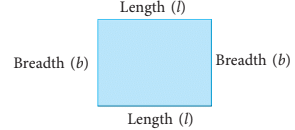
A rectangle is a plane figure whose opposite sides are equal in length. So a rectangle has two equal lengths and two equal breadths.
Perimeter of a rectangle = length + breadth + length + breadth
Perimeter of a rectangle = 2 × length + 2 × breadth = 2 × (length + breadth)
Example 1: Find the perimeter of a bedsheet whose length is 8 m and breadth is 5 m.
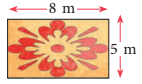
Perimeter of the bedsheet = 2 × (length + breadth)
Perimeter = 2 × (8 m + 5 m)
Perimeter = 2 × 13 m = 26 m
Perimeter of a Square
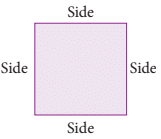
A square is a plane figure whose four sides are equal in length.
Perimeter of a square = side + side + side + side = 4 × side
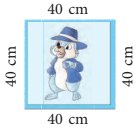
Example 2: Find the perimeter of a square photo frame of side 40 cm.
Perimeter = 4 × side
Perimeter = 4 × 40 cmPerimeter = 160 cm
Perimeter of an Equilateral Triangle
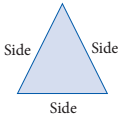
An equilateral triangle is a triangle with all three sides equal.
Perimeter of an equilateral triangle = side + side + side = 3 × side
Example 3: A stamp is in the shape of an equilateral triangle. Each side measures 2.5 cm. What is the length of the boundary of the stamp?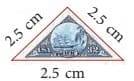
Length of the boundary = 3 × side
Length = 3 × 2.5 cm = 7.5 cm
Example 4: Mr Kapoor wants to put a wooden border around a painting. If the length of the painting is 40 cm and its breadth is 25 cm, what will be the cost of putting the border at Rs. 40 per cm?
Length of the painting = 40 cm
Breadth of the painting = 25 cm
Perimeter = 2 × (length + breadth)
Perimeter = 2 × (40 cm + 25 cm) = 2 × 65 cm = 130 cm
Cost of 1 cm border = Rs. 40
Total cost = 130 cm × Rs. 40 = Rs. 5200
Example 5: The perimeter of a rectangular field is 42 m, and its length is 10 m. Find its breadth.
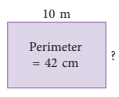
Perimeter = 2 × (length + breadth)
Therefore, length + breadth = Perimeter ÷ 2
10 m + breadth = 42 m ÷ 2 = 21 m
Breadth = 21 m - 10 m = 11 m
Example 6: What is the length of the side of a square park whose perimeter is 80 m?
Perimeter of a square = 4 × side
Side = Perimeter ÷ 4
Side = 80 m ÷ 4 = 20 m
Area
You were introduced to the idea of area in Class IV. Questions such as "How many marble tiles can fit on the floor?" or "How much paint is needed for the wall?" ask about the space inside a boundary. That space is the area of a plane figure.
What is Area?
Area of a shape is the amount of flat space it covers.
The coloured part of a shape shows the area that the shape covers on a sheet of paper. To compare areas, we look at which shape covers more surface. Area is measured by counting how many square units exactly cover the shape.
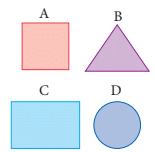
Area is found by calculating how many square units are needed to exactly cover a given shape.
Units of Measurement of Area
Units used to measure area are based on units of length: millimetre, centimetre, metre and kilometre. The square of these units is used for area.

This shows an area equal to 1 square millimetre (mm2).

This shows an area equal to 1 square centimetre (cm2).
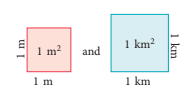
These represent 1 square metre (m2) and 1 square kilometre (km2).
The unit chosen depends on the size of the area being measured. For example, small objects like stamps use cm2; rooms and floors use m2; large land areas use km2.
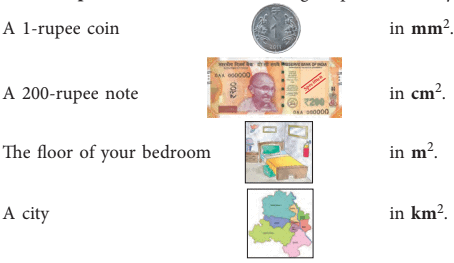
Finding Area Using a Square Grid
The area of shaded shapes on a grid can be estimated by counting unit squares that they cover. Count two half squares as one full square.
1.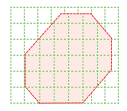
Full squares = 22
Half squares = 6
More than half squares = 3 (counted as 2 full squares)
Therefore, Area = 22 + 6 × 1/2 + 2 = 27 square units.
2.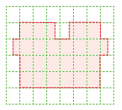
Full squares = 22
Half squares = 4
Therefore, Area = 22 + 4 × 1/2 = 24 square units.
(The area of three more-than-half squares is taken as almost equal to the area of 2 full squares in the first figure.)
Area of a Rectangle
Look at rectangles made of small 1 cm × 1 cm squares. Counting those small squares gives the area in square centimetres. You will notice a pattern: the number of small squares equals length × breadth.


Since 4 × 3 = 12, 5 × 4 = 20 and 7 × 1 = 7 in the examples, you can find areas quickly by multiplying length and breadth.

Conclusion
Area of a rectangle = length × breadth
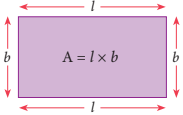
Try more examples to practise.

Area of a Square
A square is a rectangle with equal length and breadth, so its area is the square of its side.
Area of a square = side × side = side2
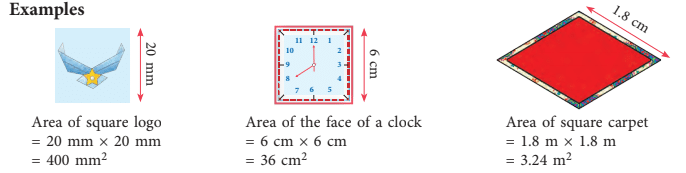
Example 7: (a) Find the length of a rectangle if its area = 120 cm2 and its breadth = 10 cm.
(b) Find the breadth of a rectangle if its area = 91 cm2 and its length = 13 cm.
(a) Area = 120 cm2, Breadth = 10 cm
Length = Area ÷ Breadth
Length = 120 cm2 ÷ 10 cm = 12 cm
(b) Area = 91 cm2, Length = 13 cm
Breadth = Area ÷ Length
Breadth = 91 cm2 ÷ 13 cm = 7 cm
Example 8: The perimeter of a square is 24 cm. Find its area.
Perimeter of square = 4 × side
Side = Perimeter ÷ 4
Side = 24 cm ÷ 4 = 6 cm
Area = side × side = 6 cm × 6 cm = 36 cm2
FAQs on Chapter Notes: Perimeter and Area
| 1. What's the difference between perimeter and area, and why do we need both? |  |
| 2. How do I find the perimeter of rectangles and squares in CBSE Class 5 maths? | |
| 3. Why is area calculated in square units and not just regular units? | |
| 4. What's the easiest way to calculate area of rectangles without getting confused? | |
| 5. Can a shape have the same perimeter as another but different area? | |