Chapter Notes: HCF & LCM


Introduction
Imagine you and your friends are playing with toys.
Now, you want to share them equally so that:
- No one feels sad
- Everyone gets the same number of toys
But wait...
What if the toys don't divide equally?
That's where HCF and LCM come to the rescue like superheroes!
- HCF helps us find the biggest number that can divide things equally, and LCM helps us find the smallest number where things match or repeat together.
Before we learn HCF and LCM, we need to revise some basic ideas.
These will make learning super easy and fun!
Prime Numbers
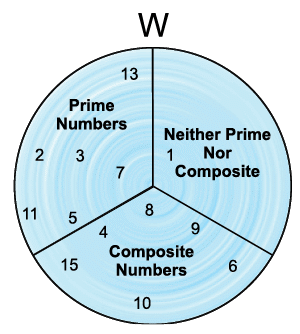
A Prime Number is a number that:
Can be divided by only 2 numbers : 1 and itself
That means...
❌ It cannot be broken into smaller equal groups (except 1 and itself)
Examples: 2,3,5,7,11,13...
It is important to note that:
•❌1 is not a prime number
⭐2 is SPECIAL!
- 2 is the only even number which is prime.
Composite Numbers
A Composite Number is a number that:
- Can be divided by more than 2 numbers
That means it has extra factors (not just 1 and itself)
Examples: 4,6,8,9,10,12,14.....
Important Things to Remember
Composite Numbers can be:
- Even numbers → 4, 6, 8, 10...
- Odd numbers → 9, 15, 21...
So, not all composite numbers are even!
⭐ Special Case: Number 1
- 1 is NOT Prime ❌
- 1 is NOT Composite ❌
Fun Method: Find Prime Numbers (1 to 100)
Sieve Trick (Easy Steps!)
To find prime numbers in a range we can use a simple method called the Sieve of Eratosthenes.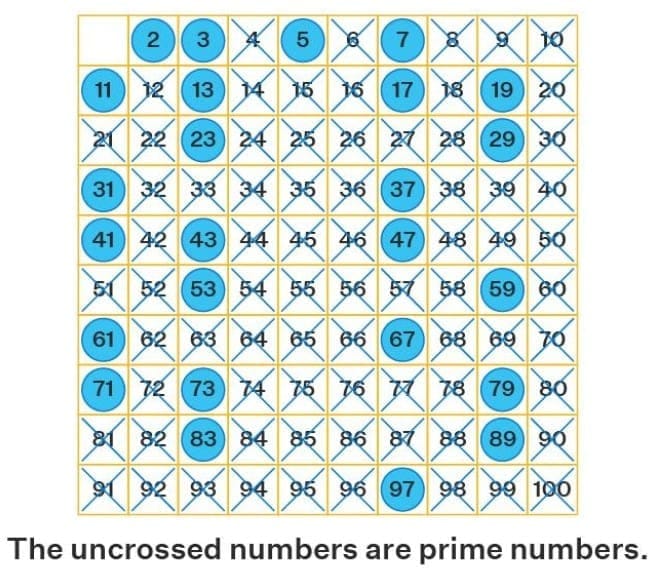
Follow these steps:
- Write numbers from 1 to 100
- Cut 1 (not prime, not composite)
- Circle 2,❌ cut all multiples of 2
- Circle 3, ❌ cut all multiples of 3
- Continue with 5, 7, 11...
The numbers left are Prime Numbers!
Thus, prime numbers from 1 to 100 are:
2, 3, 5, 7, 11, 13, 17, 19, 23, 29, 31, 37, 41, 43, 47, 53, 59, 61, 67, 71, 73, 79, 83, 89, 97.
Twin Primes
Two Prime numbers which differ by 2 are called twin primes, e.g., (3, 5) (5, 7) (11, 13 ) (17, 19)
Such numbers will form a pair of consecutive odd numbers.
Prime Triplet
A set of three prime numbers differing by 2 form a prime triplet, e.g., (3, 5, 7)
(3, 5, 7) is the only prime triplet.
Co-prime Numbers
Two numbers are co-primeif:Important:
- They have only 1 as common factor.
Examples: (2, 3) (3, 4) (4, 5) (3, 7) (4, 9)
- Co-prime numbers don't need to be prime!
Divisibility Rules
Divisibility rules help us to find whether a number divides another number completely without performing actual division.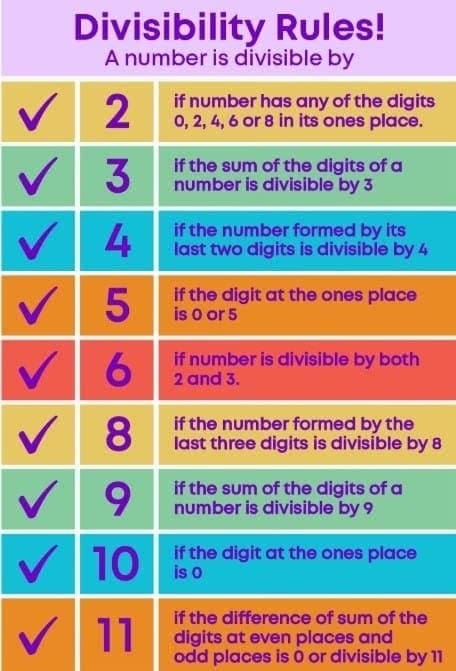
- Divisibility by 2
A number is divisible by 2 if its units digit (last digit) is even (0, 2, 4, 6 or 8)
Examples: 234 → ends in 4 → divisible by 2 . - Divisibility by 3
A number is divisible by 3 if the sum of its digits is divisible by 3.
Example: 384 → 3+8+4 = 15 → divisible by 3. - Divisibility by 4
A number is divisible by 4 if the number formed by its tens and units digits(last 2 digits) is divisible by 4.
Example: 80372 → last 2 digits = 72 → divisible by 4 - Divisibility by 5
A number is divisible by 5 if its units digit is 0 or 5.
Examples: 205 → ends in 5 → divisible by 5. - Divisibility by 6
A number is divisible by 6 if it is divisible by both 2 and 3 (i.e., it is even and the sum of its digits is divisible by 3).
Example: 68370 is even andSum = 24 → divisible by 3. So divisible by 6. - Divisibility by 8
A number is divisible by 8 if the number formed by its last three digits (hundreds, tens and units) is divisible by 8.
Example: 207608 → 608 → divisible by 8 - Divisibility by 9
A number is divisible by 9 if the sum of its digits is divisible by 9.
Example:7326 → 7+3+2+6 = 18 → divisible by 9. - Divisibility by 10
A number is divisible by 10 if its units digit is 0.
Examples: 9500 → ends in 0 → divisible by 10. - Divisibility by 11
A number is divisible by 11 if the difference between the sum of digits in odd places and the sum of digits in even places (counting from the units place) is either 0 or divisible by 11.
For example: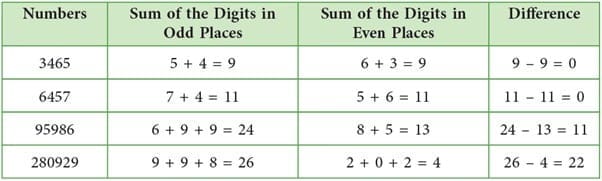
So, the numbers 3465, 6457, 95986 and 280929 are all divisible by 11.
Try yourself: Which rule can be used to determine if a number is divisible by 2?
Factors and Multiples
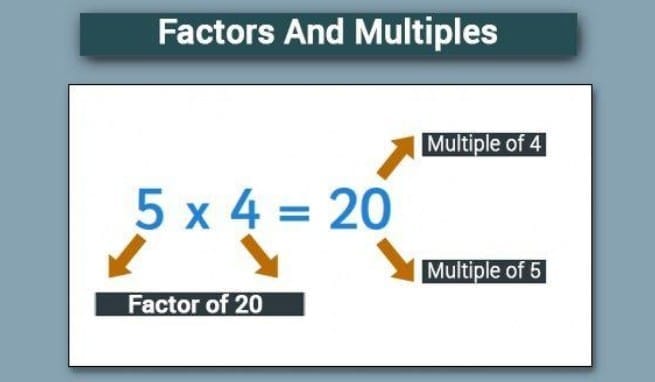 🤔 What are Factors?
A factor is a number that divides another number exactly (no remainder).
Example:
- 42 ÷ 7 = 6
So, 7 is a factor of 42
🤔 What are Multiples?
A multiple is the result when we multiply a number.
Example:
- 7 × 6 = 42
So, 42 is a multiple of 7
Even Numbers: Numbers divisible by 2 are called even numbers.
For example, 2, 4, 6, 8, ........ are even numbers.
Odd Numbers: Numbers not divisible b 2 are called odd numbers
For example, 1, 3, 5, 7, 9, ........ are odd numbers.
Common Factors
Common factors are factors that are the same in two numbers.
Example:
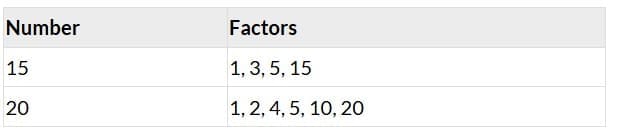
Common Factors = 1, 2, 4, 8, 16
EduRev Tips:
A number:
- With only 2 factors → Prime
- With more than 2 factors → Composite
- ⭐ 1 → neither prime nor composite
Highest Common Factor (H.C.F.)
Hence, the H.C.F. or the highest common factor of two or more than two numbers is the greatest among all their common factors. It is the biggest number that can divide two or more numbers completely, without leaving any remainder.
The highest common factor H.C.F. is also called the Greatest common divisor (G.C.D.).
Simple Understanding:
- First find common factors
- Then choose the greatest one
Example 1: Find all the common factors of 24 and 40
Sol:Common factors = 1, 2, 4, 8
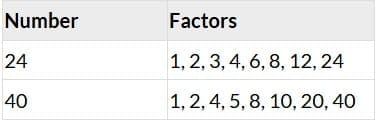
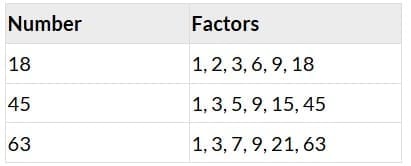
Example 2: Find the H.C.F. of 18, 45 and 63.
Sol:Common factors = 1, 3, 9
H.C.F. = 9 (biggest one)
Example 3: Find the H.C.F. of 15 and 28.
Sol:Common factor = 1
H.C.F. = 1
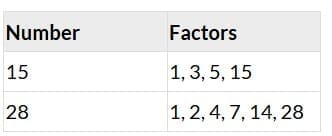
EduRev Tips: Two numbers are said to be co-prime, if their H.C.F. is 1
Example: 15 and 28
Properties of H.C.F
- H.C.F. is always smaller or equal to the numbers
- It can never be bigger than the given numbers
- If one number divides another:
H.C.F. = smaller number
Common Multiples
- A multiple of a number is obtained by multiplying that number by integers. Example: multiples of 2 are 2, 4, 6, 8, ...
- Common multiples are numbers that appear in the lists of multiples of two or more numbers.
Example: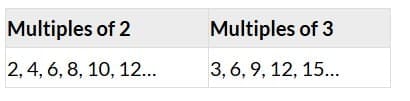 Common multiples = 6, 12...
Quick Summary:
- H.C.F. → Biggest common factor
- Co-prime → H.C.F. = 1
- Common multiples → Same multiples in lists
Lowest Common Multiple (L.C.M.)
The smallest number that is a common multiple of two or more numbers.
It is also called Least Common Multiple.
Simple Understanding:
- First find common multiples
- Then choose the smallest one
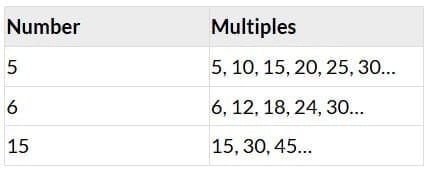
Example 1: Find the first two common multiples of:
(a) 4 and 10
(b) 5, 6 and 15.
(a)
Common = 20, 40
(b)Common = 30, 60

Example 2: Find the L.C.M. of 12 and 18.
Multiples of 12 → 12, 24, 36, 48...
Multiples of 18 → 18, 36, 54...
Common = 36, 72...
L.C.M. = 36
Properties of L.C.M
- The L.C.M. of two co-prime numbers is their product.
- If one number is the multiple of the other, then their L.C.M. is the greater number.
- The L.C.M. is always equal or bigger than the numbers.
Exponential Notation or Index Notation
When we multiply a number again and again,
we write it in short form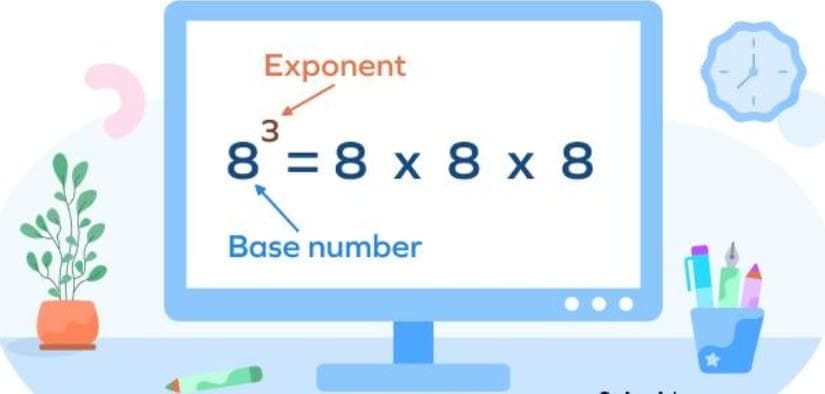
Example:
2 × 2 × 2 = 2³
- 2 = base
- 3 = power (exponent)

In 32, 3 is called the base and 2 is called the exponent or index or power.
Example 1: Write in the exponential form:
(a) 5 × 5 × 5 × 5 × 5 × 5
(b) 8 × 8 × 8 × 8 × 9 × 9
(a) 5 × 5 × 5 × 5 × 5 × 5 = 56
(b) 8 × 8 × 8 × 8 × 9 × 9 = 84 × 92.
Example 2: Write in the product form:
(a) 87
(b) 63 × 114
(a) 87 = 8 × 8 × 8 × 8 × 8 × 8 × 8
(b) 63 × 114 = 6 × 6 × 6 × 11 × 11 × 11 × 11.
EduRev Tips: Don't mix them!
❌ 2³ ≠ 3²
Prime Factorisation
When we write a number as a product of only prime numbers,it is called Prime Factorisation.
Simple Idea
- Break the number again and again
- Until you get only prime numbers
Example:
Prime Factorisation of 54
54 = 2 × 27
= 2 × 3 × 9
= 2 × 3 × 3 × 3
Final Answer:
54 = 2 × 3 × 3 × 3
Factor Tree Method
A Factor Tree helps us break numbers step-by-step
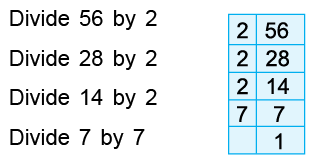
Example 1 : Factor Tree of 56
We proceed as follows:
Hence, the prime factorisation of 56 is
= 2 × 2 × 2 × 7 = 23 × 7.

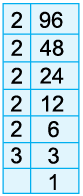
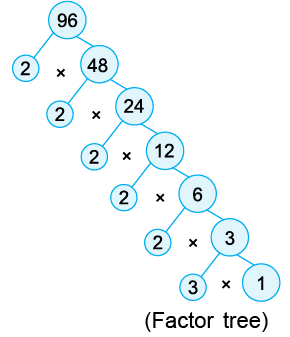
Example 2 : Draw a factor tree of 96.
Thus, the prime factorisation of 96 is
= 2 × 2 × 2 × 2 × 2 × 3 = 25 × 3.
Try This!
Find prime factorisation of 36 🤔
Ans: 2² × 3²
H.C.F by Prime Factorisation Method
🤔 How to Find H.C.F. using Prime Factorisation?
Steps are very simple:
- Find prime factors of each number
- Find common prime factors
- Take the smallest power of each common factor
- Multiply them
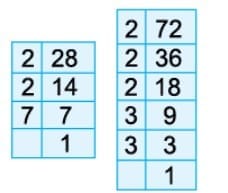
Example 1: Find the H.C.F. of 28 and 72 by the prime factorisation method.
Step 1: Prime Factorisation
Step 2: Common Factors
- 28 = 2² × 7
- 72 = 2³ × 3²
Only 2 is common
Step 3: Take Smallest Power
2² (because 2² < 2³)
Final Answer:
H.C.F. = 2² = 4
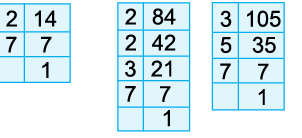
Example 2: Find the H.C.F. of 14, 84 and 105.
Step1: Resolving the given numbers into prime factors, we get.
14=2 × 7
84=2² × 3 × 7
105=3 × 5 × 7
Step 2: Common FactorsOnly 7 is common in all
Step 3: Smallest Power
7¹
Final Answer:
H.C.F. = 7
H.C.F by Long Division Method
🤔 How does this method work?
Just keep dividing until remainder becomes 0
Steps:
- Divide bigger number ÷ smaller number
- Take the remainder
- Now divide:
(old divisor ÷ remainder) - Repeat until remainder = 0
- Last divisor = H.C.F.
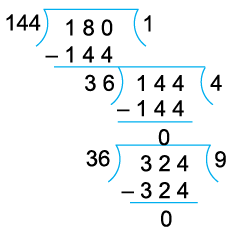
Example 1: Find the H.C.F. of 144, 180 and 324.
Step 1: Find H.C.F. of 144 and 180
Using division method → H.C.F. = 36
Step 2: Now find H.C.F. of 36 and 324
324 ÷ 36 = 9 (no remainder)
Final Answer:
H.C.F. = 36
Try This!
Find H.C.F. of 20 and 30 using prime factorisation 🤔
Ans: 10
L.C.M by Prime Factorisation Method
🤔 How to Find L.C.M. using Prime Factorisation?
Follow these easy steps:
- Find prime factors of each number
- Take all prime factors (common + different)
- Choose the highest power of each
- Multiply them
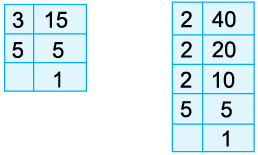
Example 1: Find the L.C.M. of 15 and 40, using the prime factorisation method.
Step 1: Prime Factorisation
Step 2: Take All Factors
- 15 = 3 × 5
- 40 = 2³ × 5
2, 3, 5
Step 3: Take Highest Powers
2³,3,5
Final Answer:
L.C.M. = 2³ × 3 × 5
= 8 × 3 × 5
= 120
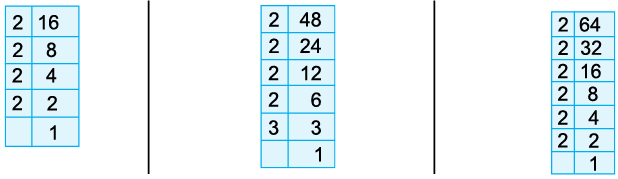
Example 2: Find the L.C.M. of 16, 48 and 64.
Step1:Resolving each of the given numbers into prime factors, we get
16 = 24 48 = 2⁴ × 3 64 = 26 2 × 2 × 2
Step2: Take All Factors
2 and 3
Step 3: Highest Powers
2⁶ and 3
Final Answer:
L.C.M. = 2⁶ × 3
= 64 × 3
= 192
L.C.M. by Long Division Method
We divide numbers step-by-step using common divisors
Steps:
- Write numbers in a row
- Divide by a number that divides at least two numbers
- Write results below
- Repeat until no more common division is possible
- Multiply all divisors and remaining numbers
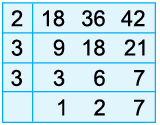
Example 1: Find the LCM of 18, 36, and 42 by long division method.
Divide step-by-step:
- Divide by 2
- Then 3
Final Answer:
- Then 3
L.C.M. = 2 × 3 × 3 × 2 × 7
= 252
Try This!
Find L.C.M. of 6 and 8 🤔
Ans: 24
Relationship Between H.C.F. and L.C.M, of Two Given Numbers
For two given numbers, we have.
- Product of two numbers = Product of their H.C.F. and L.C.M.
(First number × Second number = H.C.F. × L.C.M) 

Easy Way to Remember:
- Numbers on one side
- HCF & LCM on the other side
⚖️ Like a balance!
Example 1: The H.C.F. of two numbers is 52 and their L.C.M is 312. If one of the numbers is 104, find the other.
It is given here that:
H.C.F. = 52, L.C.M. = 312 and one number = 104
The other number
Hence, the other number is 156.

Example 2: The product of two numbers is 867 and their HCF is 17. Find their L.C.M.
We know that:
Hence, the LCM of given numbers is 51.

FAQs on Chapter Notes: HCF & LCM
| 1. What's the difference between HCF and LCM and why do we need both? |  |
| 2. How do I find the HCF of two numbers using the division method? | |
| 3. What's the easiest way to calculate LCM when numbers are really large? | |
| 4. Can HCF and LCM of two numbers ever be the same? | |
| 5. Why do I need to find HCF and LCM for word problems involving real situations? | |