Chapter Notes: Symmetry and Nets


Introduction
- Have you ever folded a paper heart exactly in half and seen both sides look the same?
- Or turned a wheel and noticed it looks the same at several positions as it spins?
- That is the idea of symmetry.
- Symmetry means a shape or object looks the same after certain flips, turns or divisions.
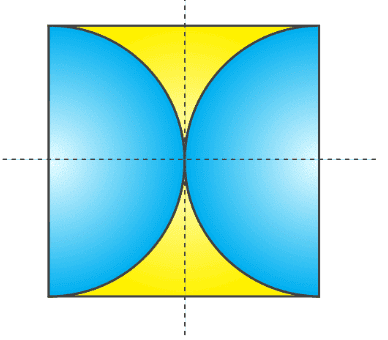
Reflection and Symmetry
- Place a mirror vertically and look at a figure in front of it. The shape seen in the mirror is called its reflection image.
- When the mirror image matches the original shape exactly, we say the figure is symmetrical about the mirror line.
- The mirror line that divides the original and its image is called the line of symmetry.
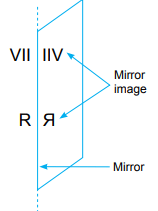
- The object and its mirror image have the same sizes - there is no change in length or breadth.
- In the figure, ΔA'B'C' is the mirror image of ΔABC.
- The distances of A', B', C' from the mirror are equal to the distances of A, B, C from the mirror line.
- The farther a point is from the mirror line, the farther its mirror image is from that line.
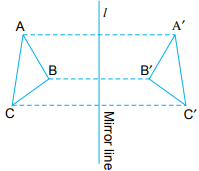
(ii) Also the length of  = length of
length of  = length of
length of  = length of
and ∠BAC = ∠B'A'C', ∠ABC = ∠A'B'C', ∠BCA = ∠B'C′A'.
(iii) AA', BB' and CC' are perpendicular to the mirror line and are bisected by the mirror line.
- Mirrors are used inside kaleidoscopes to produce images of the small pieces of bangles kept inside
- The number of images depends on how many mirrors are used and how they are placed.
- These images give beautiful repeated and symmetrical designs.
To Draw a Mirror Image of a Given Figure
Suppose ABCDE is a given figure and we want to draw its mirror image about a given mirror line.
From each vertex of the given figure draw a perpendicular to the mirror line. For example, draw AP, QE, DR, CS and BT perpendicular to the mirror line (where P, Q, R, S, T are the foots on the mirror line).
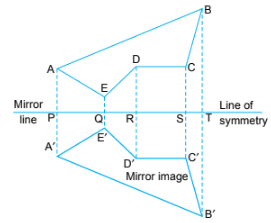
- Extend each perpendicular the same distance on the other side of the mirror line to get A', E', D', C', B' so that PA' = PA, QE' = QE, RD' = RD, SC' = SC and TB' = TB.
- Join A'-B'-C'-D'-E' in order to obtain the mirror image A'B'C'D'E' of ABCDE.
- The mirror line is the line of symmetry between the original figure and its mirror image.
To Complete a Figure with Two Lines of Symmetry
Let ABCDE be the given part of a figure. Let p and q be two lines of symmetry for the whole figure.
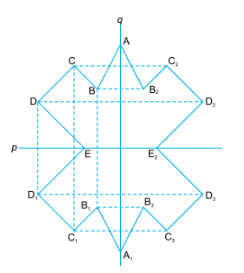
- Draw perpendiculars from the corner points of the given part to the lines p and q to find the positions of the missing corner points (their mirror images with respect to p and q).
- Join the new points in sequence to complete the figure so that the completed figure has lines p and q as its two lines of symmetry.
Section
- Imagine slicing a cube straight through its centre with a flat cut. The flat surface that appears on the cut is called a section of the cube.
- In the example shown, the section is a square.
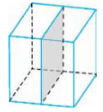
When a solid is cut by a plane, the part where the plane meets the solid is a flat shape - the section.
Planes of Symmetry
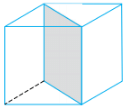
- A plane of symmetry divides a 3D shape into two congruent shapes.
- Each part is the mirror image of the other.
- The shaded plane in the image is a plane of symmetry of the cube.
Imagine cutting a cuboid into two pieces by a plane as shown.
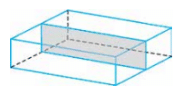
Place one of the cut pieces with its flat cut face against a mirror.
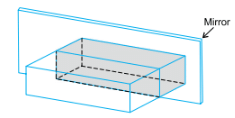
- If the piece together with its reflection looks like the complete solid, then the cutting plane is a plane of symmetry.
- Not every plane that cuts a solid into two equal volumes is a plane of symmetry.
- If the reflected half does not complete the solid, the cut is not in a plane of symmetry.

Rotational Symmetry
- Some shapes have linear (mirror) symmetry, and some also have rotational symmetry.
- A figure has rotational symmetry if it can be rotated about a point so that it looks the same at certain turns less than one full turn.
Example 1: Draw a line segment AB and mark its midpoint O. Put a pin at O and rotate the segment about O. After a rotation of 180°, the segment moves to a position that fits exactly on the original segment. A second rotation of 180° brings it back to the original position.
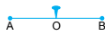
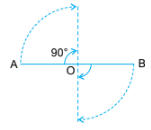
- During one full rotation (360°) about O, the line segment fits into itself twice.
- So, the line segment has rotational symmetry of order 2.
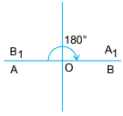
The midpoint O is the centre of rotation.
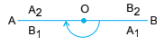
A figure has rotational symmetry if there is a point (the centre of rotation) about which the figure can be turned through a certain angle (less than 360°) and still look the same. The smallest such angle is the angle of rotation. The number of times the figure fits onto itself during one complete turn (360°) is the order of rotational symmetry.
Edurev Tips: A full rotation of 360° does not prove rotational symmetry by itself because every shape matches itself after a 360° turn.
Example 2: Rotate an equilateral triangle about its centroid by 120°. The triangle matches itself after rotations of 120°, 240°, and 360°.
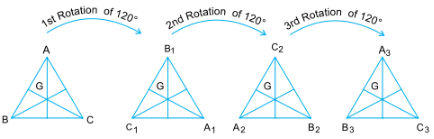
Thus the equilateral triangle has rotational symmetry of order 3 because 360° ÷ 120° = 3.
Example 3: Rotate a square about its centre by 90°. The square matches itself after rotations of 90°, 180°, 270° and 360°.
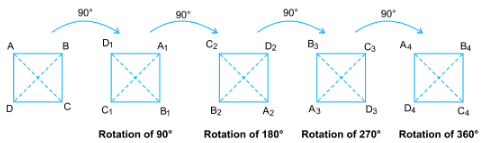
Angle of rotation = 90° so order of rotational symmetry = 360° ÷ 90° = 4.
Example 4: A rectangle rotated about its centre by 180° fits into itself. Angle of rotation = 180° so order = 360° ÷ 180° = 2.
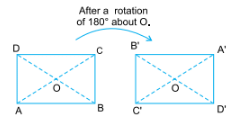
Example 5: A regular pentagon or a five-petal flower design has rotational symmetry of order 5.
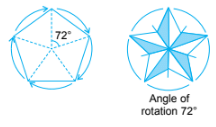
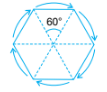
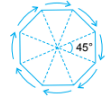
Example 6: A regular hexagon has rotational symmetry of order 6 with angle of rotation = 60°. A regular octagon has order 8 with angle of rotation = 45°.
No Rotational Symmetry
- If a figure returns to its original position only after a full rotation of 360°, it does not have any rotational symmetry (other than the trivial 360°).
- Example: many irregular quadrilaterals. Every figure fits itself after 360° but that does not mean it has rotational symmetry.
Figures with Both Linear and Rotational Symmetry
Some figures have both mirror (linear) symmetry and rotational symmetry. Examples:
- An equilateral triangle has three lines of symmetry and rotational symmetry of order 3.
- A rectangle and a rhombus each have two lines of symmetry and rotational symmetry of order 2.
- A square has four lines of symmetry and rotational symmetry of order 4. Regular polygons such as the regular pentagon, hexagon, octagon, etc., have both types of symmetry.
- The letter H has two lines of symmetry and rotational symmetry of order 2.
Only Linear Symmetry
Some figures have only mirror symmetry but no rotational symmetry (except the full 360°). Examples: letters A, C, D, E, M, T, U, V, W, Y and an isosceles triangle.
Only Rotational Symmetry
Some figures have rotational symmetry but no mirror symmetry. Examples: letters N, S and Z.
Nets
If six identical squares are joined edge to edge in a suitable arrangement we can fold them to make a cube. The flat arrangement is called a net of the cube.

It is helpful to join some parts before cutting when making a model from cardboard. A net gives the shape to cut out so that after folding and sticking we get the solid.
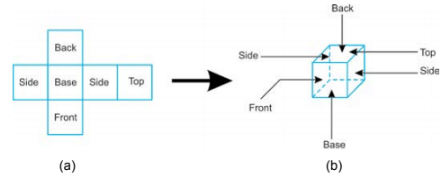
- A flat pattern such as the cross shown is a net of the cube.
- A net of a 3D figure is a shape that can be cut from a flat sheet and folded to make the 3D solid.
- There are several different nets that will fold up to form the same cube.
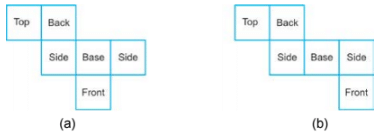
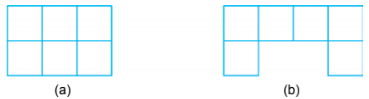
Not every arrangement of six squares will fold to make a cube. Some flat arrangements cannot form a cube.
To make a solid shape from paper or cardboard first draw a net. Faces of the solid can be different plane shapes such as rectangles, squares or triangles.
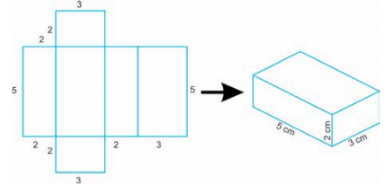
The net of a cuboid of size 5 cm × 3 cm × 2 cm is shown below.
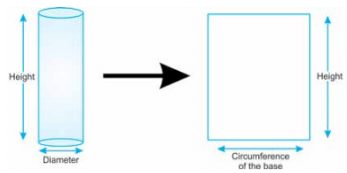
The net of a cylinder (without top and bottom) is a rectangle whose length equals the circumference of the cylinder.
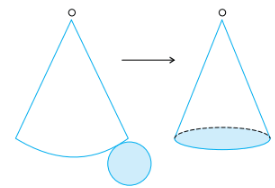
The net of a cone has one circular base and one curved surface (shown flattened).
FAQs on Chapter Notes: Symmetry and Nets
| 1. What is symmetry and why is it important in geometry? |  |
| 2. What are planes of symmetry? | |
| 3. How can we identify rotational symmetry in a shape? | |
| 4. What are some examples of shapes with no rotational symmetry? | |
| 5. What are nets in geometry and how are they related to symmetry? | |