Chapter Notes: Addition and Subtraction

Introduction
We use addition to put things together and subtraction to take things away. This helps us with everyday things like counting money, measuring objects, or finding the difference between amounts. Let's first remember how to add and subtract!
- Addition: This is the process of combining two or more numbers to find their total or sum. For example, if you have 3 apples and you get 2 more, you add them together: 3 + 2 = 5 apples.
- Subtraction: This is the process of taking one number away from another to find the difference. For example, if you have 5 apples and you give away 2, you subtract them: 5 - 2 = 3 apples left.
Addition of 4-Digit Numbers
Let's learn the addition of 4-Digit Numbers directly through the following examples:
Example 1: Add 5433 and 1522.
Arranging the addends in the column form and adding columnwise, we have,
Thus, 5433 + 1522 = 6955.
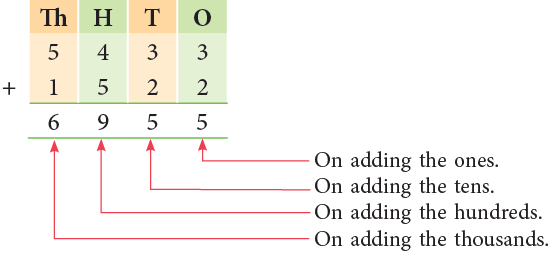
Edurev Tips: To add two or more 4-digit numbers, we add the ones, the tens, the hundreds and the thousands.
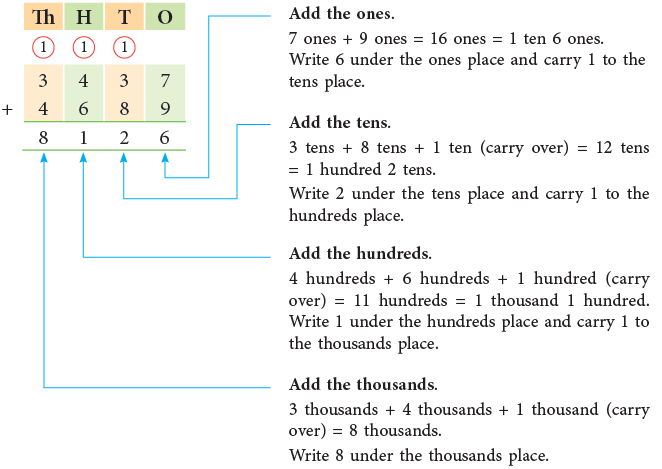
Example 2: Add 3437 and 4689.
Thus, 3437 + 4689 = 8126.
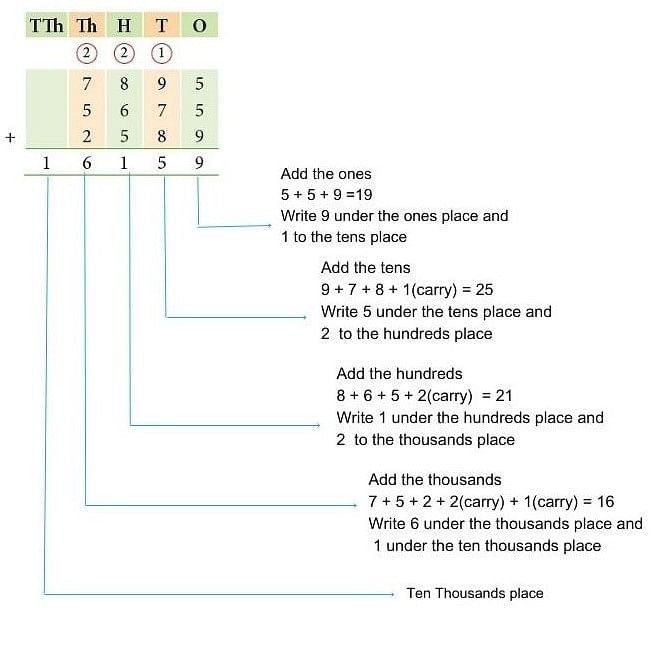
Example 3: Add7895, 5675, and 2589
Thus, 7895 + 5675 + 2589 = 16159.
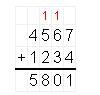
Try yourself: Add 4567 and 1234
Addition of 5- and 6-Digit Numbers
Now, we have mastered the concepts of addition of 4-digit numbers. Let's learn how to add 5- & 6-digit numbers now!
Steps in addition
- We arrange the numbers into columns that represent ten thousands, thousands, hundreds, tens, and ones.
- For any empty spots, we write zero.
- Next, we add the numbers in each column one at a time.
- It's important to always start adding from the ones place.
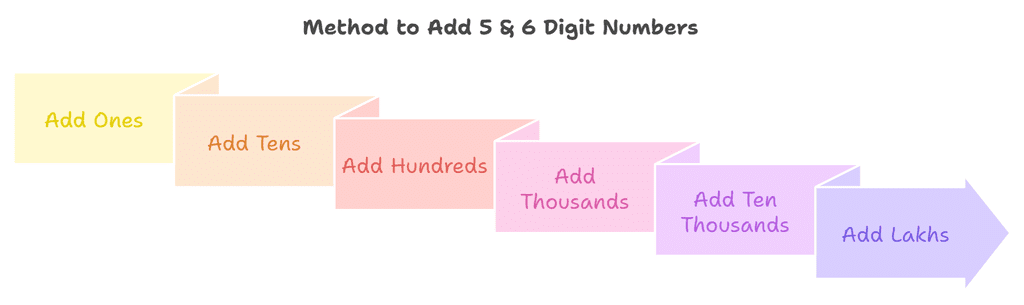 Method to Add 5 & 6 Digit Numbers
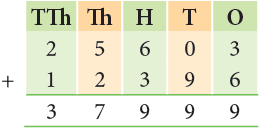
Example 1: Add 25603 and 12396.
Step 1: Let's add the ones digits.
3 + 6 = 9Step 2: Add the tens digits.
0 + 9 = 9Step 3: We add the hundreds digits.
6 + 3 = 9Step 4: We add the digits in thousands places.
5 + 2 = 7Step 5: We add the digits in ten thousands places.
2 + 1 = 3Therefore, our sum is 37999.
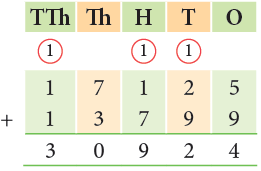
Example 2: Add 17125 and 13799.
Step 1: Let's add the ones digits.
5 + 9 = 14 ones.
= 10 ones + 4 ones
= 1 ten + 4 ones
We write 4 in ones column and carry over 1.Step 2: Add the tens digits and carried over.
1+ 2 + 9 = 12 tens
= 10 tens + 2 tens
= 1 hundreds + 2 tens
We write 2 in tens column and carry over 1.Step 3: We add the hundreds digits and carried over.
1+ 1 + 7 = 9Step 4: We add the digits in thousands places.
7 + 3 = 10 thousands
We write 0 in thousands column and carry over 1.Step 5: We add the digits in ten thousands places and carried over.
1+ 1+ 1 = 3
Thus, 17125 + 13799 = 30924.
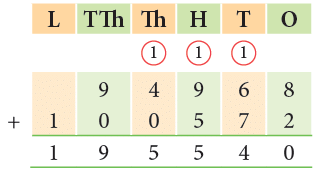
Example 3: Find the sum of ninety-four thousand nine hundred sixty-eight and one lakh five hundred seventy-two.
Step 1: First, we write numerals for the addends, in proper columns. Ninety-four thousand nine hundred sixty-eight = 94,968 One lakh five hundred seventy-two = 1,00,572
Step 2:Add the addends and write the sum.
Thus, 94968 + 100572 = 195540.
Word Problems
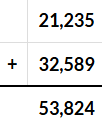
Example 1: An LED TV costs ₹ 21,235. An air conditioner costs ₹ 11,354 more. What is the cost of the air conditioner? What is the total cost of both items?
Cost of the LED TV = ₹ 21,235
Cost of the air conditioner = ₹ 21,235 + ₹ 11,354 = ₹ 32,589Total cost of both the items = ₹ 21,235 + ₹ 32,589 = ₹ 53,824.
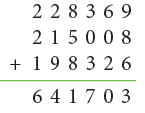
Example 2: There are 2,28,369 men, 2,15,008 women and 1,98,326 children in a town. What is the total population of the town?
Number of men in the town = 2,28,369
Thus, the total population of the town = 6,41,703.
Number of women in the town = 2,15,008
Number of children in the town = 1,98,326
Total population of the town = 2,28,369 + 2,15,008 + 1,98,326 = 6,41,703
What are the Properties of Addition?
Property 1
Order Property: Changing the order of addends does not change the sum.
- Example: 2,023 + 5,453 = 5,453 + 2,023 = 7,476
- Changing the order of the two addends does not change the sum.
- This is called the order property of addition.
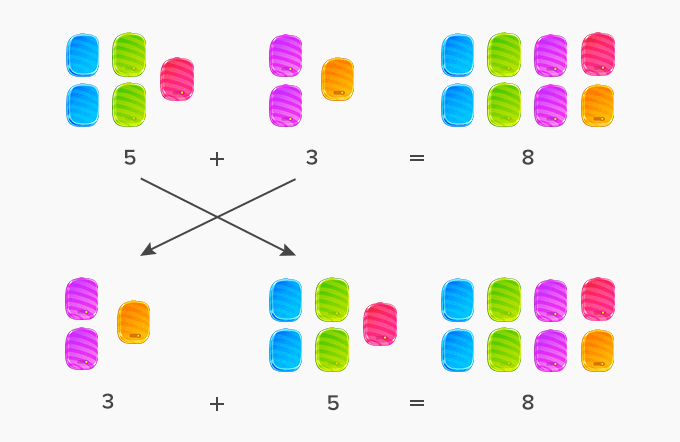
Changing the order of the two addends does not change the sum.
Study the following examples:
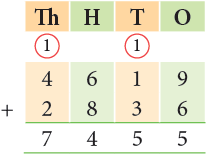
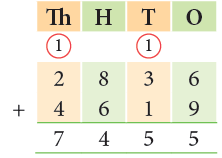
Example of Property 1: Find the sum of 4619 and 2836.
Let us add 4619 and 2836 in two ways.
First Way: 4619 + 2836
Second Way: 2836 + 4619
We see that, 4619 + 2836 = 2836 + 4619 = 7455.
This proves the order property of addition.
Property 2
Zero Property: Adding zero to any number gives the number itself.
- Example: 5,879 + 0 = 5,879
- The sum of any number and 0 is that number itself.
- This is also called the additive property of zero.
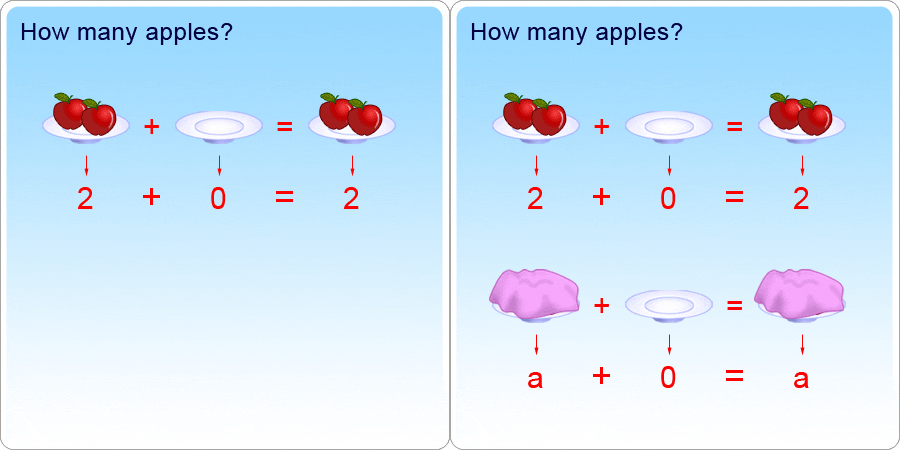 The sum of any number and 0 is that number itself.
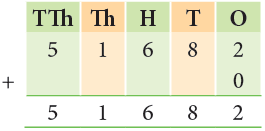
Example of Property 2: Find the sum of 51682 and 0.
Thus, 51682 + 0 =51682.
This proves the additive property of 0.
Property 3
Grouping Property: The way in which we group the addends does not change the sum. This is called the grouping property of addition.
- When adding 3 numbers, you may group the first 2 addends or the last 2 addends.
You will always get the same sum. - We call this idea, the grouping property of addition.
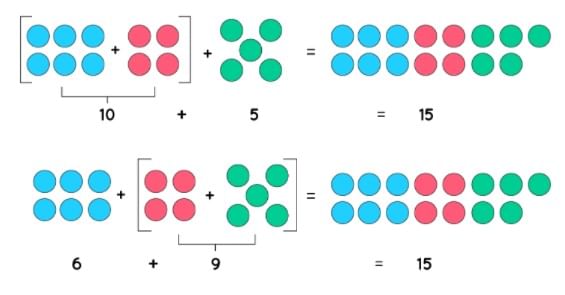 The way in which we group the addends does not change the sum
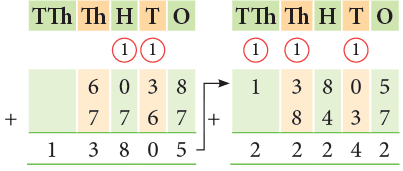
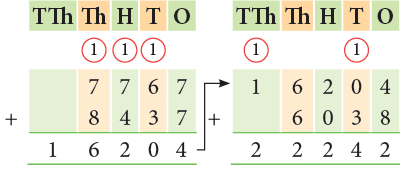
Example of Property 3: Add: 6038 + 7767 + 8437
Let us add 6038, 7767 and 8437 in two ways.
First Way: (6038 + 7767) + 8437
Second Way: 6038 + (7767 + 8437)
Thus, (6038 + 7767) + 8437 = 6038 + (7767 + 8437) = 22242.
This proves the associative property of addition.
Subtraction
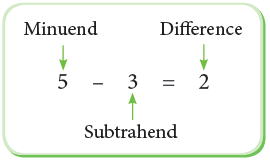
- In a subtraction problem, the larger number from which the smaller number is subtracted is called the minuend.
- The smaller number which is subtracted is called the subtrahend. The resulting number obtained after subtraction is called the difference of the two numbers.
Subtraction of 4-Digit Numbers
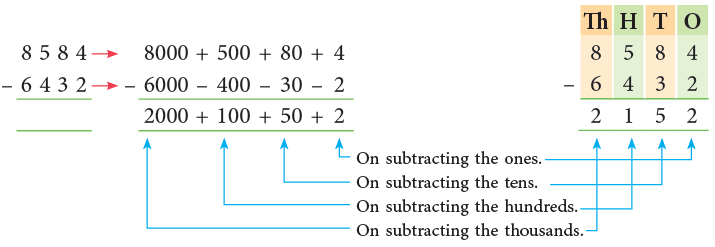
Case I: Without Borrowing
Example: Subtract 6432 from 8584.
Thus, 8584 - 6432 = 2152.
Case 2: With Borrowing
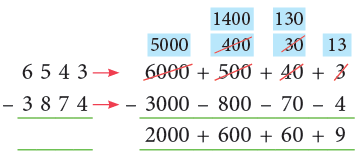
Example: Subtract: 6543 - 3874
Thus, 6543 - 3874 =2669.
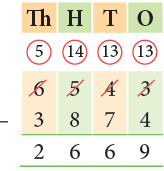
Edurev Tips: Borrow mentally and work out your subtraction question as shown below.
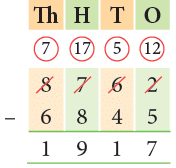
Example: Subtract 6845 from 8762.
We subtract as under:
Thus, 8762 - 6845 = 1917.
Try yourself: Subtract 4763 from 8152.
Subtraction of 5- and 6-Digit Numbers
Subtracting with 5- and 6-digit numbers is like subtracting with 1-, 2-, 3- or 4-digit numbers. You subtract the ones, subtract the tens, subtract the hundreds and so on.
Steps in subtraction
- We arrange the numbers in groups of ten thousands, thousands, hundreds, tens, and ones.
- The larger number should always be placed on top.
- The smaller number goes below the larger one.
- For any empty spots, we write a zero.
- Next, we subtract the numbers from each column one at a time.
Case I: Without Borrowing
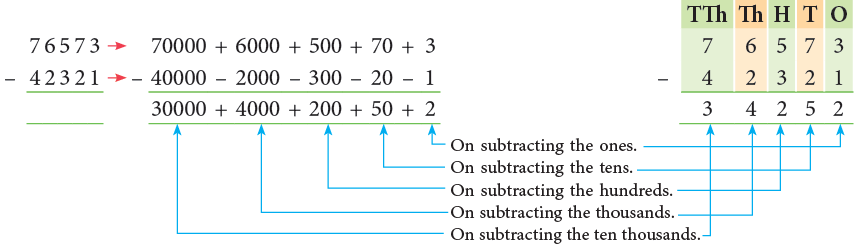
Example 1: Subtract 42321 from 76573.
Thus, 76573 - 42321 =34252.
Case 2: With Borrowing
Example 1: Subtract 2,97,973 from 5,82,621.
Thus, 5,82,621 - 2,97,973 = 2,84,648.
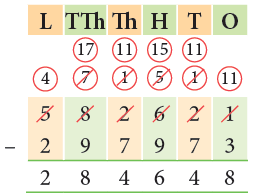
Edurev Tips: Do the borrowing mentally.
Try yourself: Subtract 6845 from 8762.
Word Problems
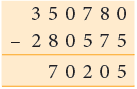
Example 1: A factory produced 2,80,575 LED bulbs in 2017. In 2018, it produced 3,50,780 bulbs. By how many bulbs did the factory's production increase?
Number of bulbs produced in 2018 = 3,50,780
Number of bulbs produced in 2017 = 2,80,575
Number of bulbs increased in 2018 = 3,50,780 - 2,80,575 = 70,205
Thus, the increase in the production of number of bulbs in 2018 is 70,205.
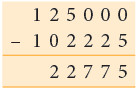
Example 2: A stadium has a seating capacity of 1,02,225. The government increases the size of the stadium. Now, the seating capacity is 1,25,000. How many new seats have been added in the stadium?
New seating capacity = 1,25,000
Old seating capacity = 1,02,225
Number of new seats added = 1,25,000 - 1,02,225 = 22,775
Thus, the number of new seats added in the stadium is 22,775.
Addition and Subtraction Together
Sometimes, we need to solve a problem that involves both addition and subtraction. In such cases, first, we add and then subtract.
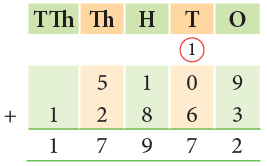
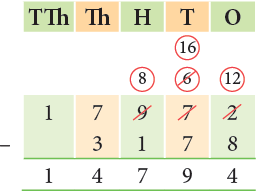
Example 1: Simplify: 5109 - 3178 + 12863.
Step 1: First, we add 5109 and 12863.
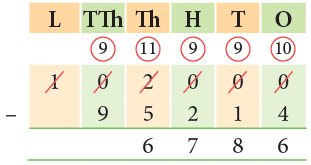
Step 2:Subtract 3178 from the sum obtained in step 1.
Thus, 5109 - 3178 + 12863 = 14794.
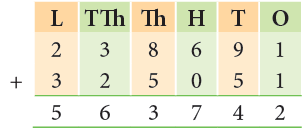
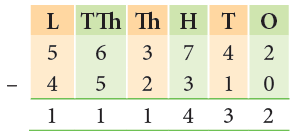
Example 2: Simplify: 238691 + 325051 - 452310.
Step 1: Add the numbers with same (+) signs.
Step 2:Subtract the third number from the sum obtained in step 1.
Thus, 238691 + 325051 - 452310 = 111432.
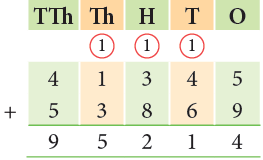
Example 3: In an exhibition, 1,02,000 persons, in all visited on Monday, Tuesday and Wednesday. If 41,345 persons visited the exhibition on Monday and 53,869 persons on Tuesday, then how many persons visited the exhibition on Wednesday?
Number of persons who visited the exhibition on the first two days
= 41,345 + 53,869 = 95,214
Total number of persons who visited the exhibition = 1,02,000.
So, the number of persons who visited the exhibition on Wednesday
= 1,02,000 - 95,214 = 6,786
Hence, 6,786 persons visited the exhibition on Wednesday.
Estimating Sums and Differences
- Often, we don't need the exact total, but just a rough idea of what it might be.
- This process is known as finding an estimate.
- To estimate, we round the numbers to the nearest tens, hundreds, thousands, or ten thousands, depending on how precise we want to be.
- After rounding the numbers, we then add these rounded values together to get an estimate.
Example 1: Mr Khan bought a mobile for ₹ 8,793 and a chair for ₹ 3,925. Estimate how much did he pay more for the mobile?
Estimated cost of a mobile = ₹ 9,000 (8793 rounded to the nearest thousand as 9,000.)
Estimated cost of a chair = ₹ 4,000 (3925 rounded to the nearest thousand as 4,000.)
So, Mr Khan paid about ₹ 9,000 - ₹ 4,000 = ₹ 5,000for mobile.
Try yourself: What is the estimated total of 47,892 and 38,716 when rounded to the nearest ten thousand?
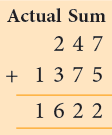
Example 2: Estimate the sum of 247 and 1,375 by rounding each number to the nearest hundred. Also, compare with actual sum?
So, the estimated sum is 1600 and the actual sum is 1622.
Difference = 1622 - 1600 = 22.
Hence, the actual sum is 22 more than the estimated sum.

FAQs on Chapter Notes: Addition and Subtraction
| 1. How do I add two-digit numbers without getting confused in Class 4 maths? |  |
| 2. What's the easiest way to check if my subtraction answer is correct? | |
| 3. Why do I have to regroup or borrow in subtraction problems? | |
| 4. Can I add and subtract numbers in any order, or does it matter for Class 4? | |
| 5. How do word problems with addition and subtraction work, and what steps should I follow? | |