Chapter Notes: Reproduction in Animals

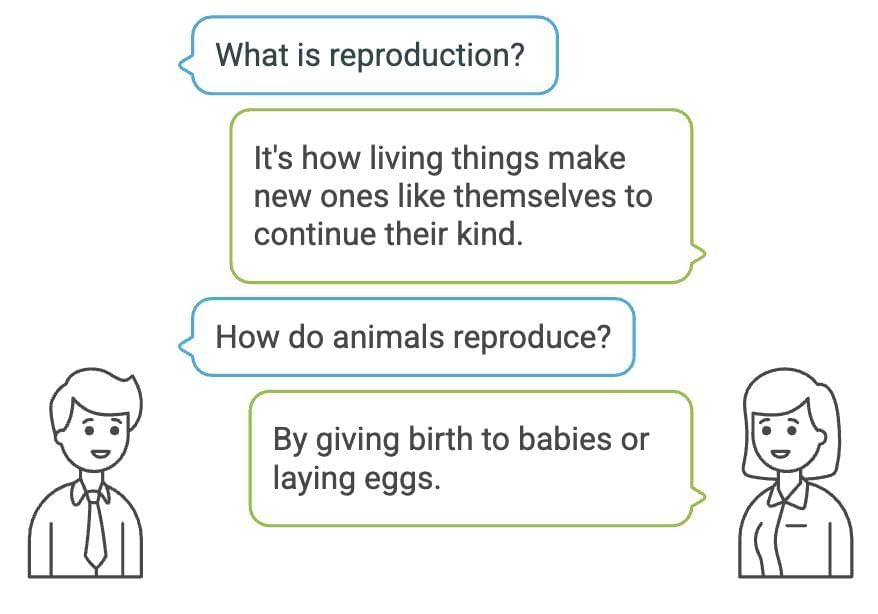 Reproduction in Different Animals
All living things are born, grow, and die after some time. The time that a living thing lives is called its lifespan.
Before they die, living things make new ones like themselves. This process is called reproduction. Reproduction helps living things to continue their kind on Earth.
Animals reproduce in two main ways:
By giving birth to babies.
By laying eggs.
(a) Viviparous Animals
- The animals which give birth to their young ones are called viviparous animals. For example, human beings reproduce by giving birth to babies. The animals such as dogs, cats, cow, horse, deer, lion and tiger, etc., also reproduce by giving birth to their young ones.
- The young babies of these animals feed on their mothers' milk till they learn to eat other food. Such animals are called mammals. They guard their babies and keep them clean. They look after them until they are old enough to look after themselves.
- Human beings are also mammals.
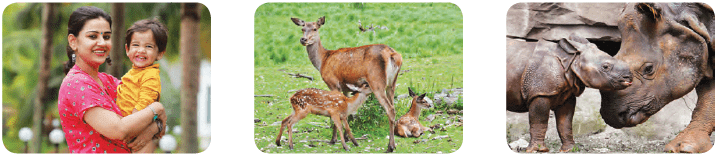 Mammals reproduce by giving birth to babies.
(b) Oviparous Animals
- The animals which give birth to their young ones through eggs are called oviparous animals.
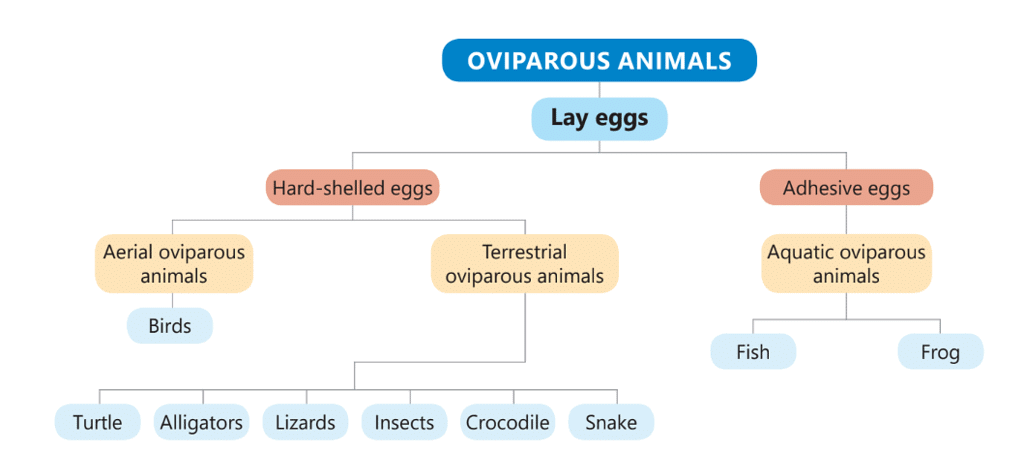
- Birds, fishes, insects, frogs, snakes, lizards, turtles, alligators and crocodiles are animals that lay eggs. When these eggs are hatched, young ones come out of these eggs.
Good to Know
Eggs come in a variety of colours, shapes and sizes. Ostriches lay the largest eggs of any living bird. The largest egg on record weighed 2.589 kg and was laid by an ostrich at a farm in Sweden, on 17 May 2008.
According to their habitat, we can divide oviparous animals into three categories:
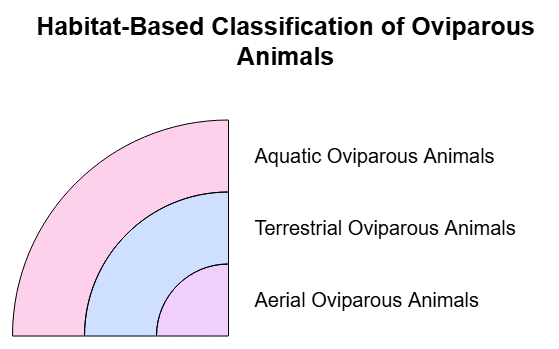
- Aerial oviparous animals - Birds
- Terrestrial oviparous animals - Insects, snakes, lizards, turtles and crocodiles
- Aquatic oviparous animals - Fishes, frogs
Let us see how these animals reproduce.
1. Aerial Oviparous Animals
Birds- The birds such as hens, pigeons, sparrows, crows, parrots, ducks ostrich, etc., lay eggs.
- They bear their young in hard-shelled eggs which hatch after some time. Adult birds sit on the eggs for a few days to keep them warm till they hatch. This process is known as incubation.
- During incubation, the embryo inside the egg goes through different stages of development. After some days the egg breaks and a chick comes out. The chick is not able to fly. Parent birds take care of it. This process is called hatching. It grows into an adult. The stages of development from an embryo to a mature adult is called the life cycle of an animal.
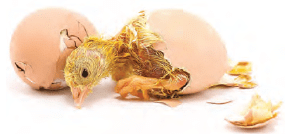 Chicken hatches from the egg
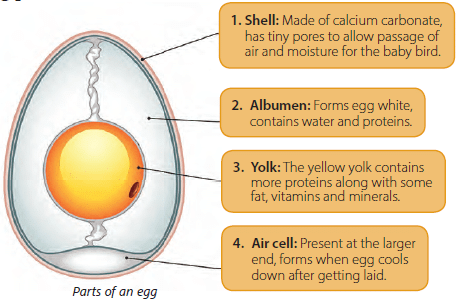
Parts of an Egg
An egg has the following parts -
- Shell: Made of a substance called calcium carbonate, it has small holes that let air and moisture through for the baby bird.
- Albumen: A white jelly-like substance called albumen is present inside the egg. Albumen is rich in proteins.
- Yolk: Within the albumen is a yellow part called the yolk. The yolk is rich in fats, vitamins and minerals. The yolk
contains food for the embryo. - Air cell: Found at the bigger end, it shapes up as the egg cools down after being laid.
2. Terrestrial Oviparous Animals
Insects- Nearly all insects reproduce by laying eggs.
- Insect eggs are deposited by adult insects in a safe location.
- This location can be anywhere-wood, leaves, dirt, water, even bodies of human beings and other animals.
- The eggs are usually sticky, so they can hang on to the surface without falling off.
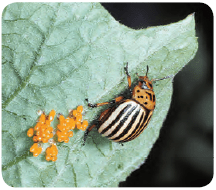 Colorado Potato Beetle lays eggs on the underside of leaves
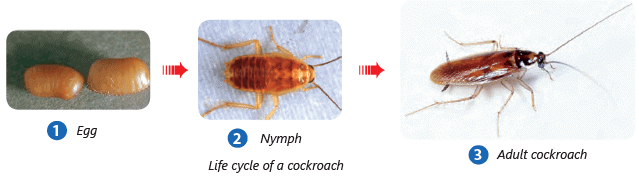
Some insects such as grasshoppers and cockroaches pass through three stages in their life cycles.
- When the eggs of a cockroach hatch, baby cockroaches come out. They are called nymphs.
- They look similar to adult cockroaches. They shed their skin several times when they are growing. This is called moulting.
- After moulting many times, they change into adult cockroaches.
Other insects such as butterflies and house flies pass through four stages in their life cycle. Let's look at the life cycle of a butterfly.
Life Cycle of a Butterfly
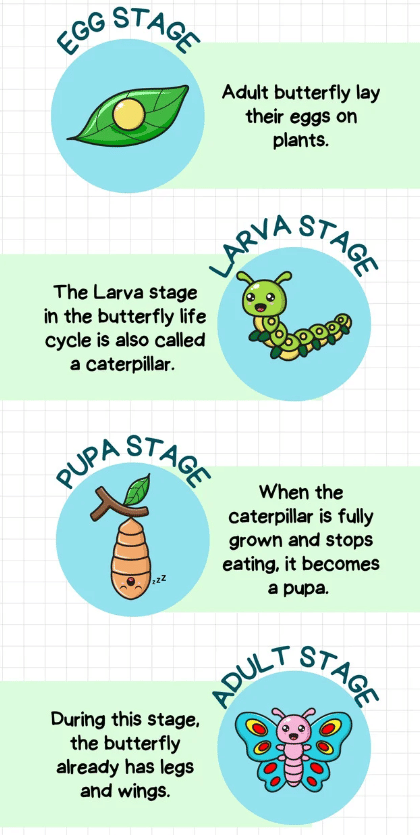
A butterfly has four stages in its life cycle.
- Eggs: The female butterfly lays eggs on the underside of leaves.
- Larva: The egg hatches and the larva comes out. It is also called a caterpillar. It looks like a worm. It eats leaves and grows quickly.
- Pupa: The caterpillar spins a covering called pupa around itself. Inside the pupa, the caterpillar slowly turns into a fully-grown butterfly.
- Butterfly: When the pupa splits open, the beautiful butterfly takes flight.
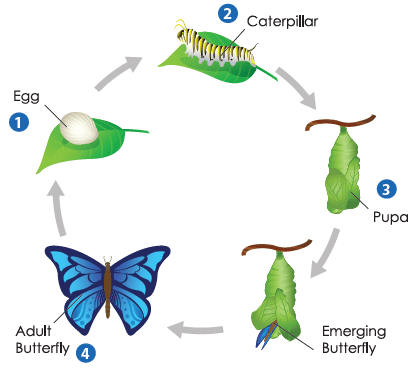 Life cycle of butterfly
It starts flying, looks for food and then lays eggs. The life cycle starts all over again.
Other Egg-laying Terrestrial Animals
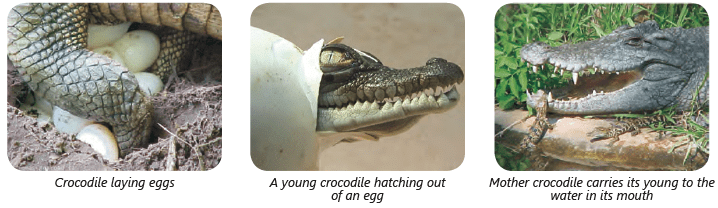
- Crocodiles, turtles, lizards, and snakes also reproduce by laying eggs. Their eggs have hard shells, like that of birds.
- Crocodiles and alligators make nests for their eggs on the ground in shallow pits near the river banks. After laying the eggs, the mother covers the eggs with sand. Only a few of them hatch as some do not get sufficient heat and some are eaten by other animals.
- When the eggs hatch, the mother picks the babies in her mouth and carries them in to the water. She guards them for several months.
3. Aquatic Oviparous Animals
Aquatic animals live in water. Animals like fish and frog lay eggs in water.Fish
- Fish lay thousands of eggs at one time.
- Many fish lay eggs on the bottom of the water bodies or among water plants. Some fish have adhesive eggs and these eggs stick together in bunches. The young ones in the eggs grow and hatch into very small baby fish called fries (singular: fry).
- Not all fries grow into adult fish as most of them are eaten by other big fishes and aquatic animals.
Frog
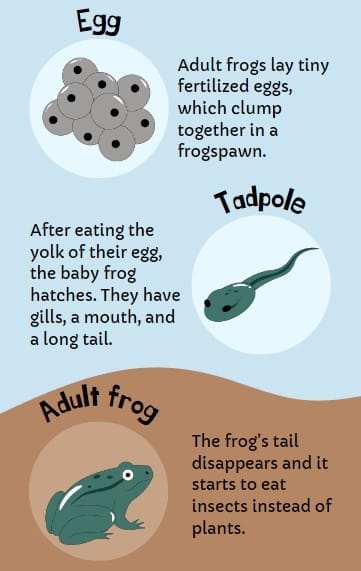
- Frogs lay their eggs in water. A floating clump of eggs is called frog spawn.
Life Cycle of a Frog
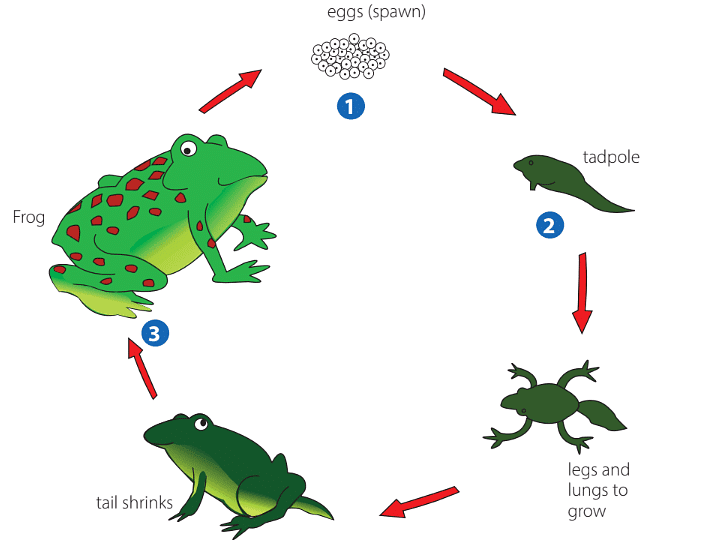 Life Cycle of a Frog
- Eggs: A jelly-like covering protects the egg. The egg slowly develops into an embryo. Organs and gills begin to form in the embryo. The yolk inside the eggs provides nutrients for growth.
- Tadpole: After its development period, the embryo leaves its jelly shell, and attaches itself to a weed in the water. It quickly becomes a tadpole or a baby frog with a long tail.
The tadpole grows with the weed until it is big enough to break free into the water. It feeds on small plants. - Frog: After about five weeks, legs begin to grow. The tail becomes smaller till it finally vanishes. Lungs begin to develop, preparing the frog for its life on land.
Finally, a fully-developed frog with lungs and legs hops out from the water.
As we observed, the young tadpole looks more like a fish than the frog. This process of transformation from a tadpole to a frog is known as metamorphosis. Metamorphosis is seen in butterflies and frogs.
Parental Care in Animals
Animals nurture and care for their eggs and babies.
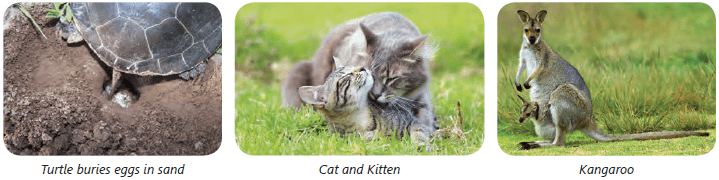
- A turtle lays hundreds of eggs at night and buries them in the sand.
- Snakes coil around the eggs and attack animals that come close.
- The male sea horse uses its pouch to store the eggs and looks after them until they hatch.
- Fish lay a lot of eggs at a time, close to water plants to hide them. Some fish keep their young in their mouth.
- A cow uses its horns to attack anyone who comes close to its young calf.
- Cats fight attackers with their claws and move their kittens to a safer place if the kittens are disturbed.
- A kangaroo carries its young in its pouch wherever it goes.
- Most birds build nests to protect the eggs from bad weather and predators. Baby birds are taken care of by at least one parent until they are able to fly and get their own food.
Try yourself: Which animals reproduce by laying eggs with hard shells?
Scientist in Focus
Maria Sibylla Merian (1647-1717) was a German naturalist and nature artist known for her illustrations of insects and plants. She was one of the first naturalists to observe insects directly. She documented evidence on the process of metamorphosis of caterpillars. She also proposed the descriptions of their life cycles.
Important Points
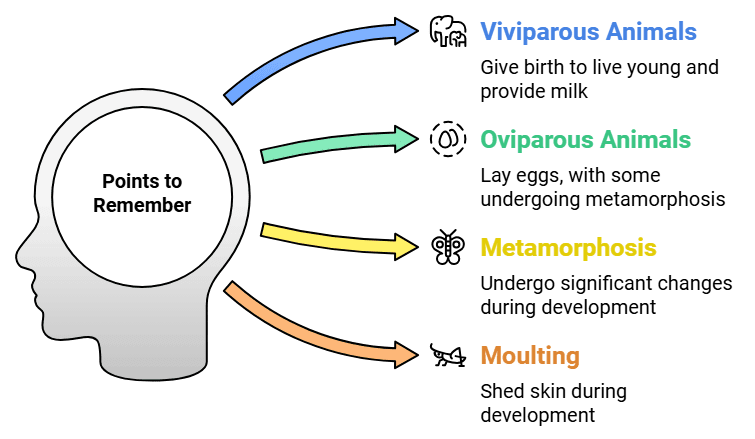
- Animals which give birth to their young ones are called viviparous animals.
- Human beings, dog, cat, cow are viviparous animals.
- Mammals give birth to young ones feed them with their milk.
- Animals that lay eggs are called oviparous animals.
- Birds, frog, fish, turtle, insect, crocodile, alligator, lizard, snake are oviparous animals.
- Some insects like cockroach passes through three stages in its life - egg-nymph adult.
- Butterfly passes through four stages in its life - egg - larva - pupa - adult.
- When a young animal undergoes extreme changes during its development, it is called metamorphosis.
- Some insects shed their skin during development, it is known as moulting.
- Some animals, including all mammals, also care for their young ones until they are able to take care of themselves.
Quick Revision: Life Cycle of Butterfly
Quick Revision: Life Cycle of Frog
FAQs on Chapter Notes: Reproduction in Animals
| 1. What is the difference between sexual and asexual reproduction in animals? |  |
| 2. How do mammals give birth compared to other animals like birds and reptiles? | |
| 3. What are the main stages of animal development from egg to adult? | |
| 4. Why do some animals lay hundreds of eggs while others have only a few babies? | |
| 5. What happens during fertilisation and why is it important for animal reproduction? | |