Chapter Notes: The Revolt of 1857


The Industrial Revolution and European Interest in India
The Industrial Revolution in Europe brought major changes in how goods were made. Machines in factories produced cloth and other manufactured items more quickly and cheaply than before. European countries therefore looked for places to buy raw materials and to sell their factory-made goods. India, rich in textiles, spices and other products, became an important centre of trade for European merchants.
- The East India Company was established in 1600 A.D. by English merchants to trade with the countries of the East, including India.
- Other European powers such as the Portuguese, Dutch and French also came to India in search of spices, textiles and other goods.
- Competition among European nations for trade led to conflicts and attempts to control ports and trading centres along the Indian coast.
- Over time the British strengthened their position and gradually overcame their European rivals to become the dominant power in India.
How the British Became Rulers
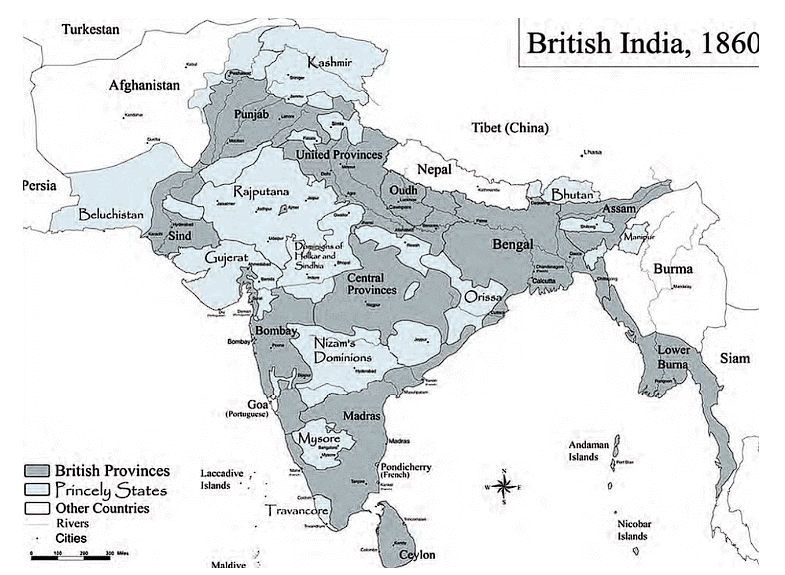
India at that time was not a single united country. It consisted of many small and large states ruled by kings, nawabs and chieftains. These rulers were often involved in fights with one another. The British used this disunity to their advantage. What began as trade gradually turned into political control. The East India Company, which first came to profit from trade, started to interfere in the affairs of Indian states and gained power over land and people.
Rise of the East India Company
At first, British traders aimed to increase their wealth by buying raw materials from India and selling factory-made goods produced in Britain. Gradually, the East India Company moved from trading to ruling, influencing how Indian farming and industry were organised.
- The Company interfered with farming. In many regions, farmers were forced to grow crops such as indigo for export even when people at home were hungry.
- Indian products such as silk and fine muslin were restricted. For example, the import of fine Dhaka muslin into Britain was discouraged so that British cloth could be sold instead. This harmed local weavers and artisans.
- Handloom weavers lost work because cheap machine-made cloth from Britain replaced traditional Indian cloth. This damaged the local economy and livelihoods.
- The Company controlled prices and trade terms. Farmers and artisans could not get fair prices for their goods because the Company decided what to pay.
- Local rulers such as zamindars and nawabs faced interference in their administration and income. Many people lost their jobs and land, creating widespread unhappiness.
- Small and scattered protests against Company policies took place, but most were local and unorganised. The largest and most important of these uprisings occurred in 1857 and is considered by many to be the first major struggle against British rule in India.
The Revolt of 1857
The disturbances that became the Revolt of 1857 began among soldiers of the East India Company. These soldiers were called sepoys. They were unhappy for several reasons: poor pay, limited chances of promotion, and the way British officers treated them. A new rifle that required soldiers to bite open greased cartridges became a major cause of anger because the grease was thought to be made from cow and pig fat, which offended both Hindu and Muslim religious beliefs.
- The use of greased cartridges was the immediate trigger, but the revolt had deeper causes, such as economic hardship, loss of traditional jobs, interference in local rule, and long-standing resentment against Company policies.
- There were early incidents of unrest at places like Berhampur and Barrackpore. A well-known early protest involved Mangal Pandey at Barrackpore on 29 March 1857.
- The revolt became widespread when it broke out in Meerut on 10 May 1857. From Meerut, the rebellion spread quickly to other parts of northern and central India.
- The last Mughal ruler, Bahadur Shah II (also called Bahadur Shah Zafar), was declared the symbolic leader by many rebels. He became a unifying figure even though his power was limited.
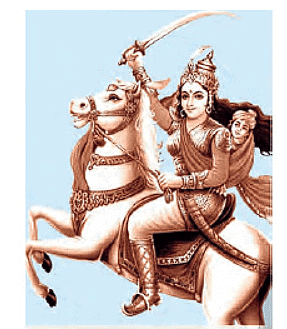
- Several local leaders and rulers joined or supported the revolt. Prominent among them were Rani Laxmi Bai of Jhansi, Nana Sahib, Tantia Tope, and Begum Hazrat Mahal of Awadh.
Timeline of Key Events (Simple Order)
- Early 1857: Growing discontent among sepoys and the people due to Company policies.
- 29 March 1857: Mangal Pandey's action at Barrackpore became a noted incident of rebellion.
- 10 May 1857: Revolt begins in Meerut and spreads to Delhi, Lucknow, Jhansi and other centres.
- 1857-1858: Fighting continues in many parts of northern and central India with successes and defeats on both sides.
- 1858: The British finally suppress the main centres of the rebellion and arrest or defeat many leaders.
Important Leaders and Their Roles
- Bahadur Shah II, the last Mughal Emperor, became the symbolic head of the uprising in Delhi.
- Rani Laxmi Bai - the queen of Jhansi, known for her bravery and resistance against the British in central India.
- Nana Sahib - a leader in the region around Kanpur who opposed British actions.
- Tantia Tope - a close associate of Nana Sahib- led several military actions during the revolt.
- Begum Hazrat Mahal - a leader in Awadh (Oudh) who took part in organising resistance.
- Mangal Pandey - a sepoy whose earlier act of defiance at Barrackpore is remembered as one of the sparks of the wider revolt.
Impact and Consequences of the Revolt
The Revolt of 1857 had several important effects on Indian society and on British rule.
- The uprising was eventually crushed by British forces. Many rebels, including the sons of Bahadur Shah II, were executed, and others were punished severely.
- The British government decided that Company rule had failed. In 1858, the East India Company was dissolved, and control of India was transferred to the British Crown. This change brought direct rule by the British government in India.
- After the revolt, the British made changes in their policies: they tried to rule more directly and carefully, avoided interfering openly in certain religious and social matters, and reorganised the army to reduce the chance of a similar revolt.
- The revolt awakened a wider desire among Indians to end foreign rule. Over the following decades, Indians organised politically and socially, which eventually contributed to the larger national movement for independence.
Definitions and Simple Explanations
- Sepoy - an Indian soldier employed by the East India Company or British army.
- East India Company - a British trading company established in 1600 that gradually began to rule large parts of India.
- Zamindar - a landholder who collected taxes from peasants; some zamindars lost power when the Company took control.
- Indigo - a plant used to make blue dye; farmers were often forced to grow indigo for export instead of food crops.
- Muslin - a very fine and delicate cloth, especially famous from Dhaka (now in Bangladesh).
Conclusion
The Revolt of 1857 was a turning point in Indian history. It began as a soldiers' mutiny but became a wider protest against many policies of the East India Company. Although the revolt did not succeed in removing British power at that time, it changed the nature of British rule and inspired later movements for independence. Many people remember 1857 as the beginning of organised resistance against colonial rule and as an important lesson in unity, leadership and sacrifice.
FAQs on Chapter Notes: The Revolt of 1857
| 1. Who were some of the important characters involved in the revolt of 1857? |  |
| 2. What role did Rani Lakshmi Bai play in the revolt of 1857? | |
| 3. How did Nana Sahib contribute to the revolt of 1857? | |
| 4. What was the significance of Bahadur Shah II in the revolt of 1857? | |
| 5. How did Tantia Tope and Mangal Pandey contribute to the revolt of 1857? | |