Chapter Notes: Money


Introduction
Money is defined as a medium of exchange. Money is required to purchase items that we need in our day-to-day lives, like clothes, food, etc. It is a means to buy all things.
Without money, we would have to exchange goods directly, which is called barter, and that is not always easy.
Let Us Understand with an Example
Suppose you want to buy a new pencil box.
You go to a shop with your parents.
Your parents give money to the shopkeeper, and the shopkeeper gives you the pencil box.
Here, money acts as a medium of exchange between you and the shopkeeper.
What is Money?
- Money is what we use to buy things, pay bills, or save for the future.
- It can take different forms like coins, paper notes (currency), or digital money (used online).
Understanding Indian Currency
The money used in our country is called Indian Currency.
It has two units - Rupees (₹) and Paise (p).
Rupees (₹):
- The main unit of currency.
- Written as ₹.
- Examples: ₹10, ₹50, ₹100.
Paise (p):
- Smaller unit of currency.
- Written as p.
- 100 paise = ₹1.
- Examples: 50p, 75p.

Note: Different countries use different currencies. Indian currency is known as rupees.
Forms of Currency
- Coins - small metal money like ₹1, ₹2, ₹5, ₹10, ₹20;

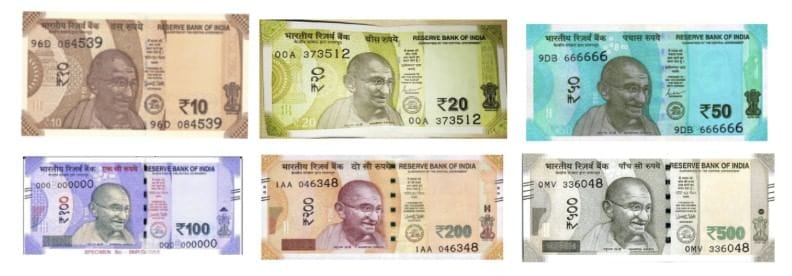
- Notes - paper money like ₹10, ₹20, ₹50, ₹100, ₹200, ₹500, ₹2000;
- Digital Money - used through cards and apps like Paytm and Google Pay.

Writing Money: Rupees and Paise
When money exceeds ₹1, it is expressed in rupees. For instance, ₹2.75 means 2 rupees and 75 paise.
Money can be written in words as well as in figures as follows:

Conversion of Rupees into Paise and Paise into Rupees

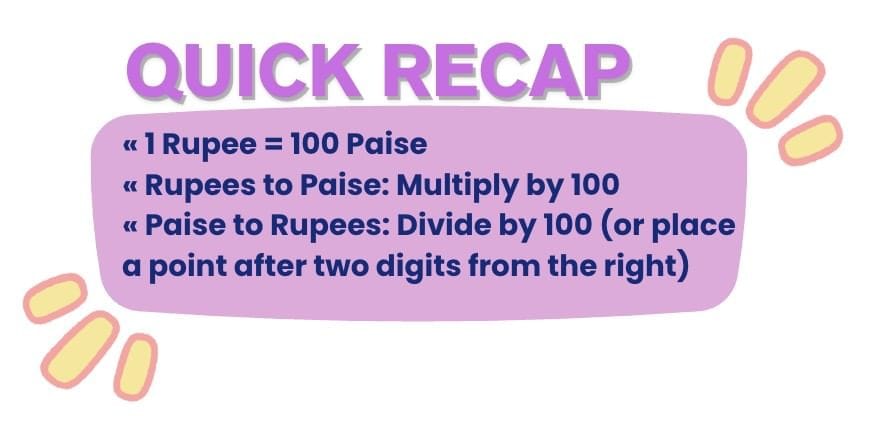
To change 'rupees' into 'paise' we multiply the number of rupees by 100
Example:
₹ 1 = 100 paise, Then
₹ 2 = 2 × 100 paise = 200 paise
₹ 3 = 3 × 100 paise = 300 paise,
₹ 4 = 4 × 100 paise = 400 paise
Below are some of the rules for the conversion of rupees into paise and vice versa.
Rule 1: Converting Rupees and Paise into Paise
To change an amount in rupees and paise into paise,
multiply the number of rupees by 100 and add the number of paise.
Example 1: Convert 35 rupees 25 paise into paise.
Sol: 35 rupees 25 paise = (35 × 100) paise + 25 paise
= 3500 paise + 25 paise
= 3525 paise
Rule 2: Converting Rupees (in decimal form) into Paise
To convert an amount given in rupees (₹) into paise,
remove the symbol ₹ and the decimal point, then write paise.
Example 2: Convert the following amounts into paise.
(a) ₹ 41.25
(b) ₹ 106.50
(c) ₹ 0.25
Sol: (a) ₹ 41.25 = 4125 paise
(b) ₹ 106.50 = 10650 paise
(c) ₹ 0.25 = 25 paise
Rule 3: Converting Paise into Rupees
To convert an amount given in paise into rupees, place a decimal point after two digits from the right.
The digits to the left of the point show rupees, and those to the right show paise.
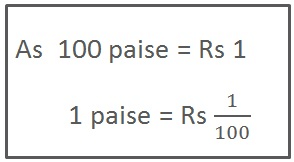 Conversion of rupees into paise and vice versa
Example 3: Convert the following into rupees.
(a) 4535 p
(b) 9p
(c) 505 p
Sol: (a) 4535 p = ₹ 45.35
(b) 9p = ₹ 0.09
(c) 505 p = ₹ 5.05
Try yourself: If Reema has 5 rupees and 75 paise, how much money does she have in paise?
Addition of Money
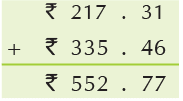
Some practical situations involve the addition of money. To find the total amount, we write one amount under the other such that the point is exactly under the point and add ordinary numbers.
Example 4: Add ₹ 217.31 and ₹ 335.46.
Sol: Steps to add money
Step 1: Write the amounts.
Write ₹217.31 and ₹335.46 one below the other. Make sure the decimal points are in a straight line.Step 2: Start adding from the right (paise).
Add the hundredths (1 + 6 = 7).
Add the tenths (3 + 4 = 7).
Now, the paise is 77 paise.Step 3: Add the rupees.
Add the units (7 + 5 = 12). Write 2 and carry over 1.
Add the tens (1 + 3 = 4), and don't forget the carry-over. So, 4 + 1 = 5.
Add the hundreds (2 + 3 = 5).Step 4: Write the final total.
The final answer is ₹552.77 or 552 rupees and 77 paise.
Subtraction of Money
Some practical situations involve the subtraction of money. To find the difference we write one amount under the other such that the point is exactly under the point and subtract as ordinary numbers.
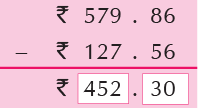
Example 5: Subtract ₹127.56 from ₹579.86.
Thus, ₹579.86 - ₹127.56 = ₹452.30.
Try yourself: If I have 50 rupees and I spend 30 rupees, how much money will I have left?
Multiplication of Money by a Number
Some practical situations involve the multiplication of a sum of money expressed by a number using a point. To find the product we multiply in the usual way and put the point two places from the right.
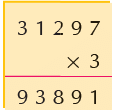
Example 6: Find ₹312.97 × 3.
Sol: We have
31297 × 3 = 93891
₹312.97 × 3 = ₹938.91
Thus ₹312.97 × 3 = ₹938.91.
Division of Money by a Number
Divide the amount given by the given whole number, taking the amount as an ordinary number. Put a decimal point after 2 digits from the right in the quotient.
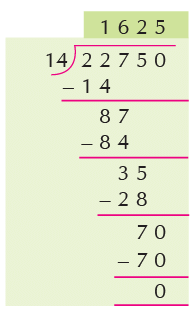
Example 7: Divide ₹22750 by 14.
Thus, the quotient is ₹1625.
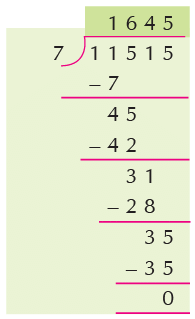
Example 8: Divide ₹115.15 by 7
First divide 11515 by 7
₹11515 ÷ 7 = 1645
Hence, ₹115.15 ÷ 7 = ₹16.45
Try yourself: What is the total amount of money if you have 3 coins of Rs. 5 and 4 coins of Rs. 10?
Estimating Money
At times, we do not need to know the exact amount of money, but we need to get an idea of the cost. To find it, we round off the amount to the nearest rupee. This is called the estimation of money.
Example 9: Round off the following to the nearest rupee:
(a) ₹523.96
(b) ₹684.35
Sol: (a) ₹523.96 = ₹524 (Rounding 96 p to the nearest hundred, we get 100 p or ₹1.)
₹523 + ₹1 = ₹524(b) ₹684.35 = ₹684 (Rounding 35 p to the nearest hundred, we get 0 p. This can be taken as ₹ 0.)
₹684 + ₹0 = ₹684
Estimating Sum and Difference
Sometimes, it's helpful to round off amounts to the nearest rupee to make calculations easier. Here's how you do it:
Steps to Round Off Amounts
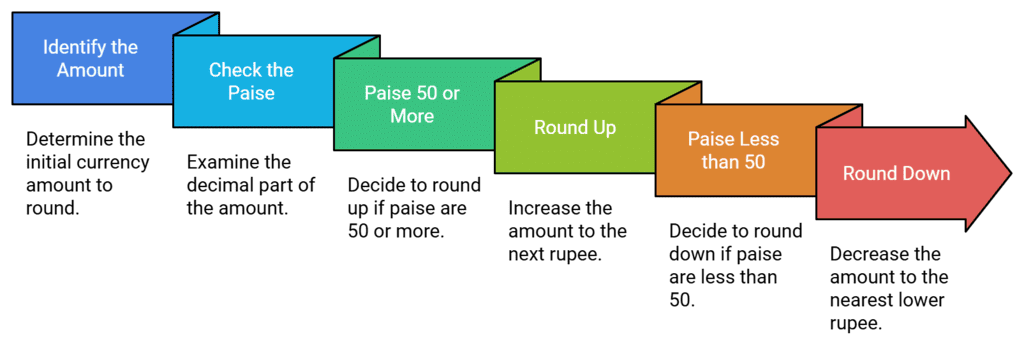
Example:
Amount: ₹112.86
- The decimal part is .86 (which is more than 50).
- Round up to the next rupee: ₹112.86 becomes ₹113.
Amount: ₹39.63
- The decimal part is .63 (which is more than 50).
- Round up to the next rupee: ₹39.63 becomes ₹40.
Adding Rounded Amounts
After rounding off, you can add the amounts easily.
Example:
- Original amounts: ₹112.86 and ₹39.63.
- Rounded amounts: ₹113 and ₹40.
- Add the rounded amounts: ₹113 + ₹40 = ₹153.
FAQs on Chapter Notes: Money
| 1. How do I add and subtract money in rupees and paise for Class 4 maths? |  |
| 2. What's the difference between rupees and paise and how do they relate? | |
| 3. How do I convert paise into rupees and rupees into paise? | |
| 4. Why do I get confused when multiplying and dividing money amounts? | |
| 5. How do I solve real-world money word problems about shopping and change? | |