CBSE Class 4  >  Class 4 Notes  >  Science  >  Worksheet: Solids, Liquids & Gases - 1

Worksheet: Solids, Liquids & Gases - 1

Q1: Multiple Choice Questions (MCQs).


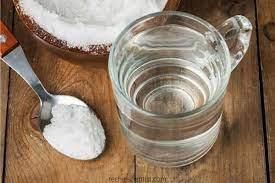
(i) The mixture of salt and water is called
(a) 
solute
(b) 
solvent
(c) 
solution
(d) 
matter
Q1: Multiple Choice Questions (MCQs).

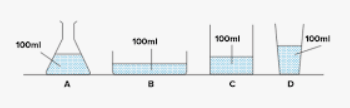
(ii) Which of these has a fixed shape and volume?
(a) 
Solid
(b) Liquid
(c) 
Gas
(d) 
All of these
Q1: Multiple Choice Questions (MCQs).

(iii) Which of the following is not always true for matter?
(a)
Has weight
(b) 
Takes up space
(c) 
Can be seen
(d) 
Is made up of molecules

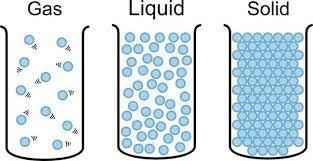
(iv) The distance between the molecules of which of these is the highest?
(a) 
Solid
(b) 
Liquid
(c) 
Gas
(d) 
Same in all of these
Q1: Multiple Choice Questions (MCQs).

Q2: True & False.

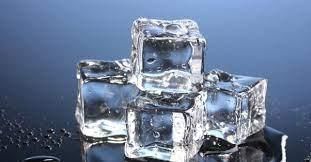
(i) Ice cube melts into water in freezing.

(ii) Insoluble substances can be seperated from liquid by sedimentation only.

(iii) Both solids and liquids have definite shapes.

(iv) In evaporation process, a liquid changes into solid.
Q2: True & False.

Q3: Fill in the blanks.


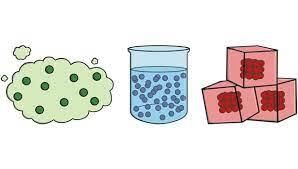
(i) Intermolecular space is least in case of ________.

(ii) Liquids do not have definite ________.

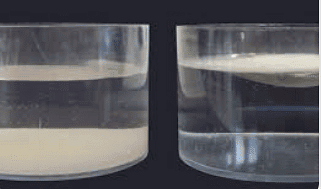
(iii) Sand is ________ in water.
Q3: Fill in the blanks.

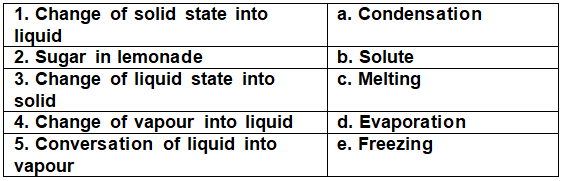
Q4: Match the following.

Q4: Match the following.

Q5: Answer the following questions in brief.


(i) What do you understand by the term freezing?

(ii) What is matter?

(iii) What is condensation?

(iv) Define the following:
(a) Solution
(b) Solvent
(c) Solute

(v) Write any two properties of solids.
Q5: Answer the following questions in brief.


You can find Worksheets Solutions here: Worksheet Solutions: Solids, Liquids & Gases - 1 

The document Worksheet: Solids, Liquids & Gases - 1 is a part of the Class 4 Course Science for Class 4.
All you need of Class 4 at this link: Class 4

FAQs on Worksheet: Solids, Liquids & Gases - 1

1. What are the main differences between solids, liquids, and gases for Class 4 science?
Ans. Solids have a fixed shape and volume, liquids take the shape of their container but have fixed volume, and gases have no fixed shape or volume-they spread out to fill any space. Solids are tightly packed particles, liquids have loosely arranged particles that can flow, and gas particles move freely with large spaces between them.
2. How can I tell if something is a solid, liquid, or gas by looking at its properties?
Ans. Identify solids by checking if they keep their own shape without a container. Liquids flow and take container shape but don't evaporate instantly. Gases are invisible or transparent, spread everywhere, and have no fixed form. Observing whether particles are tightly packed, flowing, or moving freely reveals the state of matter.
3. Why do solids keep their shape but liquids and gases don't in CBSE Class 4 science?
Ans. Particles in solids are held together tightly by strong forces, preventing movement and maintaining fixed shape. Liquid particles have weaker bonds, allowing them to slide past each other and flow. Gas particles are barely attracted to each other, enabling complete freedom of movement and no definite shape or volume.
4. What happens to particles when matter changes between solid, liquid, and gas states?
Ans. When solids heat up, particles vibrate faster and spread apart, turning into liquids. Further heating causes liquid particles to move so rapidly they escape as gases. During cooling, this process reverses-gases condense into liquids, and liquids freeze into solids. Particle movement and spacing determine the state of matter.
5. Can you give real-life examples of solids, liquids, and gases that we see every day?
Ans. Common solids include wood, stone, and books that maintain fixed shapes. Water, milk, and juice are liquids that flow and fill containers. Air, oxygen, and steam are gases surrounding us everywhere. Understanding everyday examples helps Class 4 students recognise how matter exists in three distinct states in their environment.
Explore Courses for Class 4 exam
Get EduRev Notes directly in your Google search
Related Searches
Objective type Questions, Extra Questions, pdf , shortcuts and tricks, video lectures, past year papers, Previous Year Questions with Solutions, Summary, Liquids & Gases - 1, Important questions, study material, Free, mock tests for examination, Sample Paper, Semester Notes, Viva Questions, practice quizzes, MCQs, Exam, Liquids & Gases - 1, Worksheet: Solids, Worksheet: Solids, Liquids & Gases - 1, ppt, Worksheet: Solids;