Worksheet: Operations on Large Numbers

Question 1: Add the following numbers:
- 6,230 and 1,736
- 2,536, 5,384 and 1,207
Question 2: Multiply the following numbers:
- 903 by 47
- 6,354 by 208
- 4,005 by 192
Question 3: Fill in the blanks:
- ______ + 9,573 = 9,573
- 612 × 8 = 8 ×
- 8,305 × 10 =
- 8,734 × ______ = 0
- 8,572 1,000 gives quotient = ______ and remainder = ______.
Question 4: Find the sum:
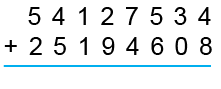
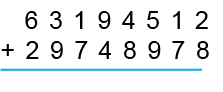
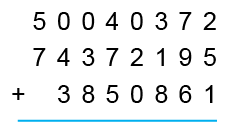
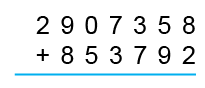
Question 5: Arrange in columns and add:
- 10,93,412; 53,09,426 and 4,01,58,394
- 54,39,724; 4,32,01,582 and 3,91,264
- 6,21,94,351; 37,25,001; 30,05,109 and 1,50,602.
Question 6: Replace * by the correct digits:
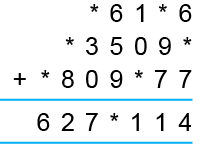
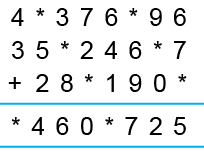
Question 7: A poultry farm produced 18,52,640; 19,25,439 and 20,05,419 eggs in three consecutive Years. Find the total number of eggs produced in the farm?
Question 8: The number of tourists who visited Nainital in three successive years were 4,32,694; 53,90,861 and 6,35,418. How man tourists in all visited Nainital in those three years?
Question 9: The population of a city is 25,00,054. Out of these, 13,85,768 are males. How man females are there in the city?
Question 10: What must be added to 35,19,472 to get 5,13,72,510?
Question 11: Using the properties of multiplication, fill in the blanks:
- 65,39,124 × 0 = ______.
- ______ × 8,32,196 = 0
- 7,325 × ______ = 5,703 × 7,325
- 92,146 × 63,146 = 63,146 × ______.
Question 12: A farmer produced 397 quintals of rice. He sold it at the rate of `1425 per quintal. How much mone did he get?
Question 13: The weight of a bag containing wheat is 4 kg 750 g. What is the weight of 1,427 such bags? [1 kg = 1,000 g.]
Question 14: Fill in the blanks :
- 35,294 ÷ ______ = 35,294.
- 80,396 ÷ 80,396 = ______.
- 0 ÷ 1,42,603 = ______.
Question 15: Find the dividend:
- quotient = 271, remainder = 837, divisor = 1,000
- quotient = 6,001, remainder = 59, divisor = 1,000
- quotient = 6,934, remainder = 2, divisor = 10
- quotient = 36,297, remainder = 12, divisor = 1,000
Question 16: If the dividend is 13,16,352 and the quotient is 256, what is the divisor?
Question 17: Simplify:
- 40 - 25 ÷ 5 × 4 + 10
- 14 ÷ 7 + 2 - 1 × 3
- 60 - 90 ÷ 10 + 3 × 5
Question 18: What is the difference of the largest 6-digit number and the smallest 7-digit number?
Question 19: 2,86,938 ÷ 1,000 gives quotient = ______ and remainder = ______.
Question 20: What number should be subtracted from 61,579 so that the remainder is divisible by 100?
The solutions of the worksheet "Operations on Large Numbers"
FAQs on Worksheet: Operations on Large Numbers
| 1. How do I add and subtract really big numbers without making mistakes? |  |
| 2. What's the fastest way to multiply large numbers in Class 5? | |
| 3. Why do I keep getting different answers when dividing large numbers? | |
| 4. How can I check if my answer is correct after doing operations on big numbers? | |
| 5. Which method works best for comparing very large numbers quickly? | |