Chapter Notes: Subtraction


What is Subtraction?
Imagine you have a bunch of candies. Subtraction is like when you want to figure out how many candies you have left after sharing some with your friends or eating some yourself.
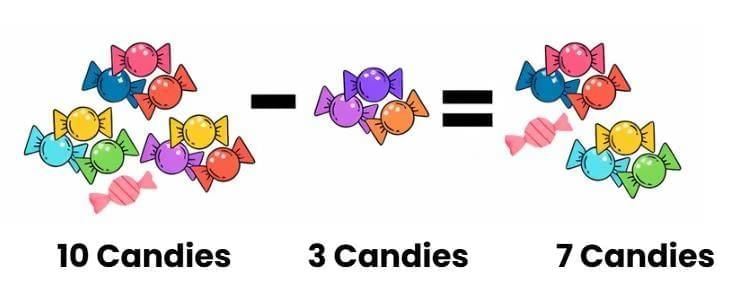 For example, let's say you start with 10 candies. If you give 3 candies to your friend, you can use subtraction to find out how many candies you have left. So, you take away the 3 candies you gave, and you're left with 7 candies. That's subtraction - it helps you figure out what's left when you take away or remove something from a group.
Subtraction is an arithmetic operation that represents the operation of removing objects from a collection. Subtraction is signified by the minus sign, -.
Subtraction of 3-Digit Numbers
Imagine you have 325 toys, and you want to give 128 toys to your friends. To find out how many toys you have left, you use subtraction.
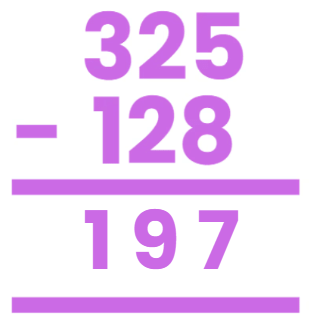
- Start by looking at the rightmost digit (the ones place). You subtract the bottom number from the top number in that column. So, 4 minus 8 isn't possible because 4 is smaller than 8. You borrow 1 from the next column to the left, making the 5 into 4 (because 4 plus 10 is 14).
Borrowing is a trick we use in subtraction when the digit at the top is smaller than the digit at the bottom in a particular column.
- Now, you have 14 minus 8, which is 6. Write down the 6 in the ones place.
- Move on to the next column (the tens place). Now, you have 4 minus 2, which is 2. Write down the 2 in the tens place.
- Finally, move to the leftmost column (the hundreds place). You have 3 minus 1, which is 2. Write down the 2 in the hundreds place.
- So, when you started with 325 toys and shared 128, you have 197 toys left. That's how you subtract 3-digit numbers!
Example 1: Subtract 246 from 358.
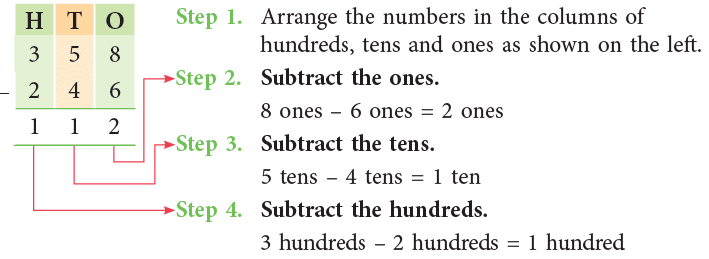 Thus, 358 - 246 = 112.
Example 2: Subtract 135 from 423.
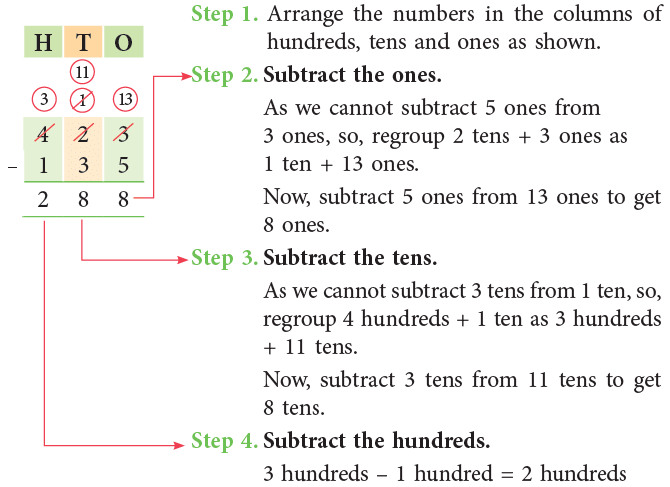 Thus, 423 - 135 = 288.
Properties of Subtraction
- When we subtract zero from a number, the difference is the number itself.
Example: 940 - 0 = 940 - When we subtract a number from the number itself, the difference is zero.
Example: 574 - 574 = 0
Try yourself: What is subtraction?
Subtraction of 4-Digit Numbers
1. Without Borrowing
Let us subtract 6312 from 8654 in different ways.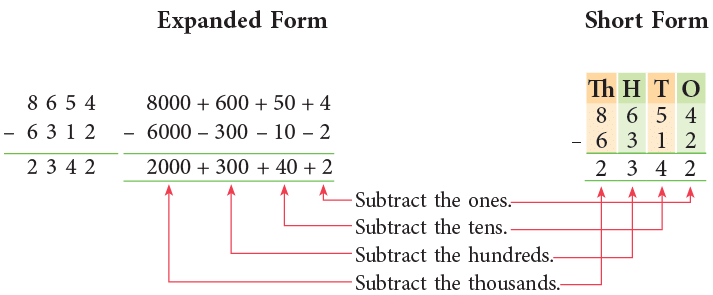
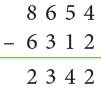
Without borrowing, we found that 8654 minus 6312 equals 2342.
2. With Borrowing
Subtracting by borrowing is a method used in subtraction when the digit at the top (in a particular column) is smaller than the digit at the bottom. This happens when you're subtracting numbers and the digit you want to subtract from is smaller than the digit you're subtracting.
Let's try Subtracting 5875 from 8543.
Step 1: Subtract the ones.
We cannot subtract 5 ones from 3 ones. So, borrow 1 ten = 10 ones from tens column leaving behind 3 tens.
Now, you have 13 ones.
Subtract 5 ones from 13 ones to get 8 ones.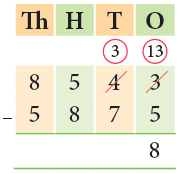
Step 2: Subtract the tens.
We cannot subtract 7 tens from 3 tens.
So, borrow 1 hundred = 10 tens from hundreds column leaving behind 4 hundreds.
Now, you have 10 tens + 3 tens = 13 tens.
Subtract 7 tens from 13 tens to get 6 tens.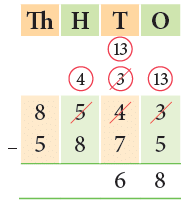
Step 3: Subtract the hundreds.
We cannot subtract 8 hundreds from 4 hundreds.
So, borrow 1 thousand = 10 hundreds from thousands column leaving behind 7 thousands.
Now, you have 10 hundreds + 4 hundreds = 14 hundreds.
Subtract 8 hundreds from 14 hundreds to get 6 hundreds.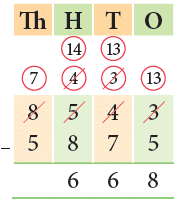
Step 4: Subtract the thousands.
7 thousands are left in the thousands column.
Subtract 5 thousands from 7 thousands to get 2 thousands.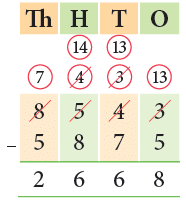
So, 8543 minus 5875 equals 2668. That's how you subtract 4-digit numbers with borrowing!
Subtracting Across Zeros
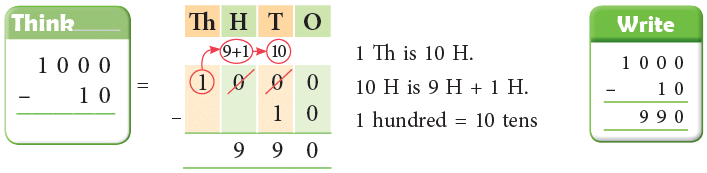
Example 1: Subtract 100, 10, and 1 from 1000.
1. To subtract 100 from 1000,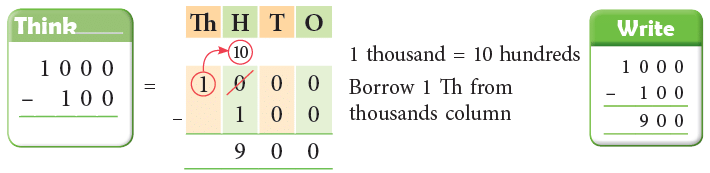
2. To subtract 10 from 1000,
3. To subtract 1 from 1000,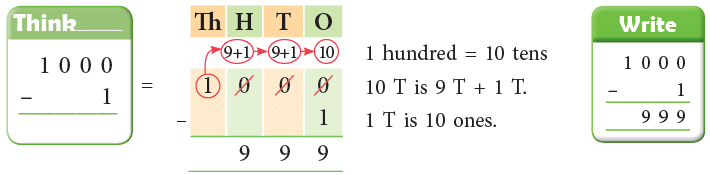
Example 2: Subtract 276 from 500.
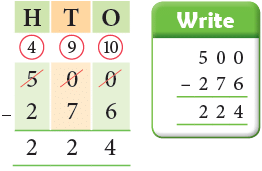
Thus, 500 - 276 = 224.
Try yourself: Subtract 500 from 1000.
Checking Subtraction
It is always considered a good practice to check your answers. We can easily check subtraction by using addition, as subtraction is inverse of addition.
Example: Subtract 2982 from 5087 and check your answer.
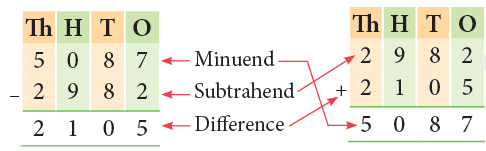
Thus, 5087 - 2982 = 2105.
EduRev Tips: Subtrahend + Difference = Minuend
Problems Based on Real Life Situations
Example 1: Suraj earned ₹ 8,760 a month. He spent ₹ 5,936. How much money did he save in that month?
Amount earned by Suraj = ₹ 8,760
Amount spent = ₹ 5,936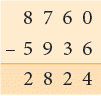 Thus, Suraj saved ₹ 2,824.
Example 2: 3,500 types of plants are at display in a flower show. If 2,274 plants are roses, how many other type of plants are there in the show?
Total number of plants in the show = 3,500
Number of roses in the show = 2,274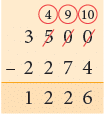 ∴ Number of other plants in the show = 3,500 - 2,274
= 1,226.
Try yourself: Subtract 456 from 890 and check your answer.
Addition and Subtraction Together
Method: First arrange the numbers to be added and then subtract.
Example 1: Solve: 6786 - 2086 + 2597 - 3967.
Step 1: Add the numbers with '+' sign before them.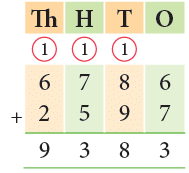
Step 2: Add the numbers with '-' sign before them.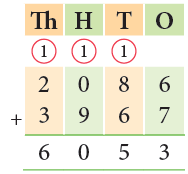
Step 3: Subtract the second sum from the first sum.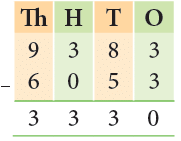
Thus, 6786 - 2086 + 2597 - 3967 = 3330.
Estimating Sums and Differences
- The word estimate means a rough calculation of a quantity. Estimation is an important skill to be developed as we use it in our daily life.
- Some examples include estimation of passengers traveling in a train, cost estimation of fare of a journey, number of persons present at a certain event, etc.
- To estimate a sum or a difference, first-round off each number to its greatest place value. For example, if there are 58 males and 43 females in a hall then we can say that there are about 100 people in the hall.
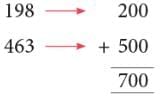
Example 1: Sachin Tendulkar played 198 test matches and 463 one-day matches. Find the total number of matches he played.
Number of test matches = 198 → round to 200
Number of one-day matches = 463 → round to 500Estimated Sum:
Thus, Sachin Tendulkar played about 700 matches in all.
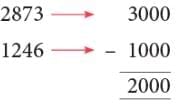
Example 2: A shop had 2,873 bars of chocolate. 1,246 bars were sold. Estimate the number of chocolate bars that were left in shop?
Number of chocolate bars = 2,873 → round to 3,000
Number of bars sold = 1,246 → round to 1,000Number of Chocolate bars left:
Thus, the estimated number of chocolate bars left in the shop were 2000.
FAQs on Chapter Notes: Subtraction
| 1. How do I subtract bigger numbers without making mistakes in Class 3 Maths? |  |
| 2. What's the difference between subtraction and regrouping in CBSE Class 3 Maths? | |
| 3. Why do we line up numbers by place value when doing subtraction problems? | |
| 4. How can I check my subtraction answers to make sure they're correct? | |
| 5. What common mistakes do Class 3 students make in subtraction with regrouping? | |