Chapter Notes: Our Universe

The Universe
The universe is everything around us. It's all the stars, planets, moons, and galaxies you can see in the night sky, along with everything you can't see, like dark matter and energy.
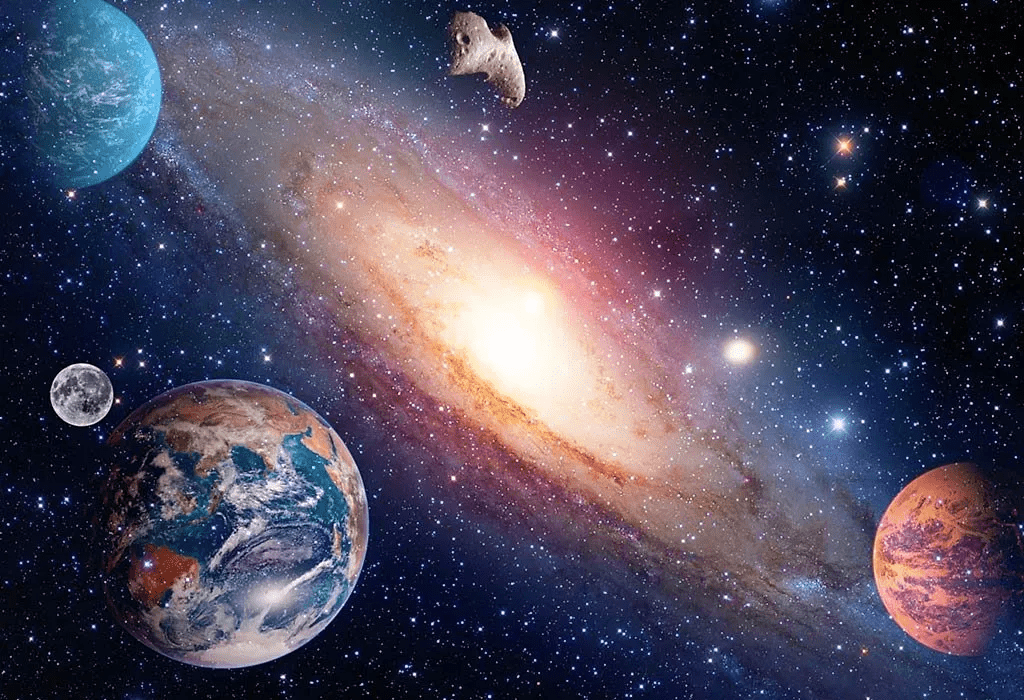 Our Universe
Theories of Origin of Our Universe
There are different theories about the origin of the universe but none is thought to be completely correct.- Many scientists regard the Big Bang theory as the most relevant and believable theory, which explains the origin of the universe.
- According to the Big Bang theory, it is believed that billions of years ago there was a big explosion, out of which a huge ball of fire was created.
- The ball eventually cooled and formed tiny particles. Thus, the universe was created.
Galaxies
Galaxies are enormous collections of stars, dust, gas, and dark matter held together by gravity. They come in different shapes, like spirals, ellipticals, and irregulars. Our own galaxy, the Milky Way, is a spiral-shaped galaxy.
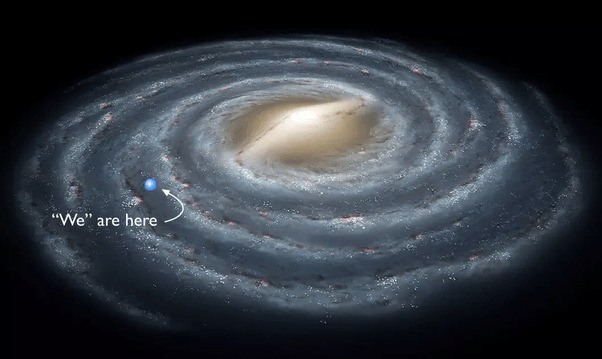
The Milky Way Galaxy and Earth's Position
- The Earth is the only planet on which life exists. The Earth, the Sun, and the rest of the Solar System constitute a tiny part of the Milky Way galaxy.
- It is also known as the Akash Ganga. The Milky Way galaxy contains approximately 200 billion stars, most of which are not visible from the Earth.
- Everything we see in the sky is a part of the Milky Way galaxy.
Do you Know?
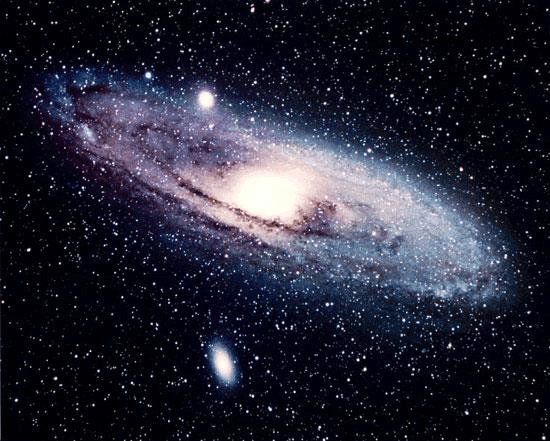
The Andromeda galaxy is the closest major galaxy to the Milky Way. It can be seen without a telescope, though it appears very small and faint.The Andromeda Galaxy
The Solar System
The solar system is like a family of planets, moons, asteroids, comets, and other objects that orbit around the Sun. It consists of the Sun, the eight planets - Mercury, Venus, Earth, Mars, Jupiter, Saturn, Uranus and Neptune, satellites and other heavenly bodies together form the Solar System.
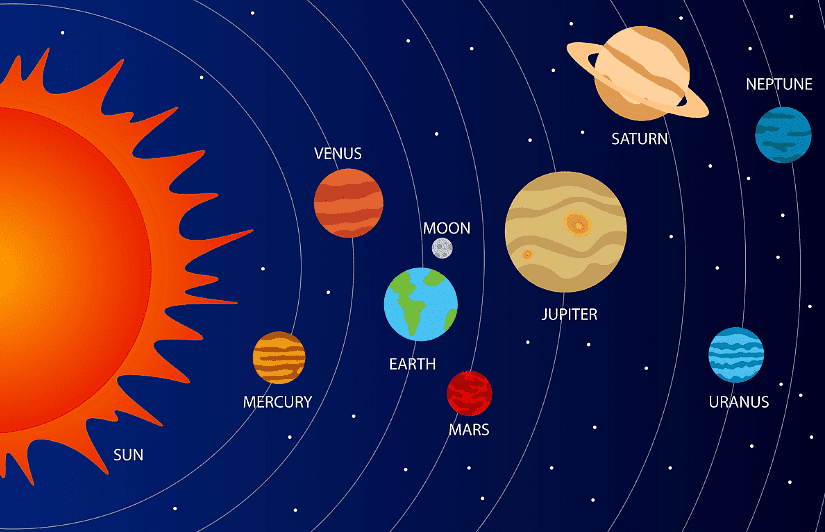 The Solar System
- Stars are the huge balls of fire that twinkle in the night. They are very far away from us. A telescope is used to see the stars, the moon and the planets clearly.
- Sun is a star. It is a huge ball of fire that gives us light and heat. Sun is also the head of a big family called solar system. Solar system consists of sun and eight planets along with their satellites.
- There are eight planets in the solar system. They are Mercury, Venus, Earth, Mars, Jupiter, Saturn, Uranus and Neptune. There is also a dwarf planet in the solar system known as Pluto. A planet revolves around the sun in a fixed path.
Our Planet Earth
Our earth is the only planet known to have life that is plants and animals on it. It is the third planet in the solar system.
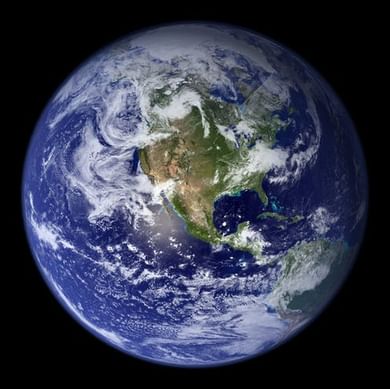 Earth
Earth
Movements of the Earth
The earth moves around the sun. We cannot feel the movement because the earth is moving very smoothly and slowly. Our earth shows two kinds of movements.
1. Rotation: Our earth spins about an imaginary line.
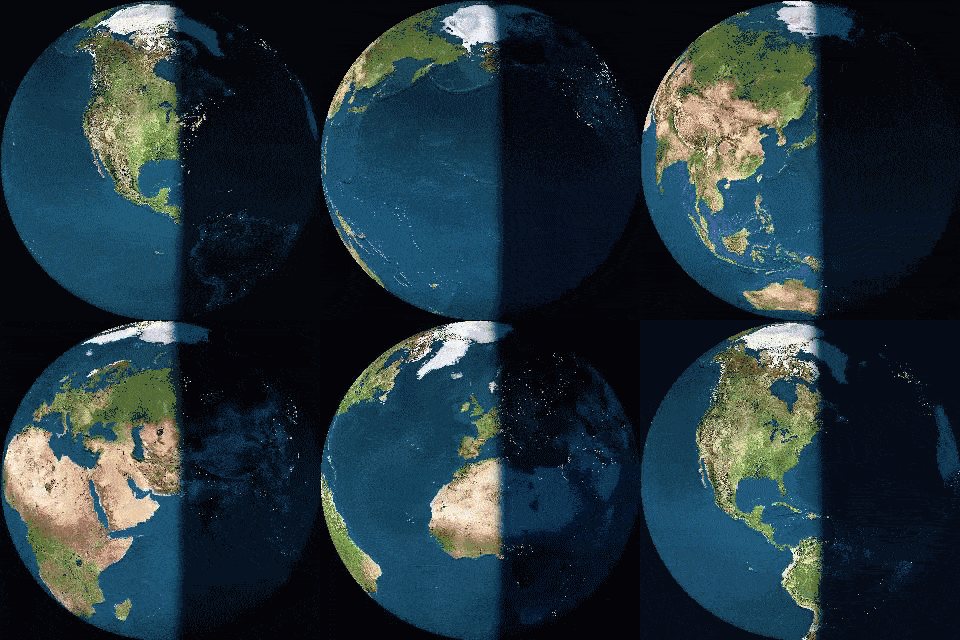 Rotation of Earth
- The imaginary line passes through the center of the earth. It is also called the axis of the earth.
- The spinning movement of the earth about its axis is called rotation.
- The rotation of the earth causes day and night. The earth takes 24 hours to rotate once on the axis.
2. Revolution: The earth moves round the sun on a fixed path known as orbit.
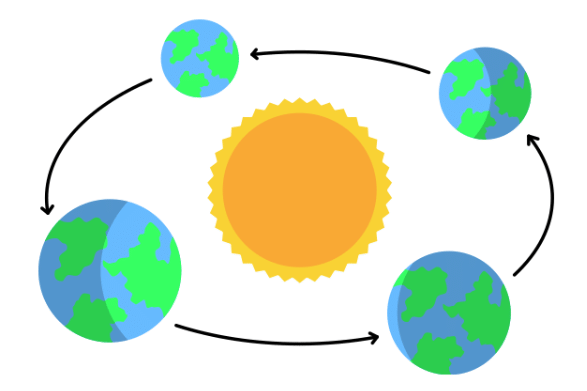 Revolution of Earth
- This movement of the earth around the sun in its fixed orbit is called the revolution of the earth.
- The earth takes about 365 days to complete on revolution.
- The revolution of the earth causes changes in seasons.
The Satellites
- Many planets in the Solar System have small heavenly bodies around them called satellites.
- These satellites revolve around their respective planets and also follow them in their revolution around the Sun.
- The moon is a natural satellite of the Earth. Like planets, satellites also rotate on their respective axes.
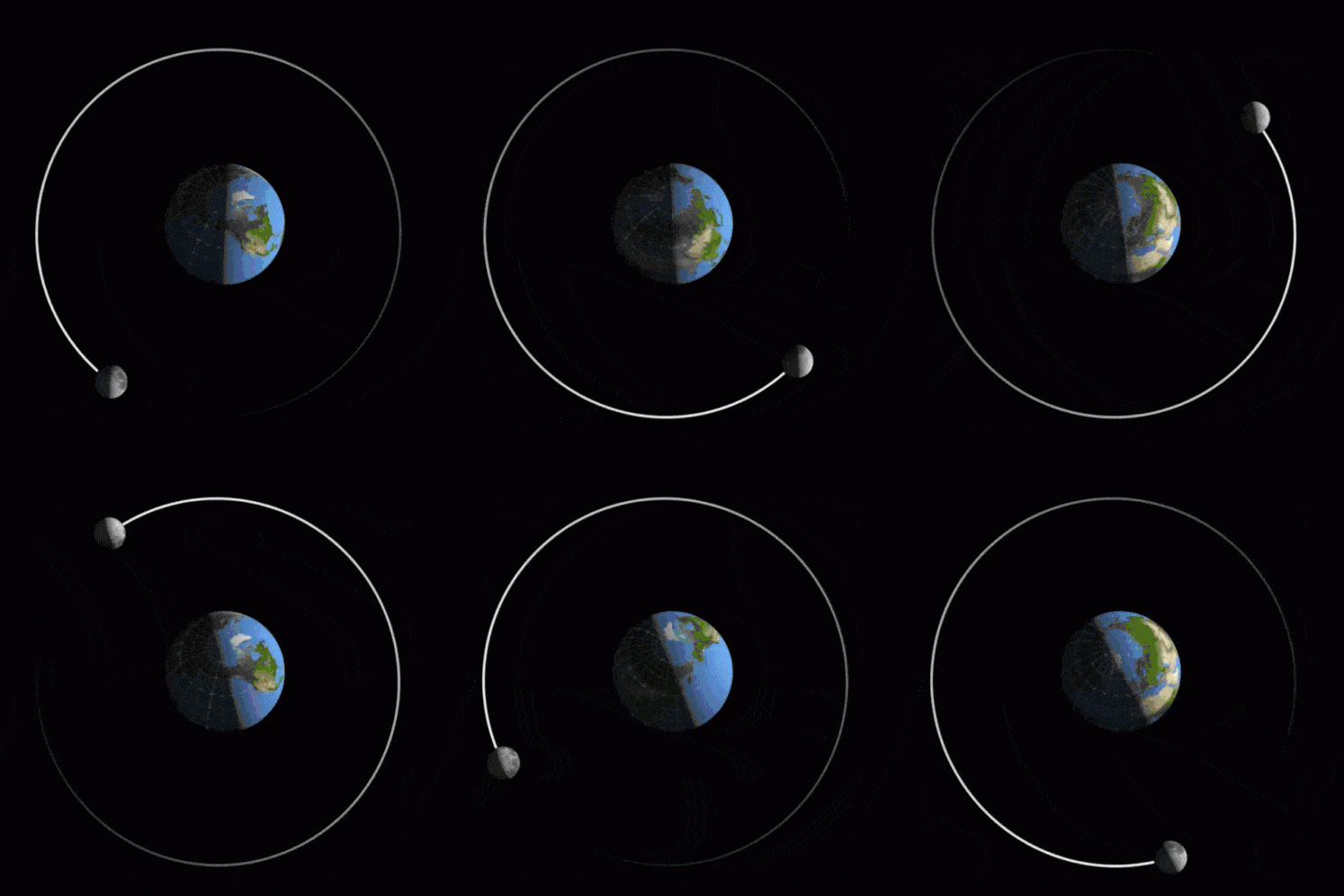 Mood-Satelite of Earth
Keywords
Solar system: the Sun, the eight planets, satellites, and other heavenly bodies together
form the Solar System.
Galaxy: a group of millions of heavenly bodies and shining stars scattered in space.
The Milky Way galaxy is one of billion galaxies in space.
Universe: a vast and infinite space having millions of stars, planets, and galaxies.
Planet: a heavenly body that revolves around the Sun and receives heat and light
from it.
Satellites: astronomical objects revolving around a planet.
Moon: natural satellite of the Earth.
FAQs on Chapter Notes: Our Universe
| 1. What are the main objects in our universe and how are they different? |  |
| 2. Why does the moon look different every night and what are those moon phases called? | |
| 3. What is the difference between a star and a planet for Class 3 science? | |
| 4. How far is Earth from the sun and why does distance matter for life? | |
| 5. What exactly is a solar system and how does ours work? | |