CBSE Class 1 > Class 1 Notes > Mathematics > Worksheet: Patterns - 1
Worksheet: Patterns - 1

Q1: Number pattern
Q2: Colour pattern

Q3: Shape pattern
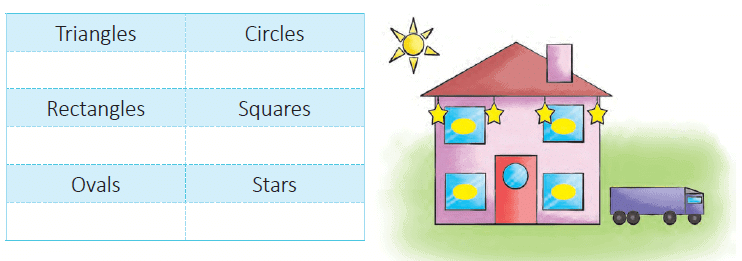
Q4: Count and write how many of each shape do you see in the picture given on the right.
Q5: Complete the following number patterns.
(a) 
(b)
Q6: How many straight lines are there in each of the following figures? Write your answer in the given blanks.
(a) 
(b) 
(c) 
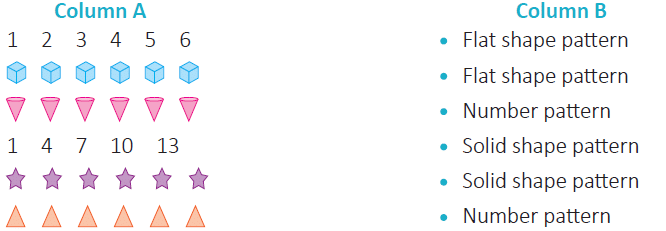
Q7: Match the pattern in column A with the type of pattern in column B.
Q8: Count the number of
(a) rectangles in 
(b) triangles in 
The document Worksheet: Patterns - 1 is a part of the Class 1 Course Mathematics for Class 1.
All you need of Class 1 at this link: Class 1
FAQs on Worksheet: Patterns - 1
| 1. How do I identify the next shape in a repeating pattern? |  |
Ans. To identify the next shape in a repeating pattern, first observe which shapes repeat and in what order they appear. Count how many shapes make up one complete cycle, then predict what comes next based on that sequence. For Class 1 patterns, look for simple repetitions like circle-square-circle-square, and continue the same order. Practice with visual pattern worksheets to strengthen this skill.
| 2. What are the different types of patterns taught in Class 1 mathematics? | |
Ans. Class 1 mathematics introduces three main pattern types: shape patterns (circles, squares, triangles repeating), colour patterns (red-blue-red-blue sequences), and size patterns (big-small-big-small arrangements). Students also learn number patterns and object patterns. These foundational pattern recognition activities develop logical thinking and help children predict sequences using visual observation and counting skills.
| 3. Why am I finding it hard to continue patterns with multiple repeating elements? | |
Ans. Difficulty with multi-element patterns often happens when students don't clearly identify where one cycle ends and the next begins. Break the pattern into smaller groups first-underline or circle each complete repeat. Then focus on just one cycle and extend it. Using flashcards with colour-coded pattern units helps visualize boundaries. Start with two-element patterns before attempting three or four-element sequences.
| 4. How can pattern worksheets help me practise for Class 1 exams? | |
Ans. Pattern worksheets build pattern recognition speed and accuracy through repeated exposure to different sequence types and difficulty levels. Regular practice strengthens visual discrimination and logical reasoning-both essential exam skills. Worksheets also build confidence by showing progress. Using varied pattern problems-from simple shape sequences to colour and size combinations-ensures students master all pattern categories tested in Class 1 assessments.
| 5. What's the easiest way to teach my child about growing patterns versus repeating patterns? | |
Ans. Repeating patterns cycle the same sequence indefinitely (red-blue-red-blue), while growing patterns expand or increase (one circle, two circles, three circles). Show repeating patterns using physical objects that loop back to the start. For growing patterns, use stacking blocks or drawings that visibly increase. EduRev offers mind maps and visual worksheets that clearly distinguish these pattern types through colour-coded examples and interactive demonstrations for young learners.
About this Document

3.6K Views

4.86/5 Rating

Apr 18, 2026 Last updated
Document Description: Worksheet: Patterns - 1 for Class 1 2026 is part of Mathematics for Class 1 preparation. The notes and questions for Worksheet: Patterns - 1 have been prepared according to the Class 1 exam syllabus. Information about Worksheet: Patterns - 1 covers topics like and Worksheet: Patterns - 1 Example, for Class 1 2026 Exam. Find important definitions, questions, notes, meanings, examples, exercises and tests below for Worksheet: Patterns - 1.
Introduction of Worksheet: Patterns - 1 in English is available as part of our Mathematics for Class 1 for Class 1 & Worksheet: Patterns - 1 in Hindi for Mathematics for Class 1 course. Download more important topics related with notes, lectures and mock test series for Class 1 Exam by signing up for free. Class 1: Worksheet: Patterns - 1
Description
Worksheet: Patterns of Mathematics - variety of important questions with solutions, helping you prepare for exam. Download free PDF from EduRev.
Information about Worksheet: Patterns - 1
In this doc you can find the meaning of Worksheet: Patterns - 1 defined & explained in the simplest way possible. Besides explaining types of Worksheet: Patterns - 1 theory, EduRev gives you an ample number of questions to practice Worksheet: Patterns - 1 tests, examples and also practice Class 1 tests


Related Searches
past year papers, Semester Notes, Previous Year Questions with Solutions, pdf , Free, practice quizzes, shortcuts and tricks, Exam, Objective type Questions, Worksheet: Patterns - 1, Important questions, video lectures, mock tests for examination, MCQs, Sample Paper, Extra Questions, Worksheet: Patterns - 1, study material, Summary, Worksheet: Patterns - 1, Viva Questions, ppt;