Worksheet Solution: Fractions

Q1: Compare the following pairs of fractions:
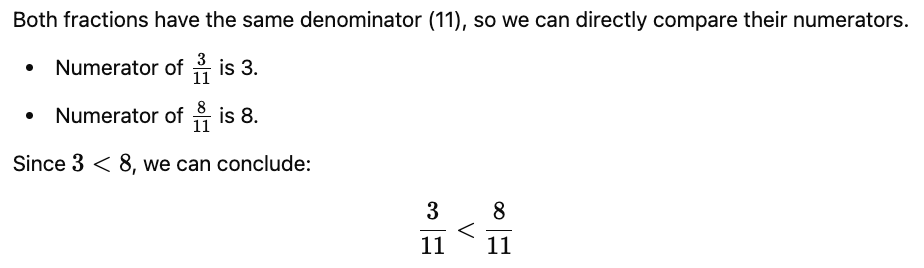
1. 3/11 and 8/11
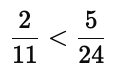
2. 2/11 and 5/24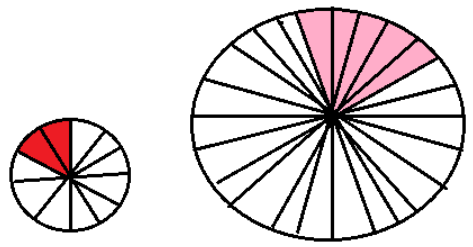
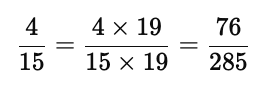
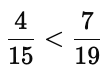
The denominators are 15 and 19.
Since 15 and 19 are co-prime, the LCM is 15×19=285.
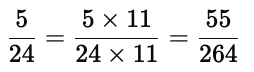
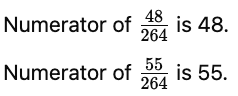

3. 4/15 and 7/19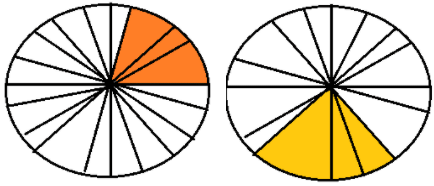
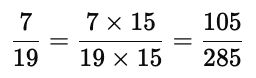
The denominators are 15 and 19.
Since 15 and 19 are co-prime, the LCM is = 285.
Therefore,

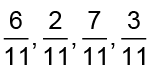
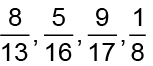
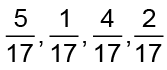
Q2: In each of the following, identify the sets of like fractions.
All are like fractions as the denominator is the same.
No like fractions.
Like Fractions, as the denominator same.
Q3: In the following set of fractions, identify the unit fractions.
A unit fraction is any fraction with 1 as its numerator
1/5, 1/21, 1/19, 1/48, 1/62
Q4: Fill in the blanks in each of the following by the correct number:
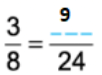
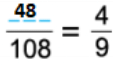
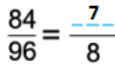
Question 5: Find the equivalent fraction of 64/84 with:
- Denominator 63
64/84 in lowest terms is,64/84 = 16/21
21*3 = 63(63 is the new denominator )
So 16 should be also multiplied by 3
= 16/21*3/3 = 48/63- Denominator 147
64/84 in lowest terms is,64/84=16/21
16/21 x 3 = 112/147- Numerator 16
64/84 in lowest terms is,
64/84=16/21
Q6: Subtract 2 from 5, we get?
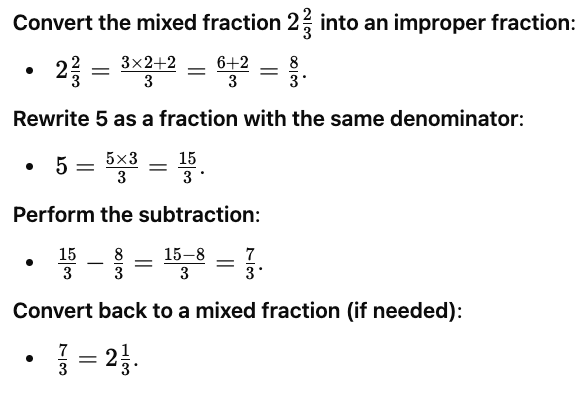
Q 7: Fill in the blanks by putting >,<or = in each of the following to make the statement true:
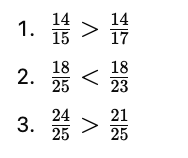
Q8: Which is smaller in each of the following pairs of fractions?
- 3/16, 21/32
Make the fractions equal
3/16 x 2 = 6/32
Thus, 3/16 is smaller.- 2/5, 7/12
Make the fractions equal2/5 x 12 = 24/60
7/12 x 5 = 35/60
Thus, 2/5 is smaller.- 10/33, 1/3
Make the fractions equal1/3 x 11 = 11/33
Thus, 10/33 is smaller.
Q 9:Add together:
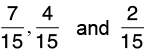

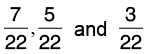

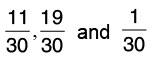

Question 10: Find the sum:
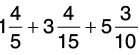
Converting the mixed fractions into improper fractions
9/5 + 49/15 + 53/10
Now, making the denominator equal by LCM.
LCM = 30
9/5 x 6 = 54/30
49/15 x 2 = 98/30
53/10 x 3 = 159/30
Now the fractions are equal, adding them we get
54 + 98 + 159/30 =311/30 = 10(11/30)
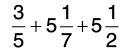
Converting the mixed fractions into improper fractions3/5 + 36/7 + 11/2
Now, making the denominator equal by LCM.
LCM = 70
3/5 x 14 = 42/70
36/7 x 10 = 360/70
11/2 x 35 = 385/70
Now the fractions are equal, adding them we get
42/70 + 360/70 + 385/70 = 787/70
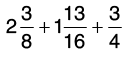
Converting the mixed fractions into improper fractions19/8 + 29/16 + 3/4
Now, making the denominator equal by LCM.
LCM = 16
19/8 x 2 = 38/16
3/4 x 4 = 12/16
Now the fractions are equal, adding them we get
38/16 + 29/16 + 12/16 = 79/16
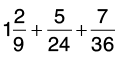
Converting the mixed fractions into improper fractions 12/9 + 2/24 + 7/36
Now, making the denominator equal by LCM.
LCM = 72
12/9 x 8 = 96/72
5/24 x 3 = 15/72
7/36 x 2 = 14/72
Now the fractions are equal, adding them we get
96/72 + 15/72 + 14/72 = 125/72
Question 11: Mukesh bought a pencil for Rs 2 (1/4) and a sharpener for Rs 1 (1/2). How much money did he spend on both these items?
Ans: Mukesh bought a pencil for = Rs 2(1/4)
Mukesh bought a sharpener for = Rs 1(1/2).
Total money spent = 2(1/4) + 1(1/2).
Converting the mixed fractions into improper fractions
9/4 + 3/2
LCM = 4
3/2 x 2 = 6/4
9/4 + 6/4 = Rs. 15/4
Question 12: Pankaj bought 5(1/9) litres of petrol on Monday, 2(5/6) litres on Tuesday, and 1(2/9) litres on Wednesday. How many litres of petrol did he buy on these three days?
Ans: Pankaj bought petrol on Monday = 5(1/9) litres
Pankaj bought petrol on Tuesday = 2(5/6) litres
Pankaj bought petrol on Wednesday = 1(2/9)litres
Total petrol on three days = 5(1/9) + 2(5/6) + 1(2/9)
Converting the mixed fractions into improper fractions
46/9 + 15/6 + 11/9
LCM = 18
46/9 x 2 = 92/18
15/6 x 3 = 51/18
11/9 x 2 = 22/18
Adding them we get total petrol on three days = 165/18
Q13: Fill in the blanks:
1.
- 2/11 x 11/2 = 1.
- 17/3 x 3/17 = 1.
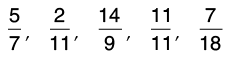
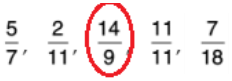
Q14:Ring the improper fractions:
Q15: is the same as
 . Is it true?
Dividing two fractions is equivalent to multiplying the first fraction by the reciprocal of the second:
On the other hand, the right-hand side expression is:
Comparing the two results:
Hence , statement is false.
FAQs on Worksheet Solution: Fractions
| 1. How do I add and subtract fractions with different denominators? |  |
| 2. What's the difference between proper fractions, improper fractions, and mixed numbers? | |
| 3. How do I multiply and divide fractions correctly in Class 5? | |
| 4. Why do I need to find the lowest terms or simplify fractions? | |
| 5. How can I compare fractions and figure out which one is bigger or smaller? | |