Class 2 Maths Measurement - CBSE Worksheets Solutions
Question 1: Circle the unit which you will use to measure each of the following.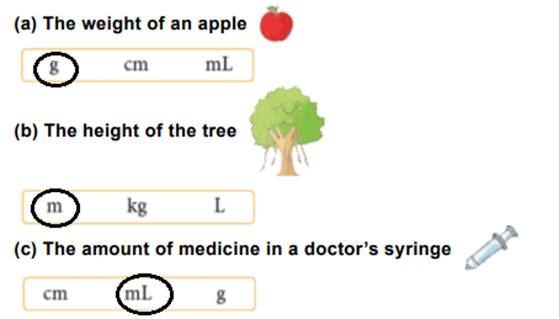
Question 2: Karan’s mother bought 125 cm cloth to stitch a shirt and 215 cm cloth to stitch a pant. How much cloth did she buy in all?
Karan’s mother bought cloth to stitch a shirt = 125 cm
Karan’s mother bought cloth to stitch a pant = 215 cm
Total cloth bought = 125 + 215 = 340 cm
Question 3: Ramesh required 630 g of refined flour, 10 g cocoa powder, 300 g sugar and 50 g butter to bake a cake. What is the total weight of the dry ingredients?
Weight of refined flour = 630 g
Weight of cocoa powder = 10 g
Weight of sugar = 300 g
Weight of butter = 50 g
Total weight = 630 g + 10 g + 300 g + 50 g = 990g
Question 4: 1 m = 100 cm
Question 5: A walking track is 200 m long. How much does a person walk in making 10 rounds of this track?
Length of walking track = 200 m
10 rounds of this track = 200 x 10 = 2000m
Question 6: The length of a spoon is about 15 cm/m.
Question 7: The weight of a jar with biscuits is 450 g. The weight of the biscuits is 395 g. What is the weight of the jar?
(a) 145 g
(b) 55 g
(c) 845 g
(d) 155 g
Correct Answer is Option C
Question 8: Kanchan has 13 kg carrots. She buys another 4 kg of carrots. Now she uses 8 kg carrots to make halwa. How much carrot is left with her?
(a) 5 kg
(b) 4 kg
(c) 9 kg
(d) 1 kg
Correct Answer is Option C
Question 9: Water from four different containers was poured into 4 glasses. The glasses were all of the same size.
Order the containers in order of capacity from the greatest to the least.
(a) C, A, D, B
(b) D, B, A, C
(c) C, A, B, D
(d) D, B, C, A
Correct Answer is Option C
Question 10: A milkman had 565 L of milk. He sold 248 L of milk throughout the day. How much milk is left with him?
Milkman had milk = 565 L
He sold = 248 L
Milk left = 565 L - 248 L = 317 L
|
14 videos|58 docs|19 tests
|
FAQs on Class 2 Maths Measurement - CBSE Worksheets Solutions
| 1. What are the units of measurement used in the class? |  |
| 2. How can I convert centimeters to meters? | |
| 3. How do I measure the weight of an object in grams? | |
| 4. What is the difference between mass and weight? | |
| 5. How can I measure the volume of a liquid in liters? | |

|
4.85/5 Rating |

|
Dec 22, 2024 Last updated |

|
Explore Courses for Class 2 exam
|

|
shortcuts and tricks
,MCQs
,Objective type Questions
,Class 2 Maths Measurement - CBSE Worksheets Solutions
,video lectures
,ppt
,mock tests for examination
,practice quizzes
,study material
,Extra Questions
,past year papers
,Free
,Class 2 Maths Measurement - CBSE Worksheets Solutions
,Class 2 Maths Measurement - CBSE Worksheets Solutions
,Sample Paper
,Important questions
,Summary
,Semester Notes
,Previous Year Questions with Solutions
,Exam
,Viva Questions
;




Worksheet Solutions: Measurement Free PDF Download
Importance of Worksheet Solutions: Measurement
Worksheet Solutions: Measurement Notes
Worksheet Solutions: Measurement Class 2 Questions
Study Worksheet Solutions: Measurement on the App
|
© EduRev
|
Education Revolution
|


|


