Extra Notes: Report Writing | English Class 12 PDF Download

Introduction
A report is an account given of a particular event, issue, subject, especially in the form of an official document, after thorough investigation or consideration by an appointed person or body. It is written for a defined purpose and for a specific audience.
What is a report?
- A report is an account given of a particular event, issue, subject, especially in the form of an Officialdocument, after thorough investigation or consideration by an appointed person or body.
- It is written for a defned purpose and for a specific audience.
- Information and evidence is objectively and in a clear and concise manner.
What are various types of Reports ? Explain their formats.
Types of Reports
- Newspaper report
- Magazine report
- official reports for various organisations
Format of various reports
1. Newspaper Reports: These are accounts of current events and happenings
Title/Headline
By (name of author)
Place, date (date is not always mentioned)
Body of report.
2. Magazine Reports: These are written to give account of speci c events that have taken place, for example, India International Fashion Week, School Annual Day etc.
Title/ Heading
By (name of author)
Body of report.
3. Formal/Official Reports: These are complex documents often of important projects and proposals, eg. results of studies and experiments, proposals for launching a new product etc.
Format -1
Heading
To:
From:
Date:
Subject:
Introduction:
Give details of the task and the reasons for it Main Body:
Information, resources and material used,
Description of task
Results
Conclusion
Your evaluation and suggestions.
Format-2
1. Title page-include
(a) To: name of person report being submitted to
(b) From: name and department
(c) Date of submission
(d) Acknowledgements: A list of people and organizations that helped you in collecting data, research and in other aspects of getting the report ready.
2. Table of contents: a clear list of all sections and subsections of the report.
3. Summary: A summary of the major points, conclusions, and recommendations should be written to give a general idea of the report.
4. Introduction: Explain the problem and make clear to the reader why the report has been written.
5. Findings: Give details of the information collected, material used, methods utilized, and results arrived at.
6. Conclusions: Include implications and inferences of your ndings based on the facts described in your main body. The importance of the study is discussed in this section.
7. Recommendations: Give suggestions and proposals based on information and data collected.
8. Bibliography/References: Give a list of all the sources you have referred within your text. Official Report writing as such does not have a speci c, xls format. Many organizations have their own formats and styles that are used by their employees. Moreover, there are differences in types of Official reports, for example, company annual reports, audit reports, financial reports etc. What are the Points to remember before drafting a report.
Explain the points to be kept in mind before drafting reports
- All reports are objective. There is no place for your personal opinions, perceptions, emotions and feelings in a report. Your suggestions and recommendations are based on facts, data and not subjective views.
- Keep in mind the target audience and structure your report accordingly.
- Personal pronouns in rst and second person (I, me, we, us, you,) are generally not used in a report.
- Passive voice is preferably used in writing newspaper and magazine reports. Active voice can be used in Official reports.
- Past tense is mostly made use of in report writing since we are reporting happenings, which have already taken place.
- The language should be clear, concise and to the point. Long winding sentences, vague information and irrelevant material must not be included.
- Technical jargon and subject speci c terminology is best avoided since all people cannot understand it. If including such terminology is necessary, add a glossary for it.
- Information should be organized logically and coherently. Many reports are written in the chronological order, i.e., following the sequence in which the event occurred. A poorly structured report makes no sense to the reader.
- Your report should not have any grammar and syntax errors. It is a good idea to get it proof read for accuracy.
Flow chart below explains the sequence involved in Report Writing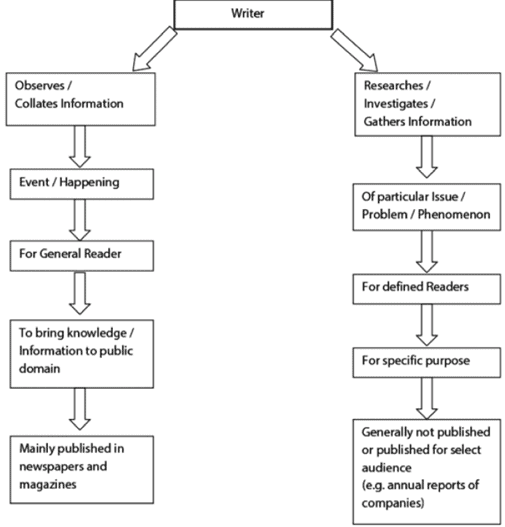
Explain steps in report writing
All reports need to be clear, concise and well structured. A well-written report requires planning and preparation. The essential stages of successful report writing are described below.
Step 1- Understand the purpose of the report
- It is the important that you understand the purpose and requirements of your report.
- Keep in mind who the report is for, and why it is being written.
- Be sure that you understand all the instructions or requirements.
Step 2- Gather and select information
- Gathering information is a time consuming and onerous task.
- You have to choose appropriate sources, read them and select only relevant information.
- Ensure that your sources are authentic and reliable.
Step 3- Organize your content
- A great deal of information is collected during the research period.
- Sort out and select the content relevant to your report.
- Group together the points that are related.
- They can be put together under sections or chapters.
- Thereafter, decide the sequence in which they have to be presented. Choose an order that is logical and easy to follow.
Step 4- Analyze your material
- Prior to writing your rst draft for the report, analyze the material you have gathered critically.
- Look through carefully at the material, thinking about aws and limitations in evidence gathered, con icting data, verifiable conclusions that can be drawn from it.
Step 5- Write the report
- After your material has been organized into appropriate sections and headings you can write the rst draft of your report.
- Some people write the summary and contents page at the end when they know exactly what will be included.
- Write clearly and concisely. Avoid irrelevant, lengthy and confusing explanations or content.
Step 6-Review and redraft
- Take a break before you review your rst draft.
- It is essential to get an appropriate perspective on the draft.
- You may rewrite or reorganize certain sections after the review.
- Assess, without any bias, the report from the perspective of a reader in terms of clarity, simplicity and relevance.
Step 7: Presentation
- Once you are ready with your final draft, check the presentation of the report.
- Make sure that the wording of each chapter/section/subheading is clear and accurate.
- Ensure proper sequencing in numbering of chapters, sections and appendices.
- Verify that you have mentioned all your sources and references.
- Check your report for errors of spelling or grammar.
- Errors in presentation or expression create a poor impression and can make the report difficult to read.
Sample Reports
Newspaper Reports
Sample 1
Daughter of Gardener Tops Board Exam‘ By Riya Sharma
Bhubneshwar, May 12: Suman Nayak, the daughter of a municipal gardener, Om Nayak, has topped the Odisha Board Senior Secondary Examination with 98.8% marks. Her success has been lauded by the sta members of her school 'The Government Senior Secondary School, Malkaganj', the Odisha Education board and the State Education Minister.
When the news was conveyed to Suman by her classmates, she did not believe them. It was only when the school principal called her that the reality sunk in. Suman's father, Om Nayak, is overjoyed at the news. He said, "Suman was always a bright student. I have made all e orts to provide her with the best education despite my meager means". He hopes that she will be able to continue her education in spite of his nancial constraints.
Suman attributes her success to her parentsnd teachers. She said that the school teachers had provided her with all possible help by giving her extra time and attention along with books and moral support. Her perseverance, dedication and hard work are spoken highly of by her teachers. When asked about her future plans, Suman said she wished to become a doctor. However, she was unsure if she could pursue her dream because of nancial problems. She hopes that she will be able to secure a scholarship and get funding by the government.
The Times Group has started an initiative to help Suman ful ll her aspirations. Anyone who wishes to contribute to Suman's education can send the amount by cheque to, 'Suman Nayak Education Fund', The Times of India, M.G. Road, Bhubneshwar.
Sample 2
Commercial tax department to train its oficials and industry participants
TNN | May 6, 2017
Indore: With an aim to become well equipped with the new Goods and Services Tax (GST) and address concerns of dealers, the commercial tax department started to train its o cials and industry participants from Friday. The department has selected 25 locations in the state, covering 23 cities on di erent dates.
Manoj Choubey, deputy commissioner, commercial tax department said, “Our aim is to be fully prepared to handle GST from July. We started a training session from Friday that will most likely extend till the end of the month across Madhya Pradesh.”
Initially, the department will train all its oficials and then conduct interactive training sessions for dealers.
GST — to be implemented in the country from July 2017 — aims to provide a single window tax structure across the country, simplifying tax refunds and inter-state transfer of goods and ensure merchant compliances.
According to the tax department, about 2,200 of its o cials across the state will be trained by experts. In Indore, two locations have been set by the department to conduct training sessions.
There are about 3 lakh dealers across the state registered with the commercial tax department of which close to 50,000 are from Indore, tax experts said.
“We plan to conduct corporate training as well under the session. Training session will bring clarity and technical knowhow about dealing with tax returns and other things under GST,” Choubey said.
Industry participants have raised serious concerns about various norms under GST stating the lack of clarity and training will lead to di culties in handling GST. This will prove especially true for small units that are not tech-savvy and do not have access to internet.
They said small industries are not computer literate and they will have to employ additional manpower to le returns every month.
(Source: The Times of India)
Magazine Report
Sample 1
St. Agnes Public School Celebrates Annual Day
By Manoj Upadhaya
St. Agnes School, Green Park, celebrated its annual day on May 2 with great fanfare. Mr. Arvind Kejriwal, the Chief Minister of Delhi, was the chief guest at the function. The programme began with the lighting of the lamp by the chief guest. It was followed by a welcome address and the presentation of the school annual report by the principal, Ms. Swati Mehra.
The rst item of the cultural program was presented by the primary wing. It was a musical drama on the necessity of protecting the environment for the future generations. The little children expressed themselves brilliantly bringing out the perils of destroying our planet.
The middle school show cased the culture of India through folk dances. Each dance was preceded by beautiful audio- visual e ects, depicting the main cultural features of the region. The colourful dresses of the graceful Garba dancers, the vigour and energy of Bhangra dancers, and lilting music with elegant swaying movements of the Bihu and Hajgiri dancers from the North East, enthralled the audience.
The senior school pupils enacted a play depicting the dangers of internet and social media addiction for adults and children. They brought out the message poignantly. Every child and adult was moved by the acting and story of a young life ruined by social media addiction. The audience gave a loud and long round of applause for all participants.
The grand nale was the speech by Mr. Arvind Kejriwal. He highly praised the performances by the children and appreciated the thought provoking themes chosen by them. The programme concluded with a vote of thanks by Sagar Mehta, the school head boy.
Sample 2
Almost 900 H1N1 cases reported: WHO
Headlines Today
Geneva, May 4, 2009
Though the World Health Organisation’s (WHO) alert level remains one short of a global pandemic, 18 countries have now reported laboratory con rmed cases.
The number of suspected H1N1 u cases across the globe has touched 898 with 20 confirmed deaths so far. Though the World Health Organisation’s (WHO) alert level remains one short of a global pandemic, 18 countries have now reported laboratory con rmed cases.
Colombia became the first South American country to report a case. However, US health officials are cautiously optimistic that the u isn’t as dangerous as it was rst feared. Mexico remains the worst a ected with 506 cases and 19 deaths. However, the country’s Health Secretary feels that the epidemic is now declining. But the WHO is not dropping the level five alert just yet.
(Source: India Today)
Financial report
Financial reports are very long and complicated with complex data and figures. A short report is being given as an example.
Sample
Nuvo Pharmaceuticals™ Announces 2017 First Quarter Results
Reports Q1 Revenue of $7.0 million and Net Income of $2.2 million
MISSISSAUGA, ON, May 10, 2017 /CNW/ - Nuvo Pharmaceuticals Inc. (Nuvo or the Company) a commercial healthcare company with a portfolio of commercial products and pharmaceutical manufacturing capabilities, today announced its nancial and operational results for the rst quarter ended March 31, 2017.
First Quarter Financial Summary(1)
Total revenue for the three months ended March 31, 2017 was $7.0 million compared to $7.8 million for the three months ended March 31, 2016. Adjusted EBITDA decreased to $2.3 million for the three months ended March 31, 2017 compared to $3.0 million for the three months ended March 31, 2016. Net income from continuing operations was $2.2 million for the three months ended March 31, 2017 or $0.19 per share compared to $1.9 million or $0.17 per share for the three months ended March 31, 2016. Cash and short-term investments increased to $18.6 million as at March 31, 2017 compared to $17.6 million as at December 31, 2016.
1) The nancial information presented herein re ects results from continuing operations with Nuvo’s previously disclosed segment, Crescita, presented as a discontinued operation.
2) Adjusted EBITDA is a non- International Financial Reporting Standards (IFRS) nancial measure de ned by the Company below.
First Quarter Financial Review
Table of Selected Financial Results For further details on the results, please refer to Nuvo’s Management, Discussion and Analysis (MD&A) and Condensed Consolidated Interim Financial Statements which are available on the Company’s website.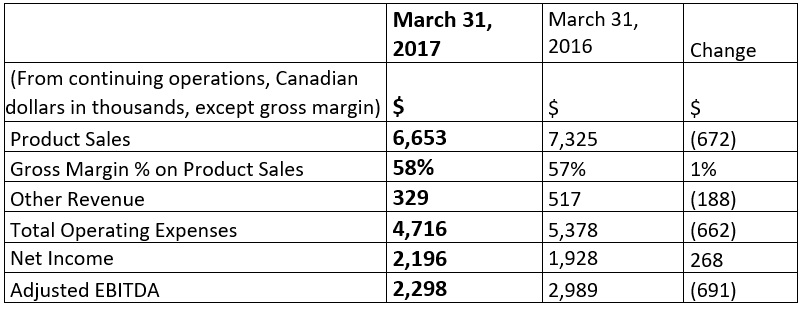
Total revenue, consisting of product sales, royalties and contract and other revenue for the three months ended March 31, 2017 was $7.0 million compared to $7.8 million for the three months ended March 31, 2016. The decrease in total revenue was primarily related to a decrease in product sales.
Total operating expenses for the three months ended March 31, 2017 decreased to $4.7 million compared to $5.4 million for the three months ended March 31, 2016. The decrease in operating expenses was primarily attributable to a decrease cost of goods sold (COGS) and general and administrative (G&A) expenses, slightly o set by an increase in research and development (R&D) expenses. R&D expenses increased slightly to $0.3 million for the three months ended March 31, 2017 compared to $0.2 million for the three months ended March 31, 2016. In the current quarter, the Company incurred R&D expenses related to the 2016 Pennsaid 2% Trial for the treatment of acute ankle sprains.
G&A expenses decreased to $1.7 million for the three months ended March 31, 2017 compared to $2.1 million for the three months ended March 31, 2016. In the current quarter, a $1.0 million decrease in stock-based compensation (SBC) expense was partially o set by an increase in regulatory consulting fees and an increase in general corporate costs due to the allocation of certain corporate G&A costs to Crescita in the comparative quarter. The Company earned net interest income of $38,000 for the three months ended March 31, 2017 compared to $56,000 for the three months ended March 31, 2016.
The decrease in net interest income in the current quarter related to the significantly lower cash balances as compared to the comparative period whereby $35.0 million was transferred to Crescita on March 1, 2016 as part of the reorganization transaction. The Company experienced a net foreign currency loss of $0.1 million for the three months ended March 31, 2017 compared to a net foreign currency loss of $0.5 million for the three months ended March 31, 2016.
Net income from continuing operations was $2.2 million for the three months ended March 31, 2017 compared to $1.9 million for the three months ended March 31, 2016. In the current quarter, the decrease in gross margin and a slight increase in R&D expenses were more than o set by a decrease in G&A expenses and a decrease in foreign exchange losses. Adjusted EBITDA decreased to $2.3 million for the three months ended March 31, 2017 compared to $3.0 million for the three months ended March 31, 2016. In the current quarter, an increase in net income from continuing operations was more than o set by a decrease in SBC expenses.
Class Work
Q-1 Your institute 'Global Business School' organized a seminar on 'Pro table Business Practices in the Next Decade'. Write a report on the seminar for your institute's monthly newsletter in about 150/200 words. (Hints: research how a seminar is conducted and what are pro table business practices).
Q-2 You are the Cultural Society President of your college. The Principal of your college, Mr. Subhash Kapoor, feels that in the increasingly westernized world, the students should not lose touch with their culture and values. He has asked you to suggest ways and means to familiarize the students with the great aspects of Indian culture. Prepare a report in 150-200 words for the principal suggesting the areas that could be covered and the ways and means they be introduced into college life. ( Hints: select areas and methods that appeal to youngsters).
Q-3 You are Mr. Sunil Kaushik, the administrator of Gyan Jyoti Institute. Certain areas of the infrastructure of your institute need to be restructured and revamped. You have been asked to prepare a report on the matter for the managing committee of the institute, stating the speci c buildings that need facelift, and the areas that need attention (example furniture, auditorium, cafeteria). Use the formal report format.
Q-4 You are Reena Singh, a reporter of the The Times of India'. Write a report on a re in a slum cluster in Seelampuri in 150 to200 words.
Q-5 You are sports reporter, Ajay Singh. Write a report on the one day cricket match between Australia and India at Melbourne in 150 to 200 words.
Home Work
Q-1 You are a reporter in Indian Express. Write a newspaper report on Gandhi Jayanti Day celebrated in your city in 150 to 200 words.
Q-2 You are a secretary in a company. Write a report to the director of the company about restlessness of the workers and their threatening for strike in 150 to 200 words.
Q-3 You are working in an academic institute. Your institute organized a guest lecture on explaining the last budget to the students by an eminent economist. Write a report for you institute's magazine in 150 to 200 words.
|
30 videos|373 docs|100 tests
|
FAQs on Extra Notes: Report Writing - English Class 12
| 1. What is the CA Foundation exam and how can I apply for it? |  |
| 2. What are the subjects included in the CA Foundation exam syllabus? | |
| 3. How many attempts are allowed for the CA Foundation exam? | |
| 4. What is the passing criteria for the CA Foundation exam? | |
| 5. Can I appear for the CA Foundation exam while pursuing graduation? | |




Previous Year Questions with Solutions
,MCQs
,shortcuts and tricks
,Free
,Objective type Questions
,Semester Notes
,Exam
,Extra Notes: Report Writing | English Class 12
,past year papers
,practice quizzes
,study material
,Sample Paper
,Extra Notes: Report Writing | English Class 12
,Extra Notes: Report Writing | English Class 12
,Viva Questions
,ppt
,mock tests for examination
,Summary
,video lectures
,Important questions
,Extra Questions
;



Extra Notes: Report Writing Free PDF Download
Importance of Extra Notes: Report Writing
Extra Notes: Report Writing
Extra Notes: Report Writing Class 12 Questions
Study Extra Notes: Report Writing on the App
|
© EduRev
|
Education Revolution
|


|




