Worksheet Solutions: Our Environment - 1


Q1: Name the following.
(i) Gases that trap heat in the Earth's atmosphere and cause global warming
Ans: Greenhouse gases
Greenhouse gases are gases that trap heat in the Earth's atmosphere, causing global warming. Examples: Carbon dioxide, Methane.
(ii) Things that rot and mix with the soil.
Ans: Biodegradable Waste
Wastes that rot by the action of decomposers are called biodegradable wastes. These wastes mix with the soil and produce manure. Some examples are dead plants and animals and their products.
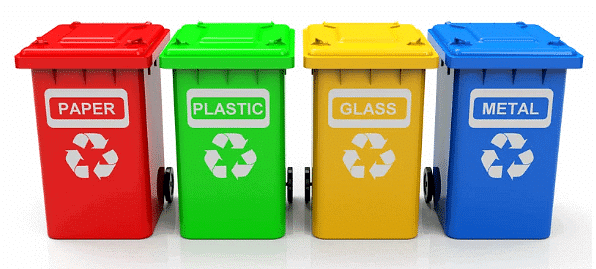 (ii) Waste that does not rot or decompose naturally.
Ans: Non-biodegradable waste
Non-biodegradable materials like plastic and metal do not break down naturally, causing long-term pollution.
Q2: True or False.
(i) If you use a plastic bag again and again you help reduce garbage.
Ans: True
Reduce your use of disposable shopping bags by using a reusable bag or container when shopping.
(ii) A safe way to dispose of garbage is to burn it.
Ans: False
In many cases, the garbage can or recycling bin is the best option.
(iii) Non-biodegradable waste does not rot.
Ans: True
Plastic is a non-biodegradable waste, as it does not rot by the action of decomposers
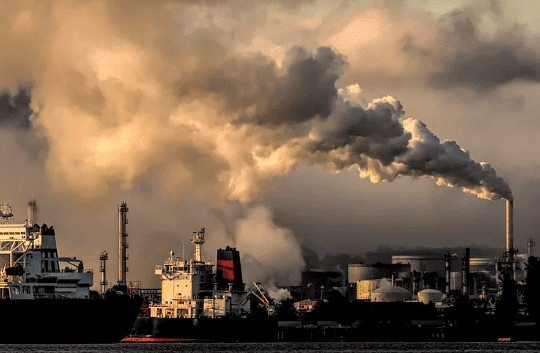
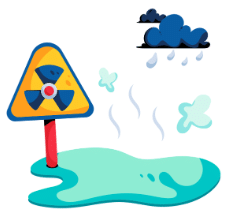
(iv) Acid rain can damage trees, buildings, and water bodies.
Ans: True
Acid rain contains harmful acids formed when pollutants mix with rainwater. It can harm trees, corrode buildings, and pollute water bodies, affecting plants and animals.
Q3: Cross Puzzle
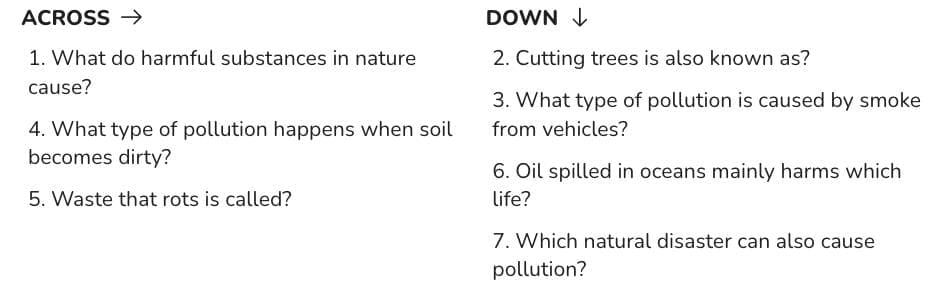
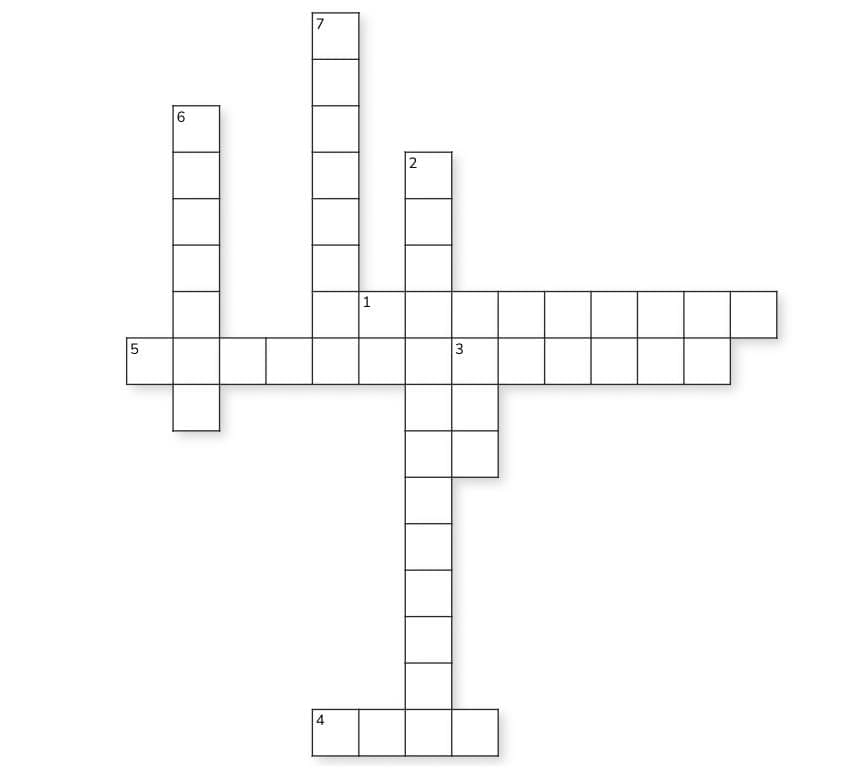
Hint:

Ans: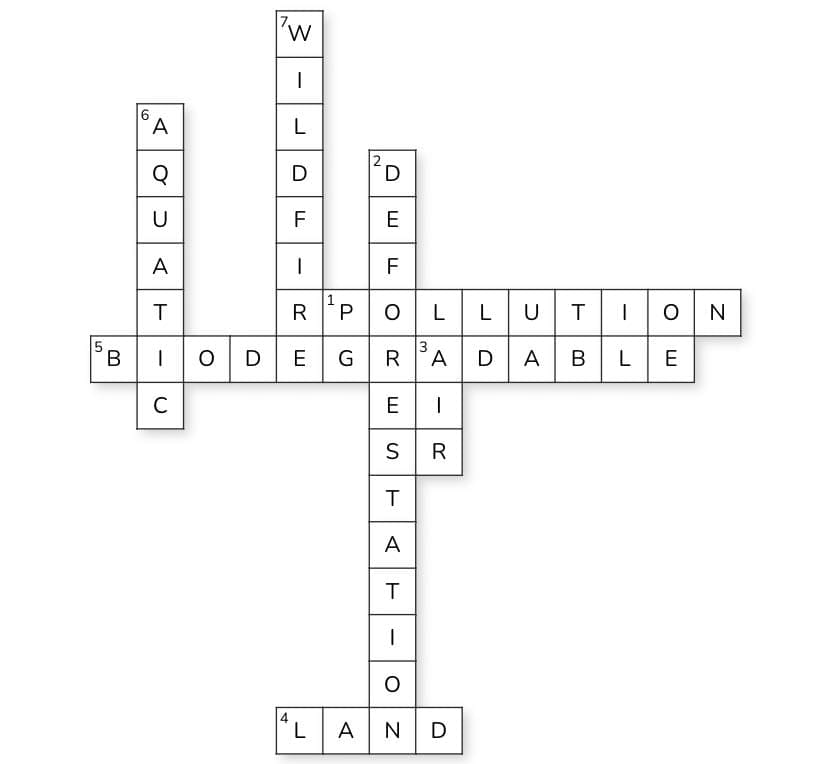
Q4: Fill in the blanks.
(i) Drinking polluted water can cause diseases such as _____ and _____.
Ans: typhoid, diarrhoea
Dirty or polluted water can spread many diseases like typhoid, diarrhoea, dysentery, hepatitis A, cholera, and polio. These happen when water is not clean and when sanitation is poor.
(ii) Harmful substances in the air, water and soil are called _____.
Ans: pollutants
Pollutants are harmful materials that make air, water, or soil dirty.
They can be natural (like volcanic ash) or made by humans (like trash or factory waste). Pollutants harm the environment.
(iii) Planting more trees helps to reduce _______ pollution.
Ans: air
Trees take in carbon dioxide and give out oxygen. This makes the air cleaner and helps reduce air pollution.
(iv) Using the 5R rule helps in managing _______ effectively.
Ans: waste
The 5R rule-Refuse, Reduce, Reuse, Repurpose, Recycle-helps us use things wisely and manage waste properly so we produce less garbage.
(v) Recycling materials like paper, plastic, and glass helps to reduce _____ waste.
Ans: landfill
When we recycle, less garbage goes to landfills. This saves resources and reduces pollution.
Q5: Answer the following questions in brief.
(i) What is recycling? Name three materials that can be recycled.
Ans: Recycling is defined as a process of converting waste and non-useful products into new and useful products for human use. Recycling is an excellent and cost-efficient system of conserving the environment and saving energy. Recyclable materials include many kinds of glass, paper, cardboard, metal, plastic, tires, textiles, batteries, and electronics.
(ii) What harm do plastic bags cause if thrown in a drain?
Ans: When plastic enters the drainage and sewerage system, they block the pipes and the drains causing waterlogging. The improperly disposed of food bags, when eaten by animals, cause stomach and intestine related disease which even lead to suffocation and death.
(iii) List the causes of land pollution.
Ans: Land pollution is caused by dumping toxic chemicals, cutting down trees, construction activities, pesticides, animal waste, open defecation, and throwing garbage and plastic bags
(iv) Explain how global warming occurs.
Ans: Global warming refers to the general increase in the earth's average temperature, which causes changes in climate patterns across the globe. Greenhouse gases are in the atmosphere, absorbing and holding heat, which causes earth's temperature to rise.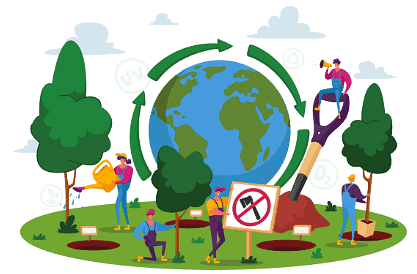
(v) Explain the 5R rule. How does it help in reducing waste?
Ans: The 5R rule stands for Refuse, Reduce, Reuse, Repurpose, and Recycle.
- Refuse - Say no to things you don't need, like plastic bags.
- Reduce - Use less to make less waste.
- Reuse - Use things again instead of throwing them away.
- Repurpose - Use old things in a new way.
- Recycle - Send materials like paper and plastic to recycling so they can be made into new things.
This rule helps in reducing waste because it teaches us to create less garbage, use things wisely, and protect our environment from pollution.
Q6: Multiple Choice Questions (MCQs).
(i) Acid rain is caused by
(a) air pollution
(b) water pollution
(c) soil pollution
(d) neither of these
Ans: (a)
Acid rain happens when harmful gases like sulfur dioxide and nitrogen oxides go up into the air. They mix with water and oxygen in the sky and turn into acids. When it rains, these acids come down with the rainwater. This is why air pollution causes acid rain.
(ii) Our environment consists of
(a) living things only
(b) non-living things only
(c) both living and non-living things
(d) neither living nor non-living things
Ans: (c)
The environment has living things like plants, animals, humans, and tiny microbes. These are called biotic parts. It also has non-living things like rocks, air, sunlight, and water. These are called abiotic parts. So, the environment is made of both living and non-living things.
(iii) Which of these causes soil pollution?
(a) Garbage
(b) Smoke
(c) Cutting trees
(d) All of these
Ans: (a)
Soil pollution happens when harmful waste gets mixed with soil.
Garbage like plastic and chemicals makes the soil dirty and less fertile.
Smoke mainly pollutes the air, not the soil.
Cutting trees causes soil to wash away (soil erosion), but it does not pollute the soil.
So, garbage is the main cause of soil pollution.
(iv) This is a gas that protects us from the ultraviolet rays of the sun.
(a) Oxygen
(b) Ozone
(c) Methane
(d) Carbon dioxide
Ans: (b)
Ozone gas forms a layer high up in the sky. It blocks the Sun's harmful UV rays and protects all living things. This is why ozone is called "good ozone" in the upper atmosphere.
(v) Which of the following actions helps reduce air pollution?
(a) Burning garbage
(b) Planting trees
(c) Using more plastic
(d) Cutting down forests
Ans: (b)
Planting trees helps clean the air. Trees take in carbon dioxide and give out oxygen, which makes the air fresh and reduces pollution.
FAQs on Worksheet Solutions: Our Environment - 1
| 1. What are the main components of our environment that Class 4 students need to know? |  |
| 2. How do plants and animals depend on each other in their natural environment? | |
| 3. What are natural resources and why should we conserve them for the environment? | |
| 4. Why is soil important for the environment and what lives in it? | |
| 5. How do human activities affect and damage the natural environment around us? | |