Worksheet Solution: Shapes and Patterns

Question 1: Using the dot grid given below, draw some patterns of your own choice:
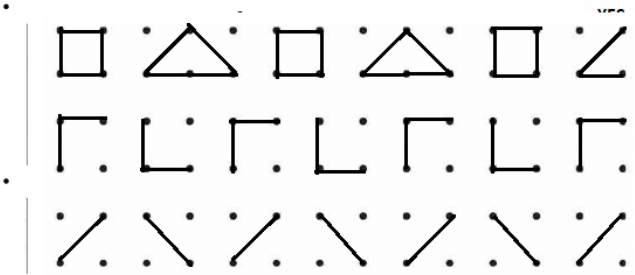
Ans: Try simple, repeated shapes made from the dots. For example:
• Make a zigzag line across the grid by joining alternate dots.
• Make a square spiral by joining dots to form a small square, then a larger square around it, and so on.
• Make a symmetric design by drawing the same pattern on the left and right of a middle line.
Colour each repeated unit the same way so the pattern looks clear and neat.
Question 2: Using the square paper given below, draw some patterns of your own choice. Don't forget to colour the patterns:
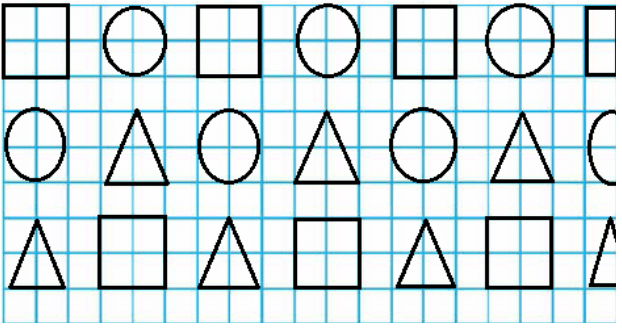
Ans: Use the squares to make repeated shapes. For example:
• Colour alternate squares to make a checkerboard pattern.
• Make diagonal stripes by colouring the squares along each diagonal the same way.
• Make a staircase pattern by colouring 1 square in the first row, 2 squares in the next, 3 in the next, and so on.
Use two or three colours and repeat the same small design across the paper to form a pattern.
Question 3: Observe and write what comes next:

Question 4: Identify the rule and write the next four numbers for each pattern:
- 119, 128, 137, 146, 155, 164, 173, 182.
- 100, 95, 90, 85, 80, 75, 70, 65.
- 1, 1, 2, 3, 5, 8, 13, 21, 34, 55.
- 9999, 9898, 9797, 9696, 9595, 9494, 9393, 9292.
- 5, 10, 20, 40, 80, 160, 320, 640.
Ans:
119, 128, 137, 146, 155, 164, 173, 182.
Explanation: Add 9 each time. 146 + 9 = 155, then +9 → 164, +9 → 173, +9 → 182.
100, 95, 90, 85, 80, 75, 70, 65.
Explanation: Subtract 5 each time. 85 - 5 = 80, then -5 → 75, -5 → 70, -5 → 65.
1, 1, 2, 3, 5, 8, 13, 21, 34, 55.
Explanation: This is the Fibonacci-type rule for young learners: each number is the sum of the two before it. 5 + 8 = 13, 8 + 13 = 21, 13 + 21 = 34, 21 + 34 = 55.
9999, 9898, 9797, 9696, 9595, 9494, 9393, 9292.
Explanation: Subtract 101 each time (or see it as tens and units decreasing by 1 while thousands and hundreds stay the same pattern). 9696 - 101 = 9595, and so on.
5, 10, 20, 40, 80, 160, 320, 640.
Explanation: Multiply by 2 each time. 40 × 2 = 80, 80 × 2 = 160, 160 × 2 = 320, 320 × 2 = 640.
Question 5: Extend the following patterns:
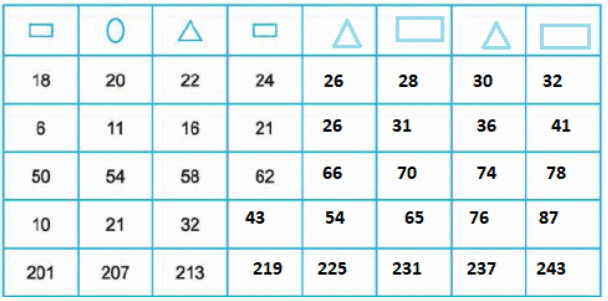
Question 6: Fill in the blanks:
- AC, BD, CE, DF, EG, FH.
- 212 - 210, 456 - 460, 374 - 370, 645 - 647.
212 - 210 = 2. 456 - 460 = - 4. 374 - 370 = 4. 645 - 647 = -2.
- 5, 6, 8, 11, 15, 20, 26.
- A98, 887, C76, 065, E54
- 901, 802, 703, 604, 505
Ans:
1) AC, BD, CE, DF, EG, FH.
Explanation: Both letters move forward by one in each pair. The first letters go A → B → C → D → E → F and the second letters go C → D → E → F → G → H.
2) 212 - 210 = 2; 456 - 460 = -4; 374 - 370 = 4; 645 - 647 = -2.
Explanation: Subtract the second number from the first. If the first is smaller, the result is negative (for example 645 - 647 = -2).
3) 5, 6, 8, 11, 15, 20, 26.
Explanation: The gaps increase by 1 each time: +1 (5→6), +2 (6→8), +3 (8→11), +4 (11→15), +5 (15→20), +6 (20→26).
4) A98, B87, C76, D65, E54. (Given entry C76 is correct.)
Explanation: The letters go A, B, C, D, E (each next letter), and the two-digit numbers fall by 11 each time: 98, 87, 76, 65, 54. The given form C76 fits this rule.
5) 901, 802, 703, 604, 505.
Explanation: The hundreds digit decreases by 1 each time (9, 8, 7, 6, 5) while the last two digits increase 01, 02, 03, 04, 05. So 901 → 802 → 703 → 604 → 505.
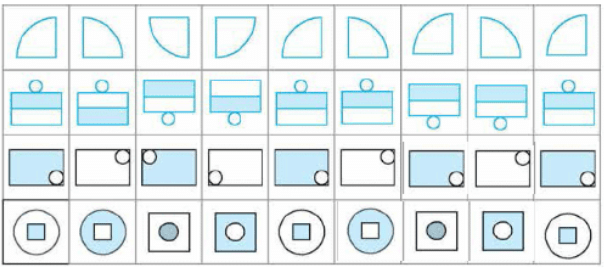
Question 7: Draw the next figures that follow the pattern:
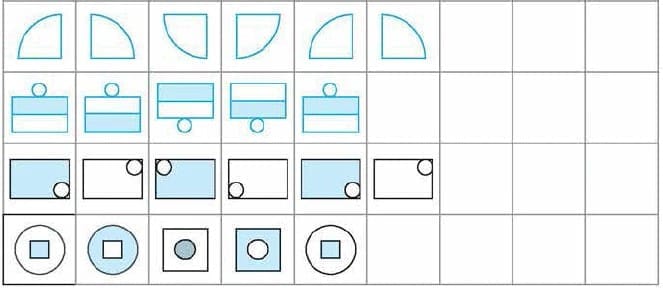
Ans:
FAQs on Worksheet Solution: Shapes and Patterns
| 1. What are the basic shapes covered in shapes and patterns worksheets? |  |
| 2. How do shapes and patterns help in early childhood education? | |
| 3. What activities can be included in a shapes and patterns worksheet? | |
| 4. How can parents assist their children with shapes and patterns homework? | |
| 5. What is the importance of recognizing patterns in mathematics? | |