How to Prepare for Quantitative Aptitude for CAT


The QA section requires a lot of practise, so in order to free up more time for practising, you should use all small, straightforward techniques to increase speed and decrease errors.
- The Quantitative Ability section of CAT aims to test three things namely- numerical ability, mathematical skills and problem-solving skills.
- In general, the questions in the quantitative ability section of the CAT are related to elementary mathematics.
- In order to score good marks and clear the CAT cutoff, one needs to be completely acquainted with the fundamental concepts of solving questions.
- The purpose of this document is to help you understand how to read Quantitative Aptitude as a subject for not just CAT but also other B School entrances like SNAP, XAT, NMAT, etc., and understand how to tackle the QA Section in these exams.
All the toppers recommend the LPA strategy - Learn, Practice & Analyse to score the maximum marks in the QA section.
So, EduRev has made this Step-wise strategy for your complete preparation of the Quant section for CAT:
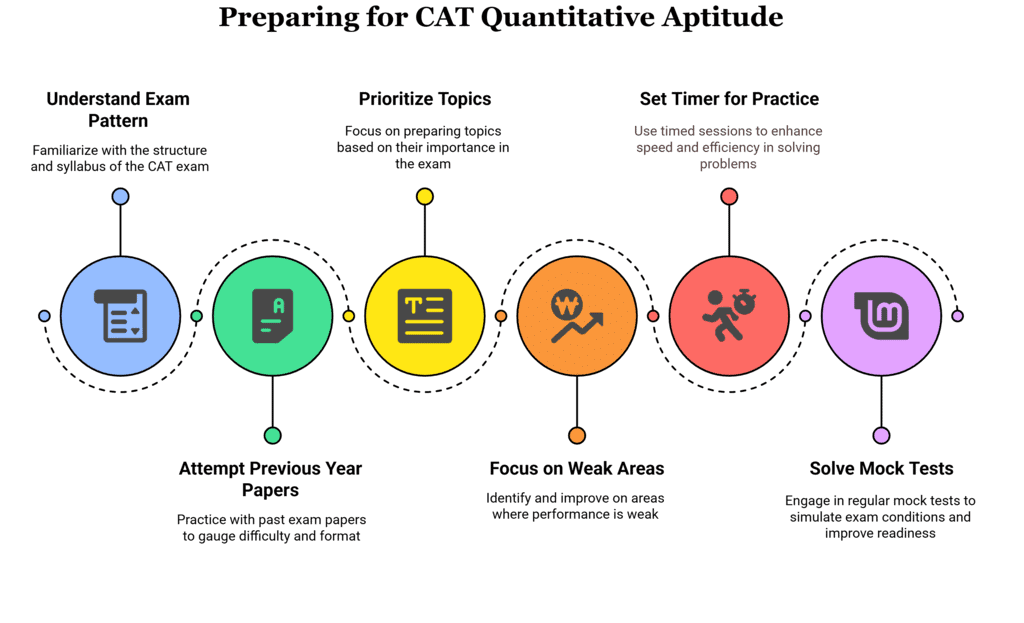
Step 0: Understand the Exam Pattern and Syllabus
Understanding what and how much to study is essential before you begin your preparation.
Understand Exam Pattern First: Typically, the CAT exam comprises around 66-68 questions in total. The QA section includes approximately 22 questions, out of which 6-8 may be TITA questions (without negative marking).
Recent Trends: IIMs have recently emphasised Arithmetic to promote academic diversity. Approximately:
7-9 questions come from Arithmetic
6-8 from Algebra
4-5 from topics like Geometry, Number Systems, and Modern Math
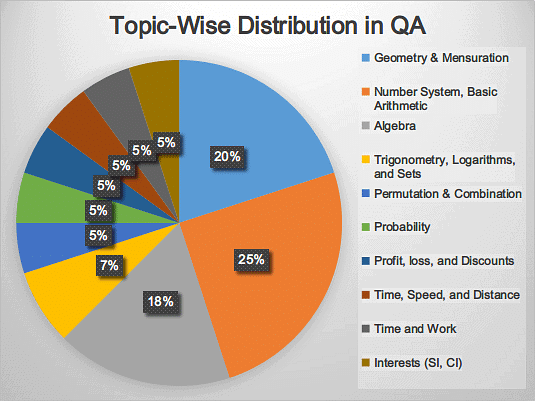
CAT Syllabus: Although CAT has no officially defined syllabus, the following broad topics are commonly tested:
- Algebra: Algebra, Linear Equations, Quadratic Equations, Inequalities, Functions, Progressions
- Arithmetic: Ratio and Proportion, Percentages, Profit and Loss, Interest (Simple and Compound), Mixtures and Allegations, Mixtures, Averages, Speed, Time, Distance, Pipes Cisterns & Time work.
- Number System:LCM and HCF, Number System, Logarithm, Surds and Indices
- Geometry: Trigonometry, Coordinate Geometry, Geometry/Mensuration
- Modern Math: Permutations and Combination, Probability, Set Theory
Step 1: Start with attempting Previous Year Papers

- It is highly recommended to attempt Previous Year Question Papers and Mock Tests for the first 2-3 weeks to understand the type of CAT questions, their composition, the subjects/topics that are being asked, and their format.
- Incorporating Topic-wise Past Year Questions for CAT into your preparation for Focused Practice, Identifying Weaknesses and Efficient Time Management.
EduRev Tip: Aim to complete 20-30 full-length mock tests by exam day.
Step 2: Prioritise the Important Topics

- Prioritise Fundamental Topics: Focus on essential areas such as Algebra, Linear Equations, Quadratic Equations, Ratio and Proportion, Averages, Speed, Time, Distance, LCM and HCF, Number System, and Geometry/Mensuration.
- Phased Study Approach: Split your preparation into three phases:
Master fundamentals
Practice extensively
Take regular mock tests
- Implement Time Management Strategies: Develop effective time management techniques to navigate each section efficiently during the exam.
Giving your learnings some time: You have to give time to what you have studied. It is not advised to read too much in one day. The concepts you study today take time to become natural to you while solving problems.
Step 2.1: Perfect your Concepts through Video Lectures & Detailed Notes
- Stick to one reliable source for notes and video lectures to understand topics clearly and from different angles. This helps you remember better and build strong basics.
- Keep revising regularly to boost confidence.
- If you're a beginner with time to spare, start with basic NCERT books to build your foundation.
Step 2.2: Work on Shortcut Techniques
- When preparing for the CAT Quantitative Ability section, the first challenge that often comes to mind is: How can I solve questions accurately within the limited time? To manage time effectively, it's crucial to develop strategies for solving questions both quickly and efficiently.
- This involves not only practising shortcuts and simplified methods but also knowing exactly which formulas to apply to different types of questions. Mastering this skill will help you improve both speed and accuracy under exam pressure.

Step 2.3: Practice topic-wise tests
- Once you're clear with the concepts, start solving questions-begin with easy ones and move to tougher problems.
- Use topic-wise tests on EduRev for focused practice in Arithmetic, Algebra, Geometry, Number Systems, and Modern Math.
Step 3: Focus on Weak Areas
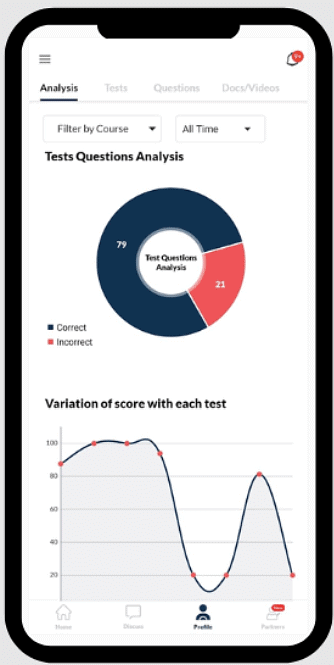
- After each test, analyse your performance to identify weak areas. Take a few sectional tests on EduRev focused on these topics. You'll start recognising which questions are easy, moderate, or difficult. EduRev's algorithm categorises them for you and shows whether you're spending too much time on tough questions or making mistakes on simpler ones.
- Each test comes with a detailed report comparing your accuracy and time with other students. This helps you improve both speed and precision. You can also track your progress using course and time filters.
- As the exam nears, practice higher-difficulty questions-but don't dwell on them if they remain tough. Focus instead on solving the easier ones quickly.
EduRev Tip: Read every question, even from weak topics-it might turn out to be simple. Skip only the truly time-consuming ones.
Step 4: Set a Timer for your Sectional Practice
- CAT gives you 40 minutes per section, so practice managing time while solving full sections.
- Aim to finish early and keep a 5-10 minute buffer for revision.
- CAT toppers recommend marking key questions and concepts for quick review in the final minutes.
- To practice sectional tests with a time limit for CAT, click here.
Step 5: Solve a lot of Full Mock Tests
Toppers recommend attempting 20-30 full-length mock tests to build stamina and familiarity. You'll face two types of questions:
Familiar questions - Solve these first.
Tricky ones - Attempt in the second round if time allows.
- CAT questions follow a consistent pattern each year, so regular practice helps you get used to the language and stay calm during the exam.
- Use EduRev's Mock Tests, which simulate the latest exam pattern and include auto-analysis of your speed and accuracy for continuous improvement.
Other Important Links:
1. Overall Understanding of Exam:
Check out these documents and prepare your strategy for CAT accordingly.
- CAT Syllabus 2026, Important topics & Changing trends of Exam
- Details about the CAT exam (Eligibility, Exam Pattern, Syllabus)
- How to Attempt CAT on D-Day
- How to Prepare for CAT with EduRev
- FAQs about CAT Exam
2. Check out Subject-Wise Strategies