Ancient History- Solved Questions (2013-2021)

Question 1:
From the declines of Guptas until the rise of Harshavardhana in the early seventh century, which of the following kingdoms were holding power in Northern India? [2021]
- The Guptas of Magadha
- The Paramaras of Malwa
- The Pushyabhutis of Thanesar
- The Maukharis of Kanauj
- The Yadavas of Devagiri
- The Maitrakas of Valabhi
Select the correct answer using the codes given below.
a) 1, 2 and 5
b) 1, 3, 4 and 6
c) 2, 3 and 4
d) 5 and 6
Question 2:
In reference to the history of ancient India, which of the following Statements is/are correct?
- Mitakshara was the civil law for upper castes and Dayabhaga was the civil law for lower castes.
- In the Mitakshara system, the sons can claim right to the property during the lifetime of the father, whereas in the Dayabhaga system, it is only after the death of the father that the sons can claim right to the property.
- The Mitakshara system deals with the matters related to the property held by male members only of a family, whereas the Dayabhaga system deals with the matters related to the property held by both male and female members of a family. [2021]
Select the correct answer using the codes given below.
a) 1 and 2
b) 2 Only
c) 1 and 3
d) 3 Only
Question 3:
Which one of the following ancient towns is well-known for its elaborate system of water harvesting and management by building a series of dams and channelizing water into connected reservoirs? [2021]
a) Dholavira
b) Kalibangan
c) Rakhigarhi
d) Ropar
Question 4:
Consider the following pairs: [2021]

a) 1 only
b) 1 and 2
c) 3 only
d) 2 and 3
Question 5:
With reference to the cultural history of India consider the following pairs: [2020-1]
1. Parivrajaka - Renunciant and Wanderer
2. Shramana - Priest with a high status
3. Upasaka - Lay follower of Buddhism
Which of the pairs given above are correctly matched?
(a) 1 and 2 only
(b) 1 and 3 only
(c) 2 and 3 only
(d) 1, 2 and 3
Question 6:
With reference to the period of the Gupta dynasty in ancient India, the towns Ghantasala, Kadura, and Chaul were well known as [2020-1]
(a) ports handling foreign trade
(b) capital of powerful kingdoms
(c) places of exquisite stone art and architecture
(d) important Buddhist pilgrimage centers
Question 7:
With reference to the history of India, consider the following pairs: [2020-I]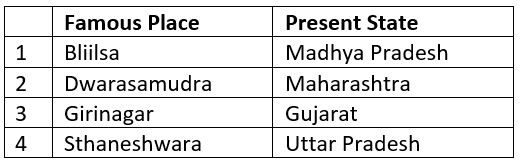
Which of the pairs given above are correctly matched?
(a) 1 and 3 only
(b) 1 and 4 only
(c) 2 and 3 only
(d) 2 and 4 only
Question 8:
Who among the following rulers advised his subjects through this inscription?: "Whosoever praises his religious sect or blames other sects out of excessive devotion to his own sect, with the view of glorifying his own sect, he rather injures his own sect very severely," [2020-1]
(a) Ashoka
(b) Samudragupta
(c) Harshavardhana
(d) Krishna Deva Raya
Question 9:
With reference to the history of India, the terms "kulyavapa" and "dronavapa" denote [2020-1]
(a) measurement of land
(b) coins of different monetary value
(c) classification of urban land
(d) religious rituals
Question 10:
Which of the following phrases defines the nature of the 'Hundi' generally referred to in the sources of the post-Harsha period? [2020-1]
(a) An advisory issued by the king to his subordinates
(b) A diary to be maintained for daily accounts
(c) A bill of exchange
(d) An order from the feudal lord to his subordinates
Question 11:
Consider the following events in the history of India: [2020-1]
1. Rise of Pratiharas under King Bhoja
2. Establishment of Pallava power under Mahendravarman - I
3. Establishment of Chola Parantaka - I
4. Pala dynasty founded by Gopala
What is the correct chronological order of the above events, starting from the earliest time?
(a) 2-1-4-3
(b) 3-1-4-2
(c) 2-4-1-3
(d) 3-4-1-2
Question 12:
With reference to the religious history of India, consider the following statements: [2020-1]
1. Sthaviravadins belong to Mahayana Buddhism.
2. Lokottaravadin sect was an offshoot of the Mahasanghika sect of Buddhism.
3. The deification of Buddha by Mahasangliikas fostered Mahayana Buddhism.
Which of the statements given above are correct?
(a) 1 and 2 only
(b) 2 and 3 only
(c) 3 only
(d) 1, 2 and 3
Question 13:
With reference to the scholars/litterateurs of ancient India, consider the following statements: [2020-1]
1. Panini is associated with Pushyamitra Shunga
2. Amarasimha is associated with Harshavardhana
3. Kalidasa is associated with Chandra Gupta-II
Which of the statements given above is/are correct?
(a) 1 and 2 only
(b) 2 and 3 only
(c) 3 only
(d) 1, 2 and 3
Question 14:
With reference to the cultural history of India, which one of the following is the correct description of the term 'paramitas'? [2020-I]
(a) The earliest Dharmashastra texts were written in aphoristic (sutra) style.
(b) Philosophical schools that did not accept the authority of Vedas.
(c) Perfections whose attainment led to the Bodhisattva path
(d) Powerful merchant guilds of early medieval South India.
Question 15:
Building 'Kalyana Mandapas' was a notable feature in the temple construction in the kingdom of [2019-I]
(a) Chalukya
(b) Chandela
(c) Rashtrakuta
(d) Vijayanagara
Correct Answer is Option (d)
Vijayanagara School: More than one mandap was built in each temple. The central mandap came to be known as Kalyan Mandap.
Question 16:
With reference to forced labor (Vishti) in India during the Gupta period, which one of the following statements is correct? [2019-I]
(a) It was considered a source of income for the State, a sort of tax paid by the people.
(b) It was totally absent in the Madhya Pradesh and Kathiawar regions of the Gupta Empire.
(c) The forced laborer is entitled to weekly wages.
(d) The eldest son of the laborer was sent as the forced laborer.
Question 17:
Consider the following : [2019-I]
1. Deification of the Buddha
2. Treading the path of Bodhisattvas
3. Image worship and rituals
Which of the above is/ are the feature/ features of Mahayana Buddhism?
(a) 1 only
(b) 1 and 2 only
(c) 2 and 3 only
(d) 1, 2 and 3
Question 18:
In which of the following relief sculpture inscriptions is 'Ranyo Ashoka' (King Ashoka) mentioned along with the stone portrait of Ashoka? [2019-I]
(a) Kanganahalli
(b) Sanchi
(c) Shahbazgarhi
(d) Sohgaura
Question 19:
Which one of the following is not a Harappan Site? [2019-I]
(a) Chanhudaro
(b) Kot Diji
(c) Sohagaura
(d) Desalpur
Question 20:
Consider the following pairs of Tradition vs State: [2018 - I]
1. Chapchar Kut festival: Mizoram
2. Khongjom Parba ballad: Manipur
3. Thang-Ta dance: Sikkim
Which of the pairs given above is/are correct?
(a) 1 only
(b) 1 and 2
(c) 3 only
(d) 2 and 3
Question 21:
Consider the following pairs Craft vs Heritage of [2018 - I]
1. Puthukkuli shawls: Tamil Nadu
2. Sujni embroidery: Maharashtra
3. Uppada Jamdani saris: Karnataka
Which of the pairs given above is/are correct?
(a) 1 only
(b) 1 and 2
(c) 3 only
(d) 2 and 3
Question 22:
With reference to Indian history, who among the following is a future Buddha, yet to come to save the world? [2018 - I]
(a) Avalokiteshvara
(b) Lokesvara
(c) Maitreya
(d) Padmapani
Question 23:
With reference to the religious practices in India, the "Sthanakvasi" sect belongs to(Pre18 Set-D) [2018 - I]
(a) Buddhism
(b) Jainism
(c) Vaishnavism
(d) Shaivism
Question 24:
Which one of the following was a very important seaport in the Kakatiya kingdom? [2017-I]
(a) Kakinada
(b) Motupalli
(c) Machilipatnam (Masulipatnam)
(d) Nelluru
Question 25:
With reference to the difference between the culture of Rigvedic Aryans and Indus Valley people, which of the following statements is/are correct? [2017-I]
1. Rigvedic Aryans used the coat of mail and helmet in warfare whereas the people of Indus Valley Civilization did not leave any evidence of using them.
2. Rigvedic Aryans knew gold, silver, and copper whereas Indus Valley people knew only copper and iron.
3. Rigvedic Aryans had domesticated the horse whereas there is no evidence of Indus Valley people having been aware of this animal. Select the correct answer using the code given below:
(a) 1 only
(b) 2 and 3 only
(c) 1 and 3 only
(d) 1, 2 and 3
Question 26:
Which of the following is/are famous for Sun temples? [2017-I]
1. Arasavalli
2. Amarkantak
3. Omkareshwar
Select the correct answer using the code given below:
(a) 1 only
(b) 2 and 3 only
(c) 1 and 3 only
(d) 1, 2 and 3
Question 27:
The painting of Bodhisattva Padmapani is one of the most famous and oft-illustrated paintings at [2017-I]
(a) Ajanta
(b) Badami
(c) Bagh
(d) Ellora
Question 28:
With reference to the religious history of India, consider the following statements: [2017-I]
1. Sautrantika and Sammitiya were the sects of Jainism.
2. Sarvastivadin held that the constituents of phenomena were not wholly momentary but existed forever in a latent form.
Which of the statements given above is/are correct?
(a) 1 only
(b) 2 only
(c) Both 1 and 2
(d) Neither 1 nor 2
Question 29:
In the context of the history of India, consider the following pairs: [2016-I]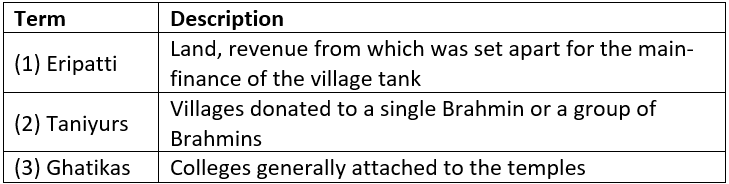
Which of the pairs given above is/are correctly matched?
(a) 1 and 2
(b) 3 only
(c) 2 and 3
(d) 1 and 3
Question 30:
Which one of the following books of ancient India has the love story of the son of the founder of the Sunga dynasty? [2016-I]
(a) Swapnavasavadatta
(b) Malavikagnirnitra
(c) Meghadoota
(d) Ratnavali
Question 31:
With reference to the art and archaeological history of India, which one among the following was made earliest? [2015-I]
(a) Lingaraja Temple at Bhubneshwar
(b) Rock-cut Elephant at Dhauli
(c) Rock-cut Monuments at Mahabalipuram
(d) Varaha Image at Udayagiri
Question 32:
Which of the following Kingdoms were associated with the life of the Buddha? [2014 - I]
1. Avanti
2. Gandhara
3. Kosala
4. Magadha
Select the correct answer using the code given below.
(a) 1, 2 and 3
(b) 2 and 4.
(c) 3 and 4 only
(d) 1, 3 and 4
Question 33:
The national motto of India, 'Satyameva Jayate' inscribed below the Emblem of India is taken from [2014 - I]
(a) Katha Upanishad
(b) Chandogya Upanishad
(c) Aitareya Upanishad
(d) Mundaka Upanishad
Question 34:
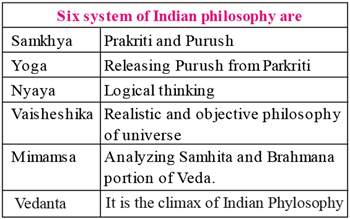
Which one of the following pairs does not form part of the six systems of Indian Philosophy? [2014 - I]
(a) Mimamsa and Vedanta
(b) Nyaya and Vaisheshika
(c) Lokayata and Kapalika
(d) Sankhya and Yoga
Question 35:
With reference to Buddhist history, tradition, and culture in India, consider the following pairs: [2014 - I]
Which of the pairs given above is/are correctly matched?
(a) 1 only
(b) 2 and 3 only
(c) 1 and 3 only
(d) 1, 2 and 3
Question 36:
With reference to the Indian history of art and culture, consider the following pairs: [2014 - I]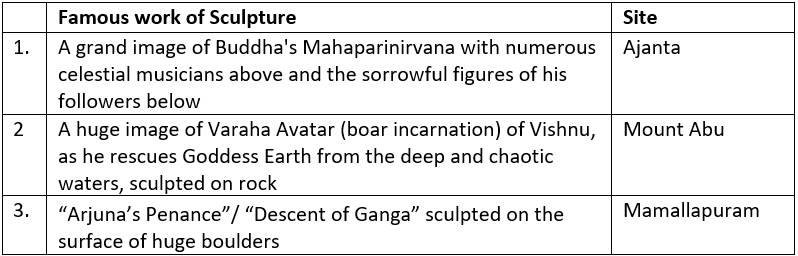
Which of the pairs given above is/are correctly matched?
(a) 1 and 2 only
(b) 3 only
(c) 1 and 3 only
(d) 1, 2 and 3
Question 37:
Consider the following historical places: [2013 - I]
1. Ajanta Caves
2. Lepakshi Temple
3. Sanchi Stupa
Which of the above places is/are also known for mural paintings?
(a) 1 only
(b) 1 and 2 only
(c) 1, 2 and 3
(d) None
Question 38:
In the context of the cultural history of India, a pose in dance and dramatics called 'Tribhanga' has been a favorite of Indian artists from ancient times till today. Which one of the following statements best describes this pose? [2013 - I]
(a) One leg is bent and the body is slightly but oppositely curved at the waist and neck
(b) Facial expressions, hand gestures, and make-up are combined to symbolize certain epic or historic characters
(c) Movements of body, face, and hands are used to express oneself or to tell a story
(d) A little smile, a slightly curved waist, and certain hand gestures are emphasized to express the feelings of love or eroticism.
Question 39:
The Chinese traveler Yuan Chwang (Hiuen Tsang) who visited India recorded the general conditions and culture of India at that time. In this context, which of the following statements is/are correct? [2013 - I]
1. The roads and river routes were completely immune from robbery.
2. As regards punishment for offenses, ordeals by fire, water, and poison were the instruments for determining the innocence or guilt of a person.
3. The tradesmen had to pay duties at ferries and barrier stations.
Select the correct answer using the codes given below.
(a) 1 only
(b) 2 and 3 only
(c) 1 and 3 only
(d) 1, 2 and 3
Question 40:
With reference to the history of Indian rock-cut architecture, consider the following statements: [2013 - I]
1. The caves at Badami are the oldest surviving rock-cut caves in India.
2. The Barabar rock-cut caves were originally made for Ajivikas by Emperor Chandragupta Maurya.
3. At Ellora, caves were made for different faiths.
Which of the statements given above is/are correct?
(a) 1 only
(b) 2 and 3 only
(c) 3 only
(d) 1, 2 and 3
FAQs on Ancient History- Solved Questions (2013-2021)
| 1. Which ancient Indian empires appear most frequently in UPSC exams based on previous year questions? |  |
| 2. What are the most common topics asked about Ashoka in UPSC Ancient History questions? | |
| 3. How do I identify which ancient civilisations to prioritise for UPSC based on question patterns? | |
| 4. Why do questions about Gupta period administration and culture come up so often in UPSC exams? | |
| 5. What specific trade routes and economic systems should I focus on for UPSC Ancient History solved questions? | |





