Question 1: With reference to the cultural history of India, consider the following statements :(Pre18 Set-D) [2018-I] 1. White marble was used in making Buland Darwaza and Khankah at Fatehpur Sikri. 2. Red sandstone and marble were used in making Ilara Imambara and Rumi Darwaza at Lucknow. Which of the statements given above is/are correct? (a) 1 only (b) 2 only (c) Both 1 and 2 (d) Neither 1 nor 2
Solution:
Correct Answer is Option (d)
Buland Darwaza:
Located in Fatehpur Sikri, it was constructed in 1602 A.D. by the Mughal emperor Akbar to celebrate his victory over Gujarat.
The structure is built from red and buff sandstone, featuring intricate carvings and inlays of white and black marble.
While the Mughals typically used red sandstone in their buildings, this is noted as incorrect according to the official UPSC answer key.
Bara Imambara:
This impressive structure was built by Asaf-ud-Daula, the Nawab of Awadh, in 1784 and is situated in Lucknow.
The entire building is unique as there is no woodwork anywhere in its design.
The roof is constructed using interlocking bricks without the support of beams or girders.
Rumi Darwaza:
Also built in 1784 by Nawab Asaf-ud-Daula, this gateway is located in Lucknow.
The darwaza is made from bricks and is covered with lime for finishing.
Question 2: Regarding the taxation system of Krishna Deva, the ruler of Vijayanagar, consider the following statements: [2016-I] 1. The tax rate on land was fixed depending on the quality of the land. 2. Private owners of workshops paid an industries tax. Which of the statements given above is/are correct? (a) 1 only (b) 2 only (c) Both 1 and 2 (d) Neither 1 nor 2
Solution:
Correct Answer is Option (c)
The rulers of the Vijayanagara Empire had a strict and heavy taxation policy.
The wealth of the empire can be understood through their taxation practices.
The main source of income during the Vijayanagara period was the land tax.
Under the rule of Krishna Devaraya, the land tax rate was set between one-third and one-sixth, depending on the quality of the land. Therefore, this statement is correct.
In addition to land tax, there were also taxes on various groups such as shopkeepers, farm workers, laborers, posters, shoemakers, and musicians.
Taxes were also levied on grazing and houses.
There were commercial taxes that included levies, duties, and customs on goods that were traded.
Private owners of workshops were required to pay an industry tax. Hence, this statement is also correct.
Question 3: With reference to the cultural history of medieval India, consider the following statements : [2016-I] 1. Siddhas (Sitters) of the Tamil region were monotheistic and condemned idolatry. 2. Lingayats of the Kannada region questioned the theory of rebirth and rejected the caste hierarchy. Which of the statements given above is/are correct? (a) 1 only (b) 2 only (c) Both 1 and 2 (d) Neither 1 nor 2
Solution:
Correct Answer is Option (c)
Almost all the Siddhas believed in the idea of the oneness of all creation, which means they practiced monotheism. They taught a philosophy based on love and service and criticized idolatry. Therefore, this statement is correct.
Most of the Siddhas' songs were written in a special language known as the twilight language.
Basavanna is recognized as the founder of Lingayatism and opposed the strict rules of the caste system.
Basavanna (1106-1168) was a Brahmana and served as a minister in the court of a ruler from the Kalachuri dynasty.
His followers were called Virashaivas (which means heroes of Shiva) or Lingayats (those who wear the linga).
The Lingayats believed in the idea that there is no rebirth. When a devotee dies, they unite with Shiva and do not return to the physical world.
Consequently, the Lingayats in the Kannada region challenged the belief in rebirth and rejected the caste hierarchy. Therefore, this statement is also correct.
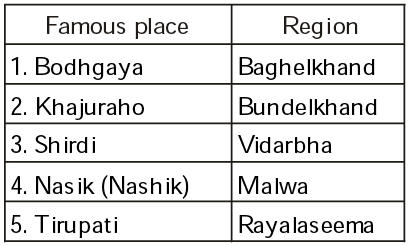
Question 4: Consider the following pairs: [2016-I]
Which of the pairs given above are correctly matched? (a) 1, 2 and 4 (b) 2, 3, 4 and 5 (c) 2 and 5 only (d) 1, 3, 4 and 5
Solution:
Correct Answer is Option (c) Khajuraho is located in the Bundelkhand region of Madhya Pradesh. Tirupati is located in the Rayalaseema region.
Question 5: With reference to the cultural history of India, the memorizing of chronicles, dynastic histories, and Epic tales was the profession of who of the following? [2016-I] (a) Shramana (b) Parivraaj (c) Agrahaarika (d) Magadha
Solution:
Correct Answer is Option (d) The Magadha and the suttas were associated with memorizing chronicles, dynastic histories, and Epic tales.
Question 6: With reference to the economic history of medieval India, the term Araghatta' refers to [2016-I] (a) bonded labor (b) land grants made to military officers (c) waterwheel used in the irrigation of land (d) wasteland converted to cultivated land
Solution:
Correct Answer is Option (c) The Persian wheel is a mechanical water lifting device operated usually by draught animals like bullocks, buffaloes, or camels. It is used to lift water from water sources typically open wells. In Sanskrit, the word Araghatta has been used in ancient texts to describe the Persian Wheel. The 'araghatta' comes from the combination of the words 'ara' meaning spoke and 'ghatta' meaning pot.
Question 7: What is/are common to the two historical places known as Ajanta and Mahabalipuram? [2016-I] 1. Both were built in the same period. 2. Both belong to the same religious denomination. 3. Both have rock-cut monuments. Select the correct answer using the code given below. (a) 1 and 2 only (b) 3 only (c) 1 and 3 only (d) None of the statements given above is correct
Solution:
Correct Answer is Option (b) The first and second statements are wrong because Ajanta (Buddhist caves) was built from the 2nd Century BCE to 5th Century CE, while Mahabalipuram (Hindu temple) was built during the 7-8th Centuries by Pallava Kings. The third statement is correct- both are rock-cut monuments.
Question 8: With reference to the religious history of India, consider the following statements : [2016-I] 1. The concept of Bodhisattva is central to the Hinayana sect of Buddhism. 2. Bodhisattva is a compassionate one on his way to enlightenment. 3. Bodhisattva delays achieving his own salvation to help all sentient beings on their path to it. Which of the statements given above is/are correct? (a) 1 only (b) 2 and 3 only (c) 2 only (d) 1, 2 and 3
Solution:
Correct Answer is Option (b) The concept of Bodhisattva is central to the Mahayana doctrines of Buddhism. The term 'bodhisattva' literally means 'one who has enlightenment as his/her essence'. A bodhisattva is a being who is destined for enlightenment rather than one who has gained it already. A bodhisattva is also normally thought of as consciously working towards enlightenment: you can't call someone a bodhisattva just because they might be enlightened in the future if they haven't started making an effort yet. For this reason, the earliest use of the term 'bodhisattva' refers to Siddhartha Gautama before he gained enlightenment, and also in his previous lives. Thus, Boddhisattva is central to the Mahayana sect of Buddhism. Hence the first statement is wrong. While 2nd and 3rd are correct.
Question 9: Who of the following had first deciphered the edicts of Emperor Ashoka? [2016-I] (a) Georg Buehler (b) James Prinsep (c) Max Muller (d) William Jones
Solution:
Correct Answer is Option (b) In 1837, British archeologist and historian James Prinsep decoded the edicts of emperor Ashoka. Prinsep's inscription proved to be a series of edicts issued by a king calling himself "Beloved-of-the-Gods, King Piyadasi."
Question 10: Banjaras during the medieval period of Indian history were generally [2016-I] (a) agriculturists (b) warriors (c) weavers (d) traders
Solution:
Correct Answer is Option (d) In India, Banjara people were transporters of goods from one place to another and the goods they transported included salt, grains, firewood, and cattle.Thus, Banjaras were trader-nomads.
Question 11: Who of the following founded a new city on the south bank of a tributary to river Krishna and undertook to rule his new kingdom as the agent of a deity to whom all the land south of the river Krishna was supposed to belong? [2015-I] (a) Amoghavarsha I (b) Ballala II (c) Harihara I (d) Prataparudra II
Solution:
Correct Answer is Option (c) Vijayanagara or "city of victory" was the name of both a city and an empire. The empire was founded in the fourteenth century. In its heyday, it stretched from the river Krishna in the north to the extreme south of the peninsula, (Krishna-Tungabhadra doab). It was founded by Harihara 1 and Bukka, in 1336.
Question 12: Consider the following: [2015-I] The arrival of Babur into India led to the 1. introduction of gunpowder in the subcontinent 2. introduction of the arch and dome in the region's architecture 3. establishment of the Timurid dynasty in the region Select the correct answer using the code given below. (a) 1 and 2 only (b) 3 only (c) 1 and 3 only (d) 1, 2 and 3
Solution:
Correct Answer is Option (b) In the fourteenth and fifteenth century gun powder was used for military purposes in India and even artillery in its rudimentary form was known. The Babur's first real expedition took place in India in 1519 when he captured Bhera. The Delhi Sultanate's greatest contribution to Indian fine arts was the introduction of Islamic architectural features, including true domes and arches, and the integration of Indian and Islamic styles of architecture. The Timurid dynasty was a Sunni Muslim dynasty. Members of the Timurid dynasty were strongly influenced by the Persian culture and had established two well-known empires in history, namely the Timurid Empire (1370-1507) in Persia and Central Asia and the Mughal Empire (1526-1857) in the Indian subcontinent.
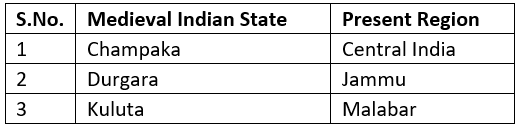
Question 13: Consider the following pairs: [2015-I] Which of the above pairs is/are correctly matched? (a) 1 and 2 (b) 2 only (c) 1 and 3 (d) 1 and 3 Only
Solution:
Correct Answer is Option (b) States such as Champaka (Chamba), Durgara (Jammu), Trigarta (Jalandhar), Kuluta (Kulu), Kumaon, and Garhwal managed to remain outside the main areas of conflict in the northern plains.
Question 14: In medieval India, the designations 'Mahattara' and 'Pattakila' were used for [2014 - I] (a) military officers (b) village headmen (c) specialists in Vedic rituals (d) chiefs of craft guilds
Solution:
Correct Answer is Option (b) In medieval India, the designations 'Mahattara' and 'Pattakila' were used for village headmen.
Question 15: Ibadat Khana at Fatehpur Sikri was [2014 - I] (a) the mosque for the use of Royal Family (b) Akbar's private prayer chamber (c) the hall in which Akbar held discussions with scholars of various religions (d) the room in which the nobles belonging to different religions gathered to discuss religious affairs
Solution:
Correct Answer is Option (c) Ibadat Khana at Fatehpur Sikri was the hall in which Akbar held discussions with scholars of various religions every Thursday to debate on religious issues raised by Akbar.
Question 16: Consider the following Bhakti Saints: [2013 - I] 1. Dadu Dayal 2. Guru Nanak 3. Tyagaraja Who among the above was/were preaching when the Lodi dynasty fell and Babur took over? (a) 1 and 3 (b) 2 only (c) 2 and 3 (d) 1 and 2
Solution:
Correct Answer is Option (b) Guru Nanak Dev was born in 1469. Babur defeated Ibrahim Lodi in 1526. When Babur took over and established the Mughal dynasty, Nanak was traveling to different parts of India and preaching Sikhism. Babur once met Guru Nanak during one of his travel.
Question 17: With reference to the religious history of medieval India, the Sufi mystics were known to pursue which of the following practices? [2012 - I] 1. Meditation and control of breath 2. Severe ascetic exercises in a lonely place 3. Recitation of holy songs to arouse a state of ecstasy in their audience Select the correct answer using the codes given below:
(a) 1 and 2 only (b) 2 and 3 only (c) 3 only (d) 1, 2 and 3
Solution:
Correct Answer is Option (d)
All statements are accurate, so option (d) is the right choice.
Sufism is a mystical branch of Islam that emphasizes the spiritual quest for God and avoids materialistic pursuits.
The practices of Sufism include:
A strong focus on love and devotion towards God.
The use of music and dance as forms of expression for devotees.
Meditation and breath control techniques.
The practice of Sama, a musical performance aimed at creating a state of mystical ecstasy.
A disciple, known as a Murīd, must experience various stages by engaging in spiritual exercises in solitude.
Question 18: With reference to Dhrupad, one of the major traditions of India that has been kept alive for centuries, which of the following statements are correct? [2012 - I] 1. Dhrupad originated and developed in the Rajput kingdoms during the Mughal period. 2. Dhrupad is primarily devotional and spiritual music. 3. Dhrupad Alap uses Sanskrit syllables from Mantras. Select the correct answer using the codes given below: (a) 1 and 2 only (b) 2 and 3 only (c) 1, 2, and 3 (d) None of the above is correct
Solution:
Correct Answer is Option (b) Dhrupad is primarily spiritual and devotional music and it uses Sanskrit syllables from mantras.
Question 19: Why did Buddhism start declining in India in the early medieval times? [2010] 1. Buddha was by that time considered as one of the incarnations of Vishnu and thus became a part of Vaishnavism. 2. Invading tribes from Central Asia till the time of last Gupta king adopted Hinduism and persecuted Buddhists. 3. Kings of the Gupta dynasty were strongly opposed to Buddhism. Which of the statements given above is/are correct? (a) 1 only (b) 1 and 3 only (c) 2 and 3 only (d) 1, 2 and 3
Solution:
Correct Answer is Option (a) Buddha was considered the 9th incarnation of Vishnu. No tribe from Central Asia persecuted Buddhists. The Gupta dynasty did not oppose Buddhism. However, they did not give them patronage.
Question 20: Among the following, who was not a proponent of the Bhakti cult? [2010] (a) Nagarjuna (b) Tukaram (c) Tyagaraja (d) Vallabhacharya
Solution:
Correct Answer is Option (a) Nagarjuna was an early philosopher and was the founder of the Madhyamika philosophy.
Question 21: With whose permission did the English set up their first factory in Surat? [2009] (a) Akbar (b) Jahangir (c) Shahjahan (d) Aurangzeb
Solution:
Correct Answer is Option (b) James-I William Hawkins was sent to the court of Jahangir and Jahangir provided the Farman which allowed East India Co. to set up a factory at Surat in 1613.
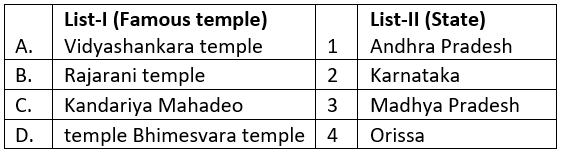
Question 22: Match List-I with List-II and select the correct answer using the code given below the lists: [2009] (a) A - 2; B - 4; C - 3; D - 1 (b) A - 2; B - 3; C - 4; D - 1 (c) A - 1; B - 4; C - 3; D - 2 (d) A - 1; B - 3; C - 4; D - 2
Question 23: Where is the famous Virupaksha temple located? [2009] (a) Bhadrachalam (b) Chidambaram (c) Hampi (d) Srikalahasti
Solution:
Correct Answer is Option (c) The oldest temple in Hampi (Pattadkal) is located on the southern bank of the river Tungabhadra. It is now a World Heritage site. It was built by Lokamahadevi, the Queen of Vikramaditya II (A.D.733-745) in about A.D.740 to commemorate her husband's victory over the Pallavas of Kanchipuram.
Question 24: During the time of which Mughal Emperor did the English East India Company establish its first factory in India? [2008] (a) Akbar (b) Jahangir (c) Shahjahan (d) Aurangzeb
Solution:
Correct Answer is Option (b) William Hawkins visited the court of Jahangir and received a Farman which allowed East India Company to set up their first factory at Surat in 1613.
Question 25: Where is the famous Vijaya Vittala temple having its 56 carved pillars emitting musical notes located? [2007] (a) Belur (b) Bhadrachalam (c) Hampi (d) Srirangam
Solution:
Correct Answer is Option (c) Vijaya Vittala temple is located at Hampi, the capital of Vijayanagar kingdom during the reign of Krishnadev Raya.
Question 26: In Indian history, who was Abdul Hamid Lahori? [2006] (a) An important military commander during Akbar's reign. (b) An official historian of the reign of Shahjahan. (c) An important noble and confidant of Aurangzeb. (d) A chronicler and poet during the reign of Muhammad Shah.
Solution:
Correct Answer is Option (b) Abdul Hamid Lahori (d. 1654) was a traveler during the period of Shahjahan who later became a court historian of Shahjahan. He wrote the book Padshah Nama also referred to as Badshah Nama, about the reign of Shahjahan.
Question 27: Bhakta Tukaram was a contemporary of which Mughal emperor? [2006] (a) Babar (b) Akbar (c) Jahangir (d) Aurangzeb
Solution:
Correct Answer is Option (c) The best answer is c as Tukaram (1608-1650) was a Marathi Bhakti poet and a devotee of Lord Krishna. The time period of Jahangir was 1605-1627.
Question 28: Which one of the following is the correct chronological order of the Afghan rulers to the throne of Delhi? [2006] (a) Sikandar Shah-Ibrahim Lodi-Bahlol Khan Lodi (b) Sikandar Shah-Bahlol Khan Lodi-Ibrahim Lodi (c) Bahlol Khan Lodi-Sikandar Shah-Ibrahim Lodi (d) Bahlol Khan Lodi-Ibrahim Lodi-Sikandar Shah
Solution:
Correct Answer is Option (c) Bahlol (1451-1489); Sikandar (1489-1517); Ibrahim (1517-1526)
Question 29: Assertion (A): Muhammad bin Tughlaq issued a new gold coin which was called Dinar by Ibn Battuta. Reason (R): Muhammad bin Tughlaq wanted to issue token currency in gold coins to promote trade with West Asian and North African countries. [2006] (a) Both A are R are true but R is the correct explanation of A (b) Both A and R are true but R is not a correct explanation of A (c) A is true but R is false (d) A is false but R is true
Solution:
Correct Answer is Option (c) A is correct but R is wrong as he issued bronze coins as the token currency which was a great fiasco.
Question 30: In the year 1613, where was the English East India Company given permission to set up a factory (trading post)? [2006] (a) Bangalore (b) Madras (c) Masulipattam (d) Surat
Solution:
Correct Answer is Option (d) In 1612 Sir Thomas Roe visited Mughal Emperor Jahangir to arrange for a commercial treaty that would give the company exclusive rights to reside and build factories in Surat and other areas. In return, the company offered to provide the Emperor with goods and rarities from the European market. Jahangir accepted the proposal and the company created trading posts in Surat (where a factory was built in 1613), Madras (1639), Bombay (1668), and Calcutta (1690).
Question 31: When Raja Wodeyar founded the kingdom of Mysore, who was the ruler of the Vijayanagar Empire? [2006] (a) Sadasiva (b) Tirumala (c) Ranga II (d) Venkata II
Solution:
Correct Answer is Option (d) Indigenous chieftains from Karnataka rose to become the founders of a dynasty after a series of internal bickerings with other local chieftains. Vijaya and Krishna, two brothers were responsible for the establishment of this small feudatory state of the Vijayanagara Empire. Vijaya ascended the throne under the assumed name of Yaduraja in 1399 A.D. To begin with, this was a very small state containing only parts of the Mysore district. Mysore was the capital city.
Question 32: The initial design and construction of which massive temple took place during the reign of Suryavarman II? [2006] (a) Sri Mariamman Temple (b) Angkor Vat Temple (c) Batu Caves Temple (d) Kamakhya Temple
Solution:
Correct Answer is Option (b) Angkorvat temple is the first Hindu temple, dedicated to the god Vishnu. A Buddhist temple was built during the reign of Suryavarman II. It is the world's largest religious building.
Question 33: Consider the following statements about Sikh Gurus: [2004] 1. Banda Bahadur was appointed as the military leader of the Sikhs by Guru Tegh Bahadur. 2. Guru Arjun Dev became the Sikh Guru after Guru Ram Das. 3. Guru Arjun Dev gave to Sikhs their own script Guru Mukhi. Which of the statements given above is/are correct? (a) 1 only (b) 2 and 3 (c) 1 and 3 (d) 1 and 2
Solution:
Correct Answer is Option (b) Banda Bahadur was appointed as the military leader of the Sikhs by Guru Gobind Singh and not Guru Tegh Bahadur.
Question 34: How did the dynasty of Nizam Shahis of Ahmadnagar come to an end? [2004] (a) Ahmadnagar was annexed into the Mughal empire and Hussain Shah was given life imprisonment (b) Mughal troops destroyed Daulatabad fort and killed Nizam-ul Mulk of Ahmadnagar (c) Fateh Khan usurped the throne from Nizam-ul-Mulk (d) Malik Ambar was defeated in a battle with Mughals in 1631 and the entire royal family was killed by the Mughal troops
Solution:
Correct Answer is Option (a) Ahmadnagar was founded by Malik Ahmad of the Nizam Shahi dynasty in 1490. It was annexed by Shahjahan in 1633 into the Mughal Empire.
Question 35: Who was the last ruler of the Tughlaq dynasty of the Delhi Sultanate? [2004] (a) Firoz Shah Tughlaq (b) Ghiyas-ud-din Tughlaq Shah II (c) Nasir-ud-din Mahmud (d) Nasrat Shah
Solution:
Correct Answer is Option (c) Ghiyasuddin Tughlaq founded the Tughlaq dyn asty in 1320 AD (CE). Nasiruddin Mahmud was the last ruler of the Tughlaq dynasty (1395-1412 AD).
Question 36: Consider the following statements: [2004] 1. Narasimha Saluva ended the Sangama dynasty and seized the throne for himself and started the Saluva dynasty. 2. Vira Narasimha deposed the last Saluva ruler and seized the throne for himself. 3. Vira Narasimha was succeeded by his younger brother, Krishnadeva Raya. 4. Krishnadeva Raya was succeeded by his half-brother, Achyuta Raya. Which of the statements given above are correct? (a) 1, 2 and 3 (b) 2, 3 and 4 (c) 1 and 4 (d) 1, 2, 3 and 4
Solution:
Correct Answer is Option (d) Sangama dynasty was founded by Harihara-I. Saluva dynasty was founded by Narasimha Saluva by defeating Dev Rayua-II of the Sangama dynasty. Taluva dynasty was founded by Vira Narasimha and was succeeded by KD Raya and Achyuta Raya.
Question 37: Which one of the following sequences indicates the correct chronological order? [2004] (a) Shankaracharya-Ramanuja-Chaitanya (b) Ramanuja-Shankaracharya-Chaitanya (c) Ramanuja-Chaitanya-Shankaracharya (d) Shankaracharya-Chaitanya-Ramanuja
Solution:
Correct Answer is Option (a) The correct chronological order is Shankaracharya (9th Century CE) - Ramanuja (1017-1137 CE) - Chaitanya (1486-1533 CE)
Question 38: How did Sultan Qutb-ud-din Aibak die? [2003] (a) He was treacherously stabbed to death by one of his ambitious nobles (b) He was killed in a battle with Taj-u-din Yildiz, the ruler of Ghazni who entered into a contest with him over the capture of Punjab (c) He sustained injuries while besieging the fortress of Kalinjar in Bundelkhand and succumbed to them later (d) He died after a fall from his horse while playing Chaugan
Solution:
Correct Answer is Option (d) Qutbud-din Aibak died after a fall from his horse while playing chaugan (polo) in 1210. He was succeeded by Aram Shah. Qutbud-din Aibak was the founder of the first independent Turkish kingdom in Northern India in 1206.
Question 39: Consider the following statements: [2003] 1. Kitab-i-Nauras, a collection of songs in praise of Hindu deities and Muslim saints, was written by Ibrahim Adil Shah II 2. Amir Khusrau was the originator in India of the early form of the musical style known as Qawali Which of these statements is/are correct? (a) Only 1 (b) Only 2 (c) Both 1 and 2 (d) Neither 1 nor 2
Solution:
Correct Answer is Option (c) Ibrahim Adil Shah II was ruler of Bijapur and wrote Kitab-i-Nauras. Amir Khusrau is popularly known as the 'Father of Qawali' in India.
Question 40: How did the Mughal Emperor Jahandarshah's reign, come to an early end? [2003] (a) He was deposed by his Wazir (b) He died due to a slip while climbing down the steps (c) He was defeated by his nephew in a battle (d) He died of sickness due to drinking
Solution:
Correct Answer is Option (c) He was defeated by his nephew, Farrukh Siyyar with the help of the Sayyid Brothers.
Question 41: Battle of Dharmat was fought between [2003] (a) Muhammad Ghori and Jai Chand (b) Babur and Afghans (c) Aurangzeb and Dara Shikoh (d) Ahmad Shah Durrani and the Marathas
Solution:
Correct Answer is Option (c) The battle of Dharmat was fought between Aurangzeb and Dara Shikoh in 1658 for Shahjahan's throne. Dara Shikoh was defeated by Aurangzeb.
Question 42: Alam Khan, one of those who invited Babur to invade India was:[2003] (a)an uncle of Ibrahim Lodi and a pretender to the throne of Delhi (b)a cousin of Ibrahim Lodi who was ill-treated and expelled from the country (c)the father of Dilawar Khan to whom cruel treatment was meted out by Ibrahim Lodi (d)a high official in Punjab province who was discontented with Ibrahim Lodi's treatment of his tribe
Solution:
Correct Answer is Option (a) Alam Khan along with Daulat Khan Lodi invited Babur to India. In the first battle of Panipat in 1526, Ibrahim Lodi was defeated by Babur
Question 43: Directions: The following item consists of two statements: one labeled as the Assertion (A) and the other as Reason (R). You are to examine these two statements carefully and select the answers to these items using the codes given below: Assertion (A): Emperor Akbar marched towards Afghanistan in 1581 with a huge army. Reason (R): He was on his way to reclaim his ancestral country of Ferghana in Central Asia.[2003] (a) Both A and R are individually true but R is the correct explanation of A (b) Both A and R are individually true but R is not the correct explanation of A (c) A is true but R is false (d) A is false but R is true
Solution:
Correct Answer is Option (c) A is correct as Akbar marched towards Afghanistan in 1581 to conquer Kabul to expand his kingdom. R is incorrect as he had no intention to reclaim his ancestral country of Ferghana.
FAQs on Medieval History- Solved Questions (2003-2018)
1. What were the major causes of the decline of feudalism in medieval Europe?
Ans. The decline of feudalism in medieval Europe can be attributed to several factors: the growth of trade and commerce, which led to the rise of a wealthy merchant class; the impact of the Black Death, which significantly reduced the population and shifted the labor dynamics; the centralization of power by monarchs who sought to consolidate their authority; and the emergence of a more educated populace that began to challenge the traditional feudal order.
2. How did the Crusades influence medieval European society?
Ans. The Crusades had a profound impact on medieval European society by fostering increased trade between Europe and the East, leading to cultural exchanges and the introduction of new ideas, technologies, and goods. They also contributed to the rise of a more powerful monarchy as nobles spent their wealth on crusading efforts, weakening their local power. Additionally, the Crusades heightened religious fervor and conflict, which had lasting implications for Christian-Muslim relations.
3. What role did the Church play in medieval society?
Ans. The Church played a central role in medieval society as the primary institution of authority and governance. It provided spiritual guidance, education, and social services, and was a unifying force in a fragmented political landscape. The Church influenced laws and customs, owned vast lands, and wielded significant political power, often mediating disputes among nobles and monarchs. It also played a crucial role in the cultural life of the period, commissioning art and literature.
4. What were the characteristics of Gothic architecture in the medieval period?
Ans. Gothic architecture, which emerged in the late medieval period, is characterized by its use of pointed arches, ribbed vaults, and flying buttresses, allowing for taller structures and larger windows. This architectural style emphasized verticality and light, often featuring intricate stained glass windows that illuminated interiors with colorful light. Notable examples include cathedrals such as Notre-Dame in Paris and Chartres Cathedral, which showcase the grandeur and ambition of the Gothic style.
5. How did the Hundred Years' War affect France and England?
Ans. The Hundred Years' War (1337-1453) significantly affected both France and England. For France, it led to a sense of national identity and unity as they rallied against a common enemy, culminating in the rise of strong leadership figures like Joan of Arc. For England, the war drained resources and contributed to internal strife, eventually leading to the Wars of the Roses. The conflict also resulted in military innovations and changes in warfare, impacting the social and political landscape in both countries.
Medieval History- Solved Questions (2003-2018), Viva Questions, video lectures, MCQs, Summary, past year papers, pdf , ppt, Important questions, study material, mock tests for examination, Medieval History- Solved Questions (2003-2018), Free, Sample Paper, practice quizzes, Previous Year Questions with Solutions, Medieval History- Solved Questions (2003-2018), shortcuts and tricks, Extra Questions, Exam, Objective type Questions, Semester Notes;