Constitution & Political System - Solved Questions (2004-2016)

Question 1: The Parliament of India acquires the power to legislate on any item in the State List in the national interest if a resolution to that effect is passed by the [2016-I]
(a) Lok Sabha by a simple majority of its total membership
(b) Lok Sabha by a majority of not less than two-thirds of its total membership
(c) Rajya Sabha by a simple majority of its total membership
(d) Rajya Sabha by a majority of not less than two-thirds of its members present and voting
Question 2: The provisions in Fifth Schedule and Sixth Schedule in the Constitution of India are made in order to [2015-I]
(a) protect the interests of Scheduled Tribes
(b) determine the boundaries between States
(c) determine the powers, authority and responsibilities of Panchayats
(d) protect the interests of all the border States
Question 3: Who/Which of the following is the custodian of the Constitution of India? [2015-I]
(a) The President of India
(b) The Prime Minister of India
(c) The Lok Sabha Secretariat
(d) The Supreme court of India
Question 4: "To uphold and protect the Sovereignty, Unity and Integrity of India" is a provision made in the [2015-I]
(a) Preamble of the Constitution
(b) Directive Principles of State Policy
(c) Fundamental Rights
(d) Fundamental Duties
Question 5: The ideal of Welfare State' in the Indian Constitution is enshrined in its [2015-I]
(a) Preamble
(b) Directive Principles of State Policy
(c) Fundamental Rights
(d) Seventh Schedule
Question 6: Consider the following statements regarding the Directive Principles of State Policy: [2015-I]
1. The Principles spell out the socio-economic democracy in the country.
2. The provisions contained in these Principles are not enforceable by any court.
Which of the statements given above is / are correct?
(a) 1 only
(b) 2 only
(c) Both 1 and 2
(d) Neither 1 nor 2
Question 7: Which one of the following Schedules of the Constitution of India contains provisions regarding anti-defection? [2014 - I]
(a) Second Schedule
(b) Fifth Schedule
(c) Eighth Schedule
(d) Tenth Schedule
Question 8: In the Constitution of India, promotion of international peace and security is included in the [2014 - I]
(a) Preamble to the Constitution
(b) Directive Principles of State Policy
(c) Fundamental Duties
(d) Ninth Schedule
Question 9: With reference to Indian History, the Members of the Constituent Assembly from the Provinces were [2013 - I]
(a) directly elected by the people of those Provinces
(b) nominated by the Indian National Congress and the Muslim League
(c) elected by the Provincial Legislative Assemblies
(d) selected by the Government for their expertise in constitutional matters
Question 10: According to the Constitution of India, which of the following are fundamental for the governance of the country? [2013 - I]
(a) Fundamental Rights
(b) Fundamental Duties
(c) Directive Principles of State Policy
(d) Fundamental Rights and Fundamental Duties
Question 11: Consider the following statements: [2013 - I]
1. An amendment to the Constitution of India can be initiated by an introduction of a bill in the Lok Sabha only.
2. If such an amendment seeks to make changes in the federal character of the Constitution, the amendment also requires to be ratified by the legislature of all the
States of India.
Which of the statements given above is/are correct?
(a) 1 only
(b) 2 only
(c) Both 1 and 2
(d) Neither 1 nor 2
Question 12: Which of the following bodies does not/do not find mention in the Constitution? [2013 - I]
1. National Development Council
2. Planning Commission
3. Zonal Councils
Select the correct answer using the codes given below.
(a) 1 and 2 only
(b) 2 only
(c) 1 and 3 only
(d) 1, 2 and 3
Question 13: Consider the following statements: [2013 - I]
1. National Development Council is an organ of the Planning Commission.
2. The Economic and Social Planning is kept in the Concurrent List in the Constitution of India.
3. The Constitution of India prescribes that Panchayats should be assigned the task of preparation of plans for economic development and social justice.
Which of the statements given above is/are correct?
(a) 1 only
(b) 2 and 3 only
(c) 1 and 3 only
(d) 1, 2 and 3
Question 14: 'Economic Justice' as one of the objectives of the Indian Constitution has been provided in [2013 - I]
(a) the Preamble and the Fundamental Rights
(b) the Preamble and the Directive Principles of State Policy
(c) the Fundamental Rights and the Directive Principles of State Policy
(d) None of the above
Question 15: Consider the following provisions under the Directive Principles of State Policy as enshrined in the Constitution of India: [2012 - I]
1. Securing for citizens of India a uniform civil code
2. Organizing village Panchayats
3. Promoting cottage industries in rural areas
4. Securing for all the workers reasonable leisure and cultural opportunities
Which of the above are the Gandhian Principles that are reflected in the Directive Principles of State Policy?
(a) 1, 2 and 4 only
(b) 2 and 3 only
(c) 1, 3 and 4 only
(d) 1, 2, 3 and 4
Question 16: Which of the following special powers have been conferred on the Rajya Sabha by the Constitution of India? [2012 - I]
(a) To change the existing territory of a State and to change the name of a State
(b) To pass a resolution empowering the Parliament to make laws in the State List and to create one or more All India Services
(c) To amend the election procedure of the President and to determine the pension of the President after his/her retirement
(d) To determine the functions of the Election Commission and to determine the number of Election Commissioners
Question 17: Which of the following provisions of the Constitution of India have a bearing on Education? [2012 - I]
1. Directive Principles of State Policy
2. Rural and Urban Local Bodies
3. Fifth Schedule
4. Sixth Schedule
5. Seventh Schedule
Select the correct answer using the codes given below :
(a) 1 and 2 only
(b) 3, 4 and 5 only
(c) 1, 2 and 5 only
(d) 1, 2, 3, 4 and 5
Question 18: According to the Constitution of India, it is the duty of the President of India to cause to be laid before the Parliament which of the following? [2012 - I]
1. The Recommendations of the Union Finance Commission
2. The Report of the Public Accounts Committee
3. The Report of the Comptroller and Auditor General
4. The Report of the National Commission for Scheduled Castes
Select the correct answer using the codes given below :
(a) 1 only
(b) 2 and 4 only
(c) 1, 3 and 4 only
(d) 1, 2, 3 and 4
Question 19: Which of the following is/are among the Fundamental Duties of citizens laid down in the Indian Constitution? [2012 - I]
1. To preserve the rich heritage of our composite culture
2. To protect the weaker sections from social injustice
3. To develop the scientific temper and spirit of inquiry
4. To strive towards excellence in all spheres of individual and collective activity
Select the correct answer using the codes given below:
(a) 1 and 2 only
(b) 2 only
(c) 1, 3 and 4 only
(d) 1, 2, 3 and 4
Question 20: The distribution of powers between the Centre and the States in the Indian Constitution is based on the Act provided in the [2012 - I]
(a) Morley-Minto Reforms, 1909
(b) Montagu-Chelmsford Act, 1919
(c) Government of India Act, 1935
(d) Indian Independence Act, 1947
Question 21: Under the Constitution of India, which one of the following is not a fundamental duty ? [2011 - I]
(a) To vote in public elections
(b) To develop the scientific temper
(c) To safeguard public property
(d) To abide by the Constitution and respect its ideals
Question 22: With reference to the Constitution of India, consider the following: [2010]
1. Fundamental Rights
2. Fundamental Duties
3. Directive Principles of the State Policy
Which of the above provisions of the Constitution of India is/are fulfilled by the National Social Assistance Programme launched by the government of India?
(a) 1 only
(b) 3 only
(c) 1 and 3 only
(d) 1, 2 and 3
Question 23: Which one of the following Constitutional Amendments states that the total number of Ministers, including the Prime Minister, in the Council of Minister shall not exceed fifteen percent of the total number of members of the House of the People? [2009]
(a) 90th
(b) 91st
(c) 92nd
(d) 93rd
Question24: Which of the following is/are included in the Directive Principles of the State Policy? [2008]
1. Prohibition of traffic in human beings and forced labour
2. Prohibition of consumption except for medicinal purposes of intoxicating drinks and of other drugs which are injurious to health.
Select the correct answer using the code given below:
(a) 1 only
(b) 2 only
(c) Both 1 and 2
(d) Neither 1 nor 2
Question 25: Which Schedule of the Constitution of India contains: Special provisions for the administration and control of Scheduled Areas in several States? [2008]
(a) Third
(b) Fifth
(c) Seventh
(d) Ninth
Question 26: Under which one of the following Constitution Amendment Acts, four languages were added to the list of languages under the Eighth Schedule of the Constitution of India, thereby raising their number to 22? [2008]
(a) Constitution (Ninetieth Amendment) Act
(b) Constitution (Ninety-first Amendment) Act
(c) Constitution (Ninety-second Amendment) Act
(d) Constitution (Ninety-third Amendment) Act
Question 27: Which of the following Constitution Amendment Acts seeks that the size of the Councils of Ministers at the Centre and in a State must not exceed 15 per cent of the total number of members in the Lok Sabha and the total number of members of the Legislative Assembly of that State, respectively? [2007]
(a) 91st
(b) 93rd
(c) 95th
(d) 97th
Question 28: Which one of the following subjects is under the Union List in the Seventh Schedule of the Constitution of India ? [2006]
(a) Regulation of labour and safety in mines and oilfields
(b) Agriculture
(c) Fisheries
(d) Public Health
Question 29: What does the 104th Constitution Amendment Bill related to? [2006]
(a) Abolition of Legislative Councils in certain states.
(b) Introduction of dual citizenship for persons of Indian origin living outside India.
(c) Providing quota to socially and educationally backward classes in private educational institutions.
(d) Providing quota for religious minorities in the services under the central Government.
Question 30: Which one among the following commission was set up in pursuance of a definite provision under an Article of the Constitution of India? [2006]
(a) University Grants Commission
(b) National Human Rights Commission
(c) Election Commission
(d) Central Vigilance Commission
Question 31: Consider the following statements: [2006]
1. Free and compulsory education to the children of 6-14 years age-group by the State by the seventy-sixth Amendment to the Constitution of India.
2. Sarva Shiksha Abhiyan seeks to provide computer education even in rural areas.
3. Education was included in the Concurrent List by the Forty-second Amendment, 1976 to the Constitution of India'.
Which of the statements given above are correct?
(a) 1, 2 and 3
(b) 1 and 2
(c) 2 and 3
(d) 1 and 3
Question 32: Consider the following statements: [2005]
1. Part IX of the Constitution of India provisions for Panchyats and was inserted by the Constitution (Amendment) Act, 1992.
2. Part IX A of the Constitution of India contains provisions for Municipalities and the Article 243 Q envisages two types of Municipalities a Municipal Council and a Municipal Corporation for every State.
Which of the statements given above is/are correct?
(a) Only 1
(b) Only 2
(c) Both 1 and 2
(d) Neither 1 nor 2
Question 33: Consider the following statements: [2005]
1. Article 371 A to 371 I were inserted in the Constitution of India to meet regional demands of Nagaland, Assam, Manipur, Andhra Pradesh, Sikkim, Mizoram, Arunchal Pradesh and Goa.
2. Constitution of India and the United States of America envisage a dual policy (The Union and the States) but a single cititzenship.
3. A naturalized citizen of India can never be deprived of his citizenship.
Which of the statements given above is/are correct?
(a) 1, 2 and 3
(b) 1 and 3
(c) 3 only
(d) 1 only
Question 34: The Constitution (98th Amendment) Act is related to: [2005]
(a) empowering the centre to levy and appropriate service tax
(b) the Constitution of the National Judicial Commission
(c) readjustment of electoral constituencies on the basis of the population census 2001
(d) the demarcation of new boundaries between States.
Question 35: Consider the following statements: [2005]
1. The Constitution of India has 20 parts.
2. There are 390 Articles in the Constitution of India in all.
3. Ninth, Tenth, Eleventh and Twelfth Schedules were added to the Constitution of India by the Constitution (Amendment) Acts.
Which of the statements given above is/are correct?
(a) 1 and 2
(b) 2 only
(c) 3 only
(d) 1, 2 and 3
Question 36: Who among the following was the chairman of the Union Constitution Committee of the Constituent Assembly? [2005]
(a) B.R. Ambedkar
(b) J. B. Kripalani
(c) Jawaharalal Nehru
(d) Alladi Krishnaswami Ayyar
Question 37: Which one of the following statements correctly describes the Fourth Schedule of the Constitution of India? [2004]
(a) It contains the scheme of the distribution of powers between the Union and the States
(b) It contains the languages listed in the Constitution
(c) It contains the provisions regarding the administration of tribal areas
(d) It allocates seats in the Council of States
Question 38: Which one of the following Articles of the Constitution of India says that the executive power of every State shall be so exercised as not to impede or prejudice the exercise of the executive power of the Union? [2004]
(a) Article 257
(b) Article 258
(c) Article 355
(d) Article 358
Question 39: Match List I (Articles of the Constitution of India) with List II (Provision) and select the correct answer using the codes given below the lists: [2004]
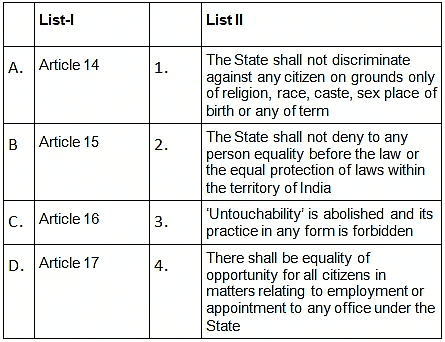
(a) A-2, B-4, C-1, D-3
(b) A-3, B-1, C-4, D-2
(c) A-2, B-1, C-4, D-3
(d) A-3, B-4, C-1, D-2
Question 40: Which Article of the Constitution of India says, 'No child below the age of fourteen years shall the employed to work in any factory or mine or engaged in any other hazardous employment'? [2004]
(a) Article 24
(b) Article 45
(c) Article 330
(d) Article 368
FAQs on Constitution & Political System - Solved Questions (2004-2016)
| 1. What are the key features of the Indian Constitution? |  |
| 2. How does the Indian political system ensure the separation of powers? | |
| 3. What role do fundamental rights play in the Indian Constitution? | |
| 4. What is the significance of the Directive Principles of State Policy in India? | |
| 5. How are amendments to the Indian Constitution made? | |





