Q1: Consider the following statements: (2025) I. Panchayats at the intermediate level exist in all States. II. To be eligible to be a Member of a Panchayat at the intermediate level, a person should attain the age of thirty years. III. The Chief Minister of a State constitutes a commission to review the financial position of Panchayats at the intermediate levels and to make recommendations regarding the distribution of net proceeds of taxes and duties, leviable by the State, between the State and Panchayats at the intermediate level. Which of the statements given above are not correct? (a)I and II only (b)II and III only (c)I and III only (d)I, II and III
Solution:
Ans: (d)
Statement I: "Panchayats at the intermediate level exist in all States.": Incorrect. According to Article 243B of the Constitution, the intermediate level of Panchayats is required only in states having a population of more than 20 lakhs. Smaller states are not mandated to have Panchayats at the intermediate level.
Statement II: "To be eligible to be a Member of a Panchayat at the intermediate level, a person should attain the age of thirty years.": Incorrect. As per Article 243F, the minimum age to contest Panchayat elections is 21 years, unless a higher age is prescribed by the state legislature. However, there is no general requirement of 30 years.
Statement III: "The Chief Minister of a State constitutes a commission to review the financial position of Panchayats...": Incorrect. Under Article 243I, it is the Governor of the state who constitutes the State Finance Commission every five years to review the financial position of the Panchayats and make recommendations. All the statements are not correct.
Q2: Which of the following statements are correct about the Constitution of India? (2024)
1. Powers of the Municipalities are given in Part IX A of the Constitution. 2. Emergency provisions are given in Part XVIII of the Constitution. 3. Provisions related to the amendment of the Constitution are given in Part XX of the Constitution. Select the answer using the code given below: (a) 1 and 2 only (b) 2 and 3 only (c) 1 and 3 only (d) 1, 2 and 3
Solution:
Ans: (d)
Statement 1: "Powers of the Municipalities are given in Part IX A of the Constitution" : Correct.
Part IX-A (Articles 243P to 243ZG) was added by the 74th Constitutional Amendment Act, 1992.
It deals with the Municipalities - their constitution, composition, powers, and responsibilities.
Statement 2: "Emergency provisions are given in Part XVIII of the Constitution" : Correct.
Part XVIII (Articles 352 to 360) contains provisions related to:
National Emergency (Article 352)
President's Rule/State Emergency (Article 356)
Financial Emergency (Article 360)
Statement 3: "Provisions related to the amendment of the Constitution are given in Part XX of the Constitution": Correct.
Part XX consists of only one Article - Article 368, which provides the procedure for amending the Constitution.
Q3: Consider the following statements in the context interventions being undertaken under Anaemia Mukt Bharat Strategy: (2023)
It provides prophylactic calcium supplementation for pre-school children, adolescents and pregnant women.
It runs a campaign for delayed cord clamping at the time of child-birth.
It provides for periodic deworming to children and adolescents.
It addresses non-nutritional causes of anaemia in endemic pockets with special focus on malaria, hemoglobinopathies and fluorosis.
How many of the statements given above are correct? (a) Only one (b) Only two (c) Only three (d) All four
Solution:
Ans: (c) Interventions of Anaemia Mukt Bharat:
Not Prophylactic calcium supplementation but Prophylactic Iron and Folic Acid Supplementation is provided to children, adolescents and women of reproductive age and pregnant women irrespective of anemia. Hence, statement 1 is not correct.
Appropriate Infant and Young Child Feeding (IYCF) with emphasis on adequate and age-appropriate complementary foods for children 6 months and above. Increase intake of iron-rich, protein-rich and vitamin C-rich foods through dietary diversification/quantity/frequency and food fortification
Promoting practice of delayed cord clamping (by atleast 3 minutes or until cord pulsations cease) in all health facility deliveries followed by early initiation of breastfeeding within 1 hour of birth. Hence, statement 2 is correct.
Bi-annual mass deworming for children in the age groups between 1-19 years is carried out every year under National Deworming Day (NDD) programme. Hence, statement 3 is correct.
The Anemia Mukt Bharat, also integrates deworming of women of reproductive age and for pregnant women as part of the NDD strategy.
Addressing non-nutritional causes of anemia in endemic pockets, with special focus on malaria, haemoglobinopathies and fluorosis. Hence, statement 4 is correct.
Q4: With reference to Scheduled Areas in India, consider the following statements: (2023)
Within a State, the notification of an area as Scheduled Area takes place through an Order of the President.
The largest administrative unit forming the Scheduled Area is the District and the lowest is the cluster of villages in the Block.
The Chief Ministers of the concerned States are required to submit annual reports to the Union Home Ministry on the administration of Scheduled Areas in the States.
How many of the above statements are correct? (a) Only one (b) Only two (c) All three (d) None
Solution:
Ans: (b)
The term "Scheduled Areas" are those that are scheduled as such by a Presidential Order under Paragraph 6 (1) of the Fifth Schedule, which states: "In this Constitution, the expression 'Scheduled Areas' means such areas as the President may by order declare to be "Scheduled Areas".
The specification of "Scheduled Areas" in relation to a State is by a notified order of the President, after consultation with the State Government concerned. The same applies in the case of any alteration, increase, decrease, incorporation of new areas, or rescinding any Orders relating to "Scheduled Areas". Hence, statement 1 is correct.
The largest administrative unit forming the scheduled areas has been the district and the lowest the cluster of villages in the block. Hence, statement 2 is correct.
The Governor of each State having Scheduled Areas therein shall annually, or whenever so required by the President, make a report to the President regarding the administration of the Scheduled Areas in that State and the executive power of the Union shall extend to the giving of directions to the State as to the administration of the said areas. Hence, statement 3 is not correct.
Q5 : Consider the following statements in relation to Janani Suraksha Yojana: (2023)
It is a safe motherhood intervention of the State Health Departments.
Its objective is to reduce maternal and neonatal mortality among poor pregnant women.
It aims to promote institutional delivery among poor pregnant women.
Its objective includes providing public health facilities to sick infants up to one year of age.
How many of the statements given above are correct? (a) Only one (b) Only two (c) Only three (d) All four
Solution:
Ans: (b) Janani Suraksha Yojana:
The Yojana, launched on 12th April 2005, is being implemented in all states and UTs with special focus on low performing states.
It is a safe motherhood intervention under the National Rural Health Mission (NRHM). Hence, statement 1 is not correct.
It was implemented with the objective of reducing maternal and neo-natal mortality by promoting institutional delivery among the poor pregnant women. Hence, statements 2 and 3 are correct.
Providing public health facilities to sick infants up to one year of age is not an objective of the scheme. Hence, statement 4 is not correct.
Q6: With reference to Ayushman Bharat Digital Mission, consider the following statements:(2022)
Private and public hospitals must adopt it.
As it aims to achieve universal, health coverage, every citizen of India should be part of it ultimately.
It has seamless portability across the country.
Which of the statements given above is/are correct? (a) 1 and 2 only (b) 3 only (c) 1 and 3 only (d) 1, 2 and 3
Solution:
Ans: (b)
Ayushman Bharat is a flagship scheme of the country, which was launched as per the recommendation of National Health Policy 2017 to achieve the vision of Universal Health Coverage (UHC). Under Ayushman Bharat Digital Mission, citizens will be able to get their Ayushman Bharat health account number, which can be linked to their digital health records.
Participation in ABDM is voluntary including for citizens. Participation of a healthcare facility or an institution is also voluntary and shall be taken by the respective management (government or private management). However, once the management decides to register the respective healthcare facility/institution in ABDM, it is essential for all the healthcare professionals serving the said facility/institution to register in Healthcare Professionals Registry so that the institution can become fully integrated with the National Digital Health Ecosystem (NDHE). Hence, both statements 1 and 2 are not correct.
Ayushman Bharat Digital Mission will have a national footprint and will enable seamless portability across the country through a Health ID - Personal Health Identifier, with supporting blocks, including adoption of Health Information Standards will play a pivotal role in national portability. Hence, statement 3 is correct.
Q7: With reference to the funds under Members of Parliament Local Area Development Scheme(MPLADS), which of the following statements are correct? [2020-I] 1. MPLADS funds must be used to create durable assets like physical infrastructure for health, education etc., 2. A specified portion of each MP's fund must benefit SC/ST populations 3. MPLADS funds are sanctioned on yearly basis and the unused funds cannot be carried forward to the next year. 4. The district authority must inspect at least 10% of all works under implementation every year Select the correct answer using the code given below: (a) 1 and 2 only (b) 3 and 4 only (c) 1, 2 and 3 only (d) 1, 2 and 4 only
Solution:
Correct Answer is Option (d)
15 percent of MPLADS funds are to be utilized for areas inhabited by SC population and 7.5 per cent for areas inhabited by ST population. So, #2 is correct. b eliminated.
The funds released under the Scheme are nonlapsable, i.e., the entitlement of funds not released in a particular year is carried forward to the subsequent years, subject to eligibility. So, #3 is wrong. Upon reading the official guidelines page 34: District Authority would inspect at least 10% of the works under implementation every year. So, #4 is right answer therefore Answer is d.
Q8: Consider the following statements about particularly Vulnerable Tribal Groups (PVTGs) in India: [2019 - I] 1. PVTGs reside in 18 states and one union Territory. 2. A stagnant or declining population is one of the criteria for determining PVTG status.
3. There are 92 PVTGs officially notified in the country so far. 4. Irular and Konda Reddi tribes are included in the list of PVTGs. Which of the statements given above are correct? (a) 1,2 and 3 (b) 2,3 and 4 (c) 1, 2 and 4 (d) 1,3 and 4
Solution:
Correct Answer is Option (c)
75 tribal groups have been categorized categorized by Ministry of Home Affairs as Particularly Vulnerable Tribal Groups (PVTG)s. PVTGs reside in 18 States and UT of A&N Islands. Says Tribal Ministry website. So, #1 is right but #3 is wrong. This eliminates all options except c.
Q9: Consider the following statements: [2019 - I]
1. The United Nations Convention against Corruption (UNCAC) has a "protocol against the smuggling of Migrants by Land, Sea and Air".
2. The UNCAC is the ever-first legally binding global anti-corruption instrument.
3. A highlight of the United Nations Convention against Transnational organized Crime (UNTOC) is the inclusion of a specific chapter aimed at returning assets to their rightful owners from whom they had been taken illicitly.
4. The United Nations office on Drugs and Crime (UNODC) is mandated by its member states to assist in the implementation of both UNCAC and UNTOC. Which of the following statements given above are correct?
(a) 1 and 3 only (b) 2, 3 and 4 only (c) 2 and 4 only (d) 1, 2, 3 and 4
Solution:
Correct Answer is Option (c) United Nations Convention against Corruption is the only legally binding universal anti-corruption instrument. So, #2 is right, this eliminates A. Upon checking the official webpages of UNTOC and UNCAC, it's evident that #3 is not related with UNTOC but UNCAC. So, #3 is wrong. So, by elimination, we are left with answer c.
Q10: As per the Industrial Employment (Standing Orders) Central (Amendment) Rules, 2018: [2019 - I]
1. If rules for fixed-term employment are implemented, it becomes easier for the firms/companies to lay off workers
2. No notice of termination of employment shall be necessary in the case of temporary workman Which of the following statements given above is/are correct
(a) 1 only (b) 2 only (c) Both 1 and 2 (d) Neither 1 nor 2
Solution:
Correct Answer is Option (c)
2018-March: Indian Express: As per the the Industrial Employment (Standing Orders) Central (Amendment) Rules, 2018:
No workman employed on fixed term employment basis shall be entitled to any notice or pay, if his services are terminated by non-renewal of contract. So, #1 is right.
No notice of termination of employment shall be necessary in the case of temporary workman. So, #2 is right. Answer C: both correct.
Q11: Consider the following statements: [2019 - I]
1. As per law, the Compensatory Afforestation Fund Management and Planning Authority exists at both National and State levels.
2. People's participation is mandatory in the compensatory afforestation programmes carried out under the Compensatory Afforestation Fund Act, 2016.
Which of the statements given above is/are correct? (a) 1 only (b) 2 only (c) Both 1 and 2 (d) Neither 1 nor 2
Solution:
Correct Answer is Option (a)
This act establishes the National and State Compensatory Afforestation Fund Management and Planning Authorities to manage the National and State Funds. But, in the bare act there is no mention of mandatory People's participation so, #2 is wrong. Thus answer A: only 1 correct.
Q12: Consider the following statements: [2016-I]
1. The minimum age prescribed for any person to be a member of Panchayat is 25 years.
2. A Panchayat reconstituted after premature dissolution continues only for the remainder period. Which of the statements given above is/are correct? (a) 1 only (b) 2 only (c) Both 1 and 2 (d) Neither 1 nor 2
Solution:
Correct Answer is Option (b)
This question can be directly solved from Disha publication's Polity compendium, page P-121.
The minimum age to contest Panchayat elections is 21 years.
2nd statement is correct.
Q13: Rashtriya Garima Abhiyaan' is a national campaign to [2016-I]
(a) rehabilitate the homeless and destitute persons and provide them with suitable sources of livelihood (b) release the sex workers from their practice and provide them with alternative sources of livelihood (c) eradicate the practice of manual scavenging and rehabilitate the manual scavengers (d) release the bonded labourers from their bondage and rehabilitate them
Solution:
Correct Answer is Option (c)
It is a campaign for eradication of inhuman practice of manual scavenging and comprehensive rehabilitation of manual scavengers in India. Ashif Shaikh is well known for his role in the campaign (Rashatriya Garima Abhiyan) through various campaigns of Jan Sahas.
Rashtriya Garima Abhiyaan is an NGO-led movement for manual scavengers.
Q14: The fundamental object of Panchayati Raj system is to ensure which among the following ? [2015 - I] (1) People's participation in development (2) Political accountability (3) Democratic decentralization (4) Financial mobilization Select the correct answer using the code given below. (a) 1, 2 and 3 only (b) 2 and 4 only (c) 1 and 3 only (d) 1, 2, 3 and 4
Solution:
Correct Answer is Option (c)
Financial mobilization is not the fundamental objective of PRls. Even though Panchayats have the powers to collect revenue.
Political accountability refers to the responsibility or obligation of government officials (both politicians and civil servants) to act in the best interests of society or face consequences.
Q15: Under the Scheduled Tribes and Other Traditional Forest Dwellers (Recognition of Forest Rights) Act, 2006 who shall be the authority to initiate the process for determining the nature and extent of individual or community forest rights or both? [2013 - I] (a) State Forest Department (b) District Collector / Deputy Commissioner (c) Tahsildar / Block Development Officer / Mandal Revenue Officer (d) Gram Sabha
Solution:
Correct Answer is Option (d)
Section C of the Forest Dwellers Act provides a transparent three step procedure for deciding on who gets rights. Firstly, the Gram Sabha makes a recommendation- i.e, who has been cultivating land for how long, which minor forest produce is collected; etc. The Gram Sabha plays this role because it is a public body where all people participate and hence is fully democratic and transparent. The Gram Sabha's recommendation goes through two stages of screening committees- the Taluka and the District levels.
Q16: The Government enacted the Panchayat Extension to Scheduled Areas (PESA) Act in 1996. Which one of the following is not identified as its objective? [2013 - I] (a) To provide self-governance (b) To recognize traditional rights (c) To create autonomous regions in tribal areas (d) To free tribal people from exploitation
Solution:
Correct Answer is Option (d)
The salient feature of the Panchayats (Extension to the Scheduled Areas) Act, 1996 (PESA) and the modalities worked out to grant rights to tribals in the country are:
Legislation on Panchayats shall be in conformity with the customary law, social and religious practices and traditional management practices of community resources;
Habitation or a group of habitations or a hamlet or a group of hamlets comprising a community and managing its affairs in accordance with traditions and customs; and shall have a separate Gram Sabha.
Every Gram Sabha to safeguard and preserve the traditions and customs of people, their cultural identity, community resources and the customary mode of dispute resolution.
Q17: Consider the following statements: [2013 - I] The parliamentary Committee on public accounts 1. consists of not more than 25 Members of the Lok Sabha 2. scrutinizes appropriation and finance accounts of the Government 3. examines the report of the Comptroller and Auditor General of India.
Which of the statements given above is/are correct? (a) 1 only (b) 2 and 3 only (c) 3 only (d) 1, 2 and 3
Solution:
Correct Answer is Option (b)
At present the Public Accounts committee consists of 22 members (15 from the Lok Sabha and 7 from the Rajya Sabha. The function of the committee is
To examine the annual audit reports of the comptroller and auditor general of India (CAG), which are laid before the Parliament by the President.
To examine the appropriation accounts and the finance accounts of the Union government and any other accounts laid before the Lok-Sabha.
Q18: In the areas covered under the Panchayat (Extension to the Scheduled Areas) Act, 1996, what is the role/power of Gram Sabha? [2012 - I]
1. Gram Sabha has the power to prevent alienation of land in the Scheduled Areas.
2. Gram Sabha has the ownership of minor forest produce.
3. Recommendation of Gram Sabha is required for granting prospecting licence or mining lease for any mineral in the Scheduled Areas.
Which of the statements given above is/are correct?
(a) 1 only (b) 1 and 2 only (c) 2 and 3 only (d) 1, 2 and 3
Solution:
Correct Answer is Option (b)
Recommendation of Gram sabha or Panchayat at the appropriate level shall be mandatory for grant of prospecting licence or mining lease for minor minerals (not for any minerals) in the sheduled areas. Therefore statement 3 is false.
Q19: Consider the following statements: [2011 - I] In India, a Metropolitan Planning Committee: 1. is constituted under the provisions of the Constitution of India. 2. prepares the draft development plans for metropolitan area. 3. has the sole responsibility for implementing Government sponsored schemes in the metropolitan area. Which of the statements given above is/are correct? (a) 1 and 2 only (b) 2 only (c) 1 and 3 only (d) 1, 2 and 3
Solution:
Correct Answer is Option (a)
Article 243ZE - Committee on Metropolitan Planning does not have a sole responsibility for implementing Government sponsored schemes in metropolitan area. Metropolitan planning committee is constituted under the provisions of the constitution of India.
According to the constitution of India, every Metropolitan area shall have a Metropolitan planning committee to prepare a draft development plan.
Q20: The Constitution (Seventy-Third Amendment) Act, 1992, which aims at promoting the Panchayati Raj Institutions in the country, provides for which of the following? [2011 - I]
1. Constitution of District Planning Committees.
2. State Election Commissions to conduct all panchayat elections.
3. Establishment of State Finance Commission.
Select the correct answer using the codes given below: (a) 1 only (b) 1 and 2 only (c) 2 and 3 only (d) 1, 2 and 3
Solution:
Correct Answer is Option (c)
District planning committee comes under 74th Amendment not in 73rd Amendment.
Q21: If a Panchayat is dissolved, elections are to be held within: [2009] (a) 1 month (b) 3 months (c) 6 months (d) 1 year
Solution:
Correct Answer is Option (c)
Duration of Panchayats is five year. Fresh election to constitute a Panchayat shall be completed before the expiry of its term; or in case of dissolution fresh election is to be conducted before the expiry of a period of 6 months from the date of its dissolution.
Q22: In India, the first Municipal Corporation was set up in which one among the following? [2009]
(a) Calcutta (b) Madras (c) Bombay (d) Delhi
Solution:
Correct Answer is Option (b)
In 1688, the first Municipal Corporation of India was set up in Madras.
Q23: Consider the following statements: [2007] 1. The nation-wide scheme of the National Child Labour Projects (NCLP) is run by the Union Ministry of Social Justice and Empowerment. 2. Gurupadswamy Committee dealt with the issues of child labour. Which of the statements given above is/are correct? (a) 1 only (b) 2 only (c) Both 1 and 2 (d) Neither 1 nor 2
Solution:
Correct Answer is Option (b)
National Child Labour Project (NCLP) Scheme was launched by the government of India in 1988 for rehabilitation of Child Labour.The scheme focuses on
All the child labours below the age of 14 yeas, identified in the target area.
All the adolescent labours below the age of 18 years, occupied in hazardous occupations or processes.
Families of such children mentioned in the above points. Gurupadaswamy Committee dealt with the issues of child labour.
Q24: Consider the following statements: [2006]
1. There is no provision in the Constitution of India to encourage equal pay for equal work for both men and women. 2. The Constitution of India does not define backward classes. Which of the statement(s) given above is/are correct? (a) I only (b) 2 only
(c) Both I and 2 (d) Neither I nor 2
Solution:
Correct Answer is Option (b)
Statement 1 is incorrect as equal pay for equal work for both men and women is provided under Article 39(d) in Directive Principles of the State Policy under Part IV of the Constitution. Under Article - 340 of the Indian constitution, it is obligatory for the government to promote the welfare of the other Backward classes (OBC) .
Q25: Consider the following: [2005] 1. Disputes with mobile cellular companies 2. Motor accident cases 3. Pension cases For which of the above are Lok Adalats held? (a) 1 only (b) 1 and 2 (c) 2 only (d) 1, 2 and 3
Solution:
Correct Answer is Option (d)
National Legal Services Authority (NALSA) along with other Legal Services Institutions conducts Lok Adalats. Lok Adalat is one of the alternative dispute redressal mechanisms, it is a forum where disputes / cases pending in the court of law or at pre-litigation stage are settled / compromised amicably. Lok Adalats have been given statutory status under the Legal Services Authorities Act, 1987. Under the said Act, the award (decision) made by the Lok Adalats is deemed to be a decree of a civil court and is final and binding on all parties and no appeal against such an award lies before any court of law. If the parties are not satisfied with the award of the Lok Adalat though there is no provision for appeal against such an award, but they are free to initiate litigation by approaching the court of appropriate jurisdiction by filling a case by following the required procedure, in exercise of their right to litigate.
Q26:
Assertion (A): The Central Rural Sanitation Programme was launched in 1986 to improve the quality of life of rural people in India.
Reason (R): Rural sanitation is a subject in the Concurrent List in the Constitution of India. In the context of above two statements, which one of the following is correct? [2004] (a) Both A and R are individually true and R is the correct explanation of A. (b) Both A and R are individually true but R is not the correct explanation of A. (c) A is true but R is false. (d) A is false but R is true
Solution:
Correct Answer is Option (c) Rural sanitation is not a subject in the Concurrent List. Public Health and Sanitation comes under the State List. Personal and food hygiene have been major cause of many diseases in developing countries. It was in this context that the central Rural Sanitation Programmer (CRSP) was launched in 1986.
Q27: With reference to Indian public finance, consider the following statements: [2004]
1. Disbursements from Public Accounts of India are subject to the Vote of the Parliament
2. The Indian Constitution provides for the establishment of a Consolidated Fund, a Public Account and a Contingency Fund for each State
3. Appropriations and disbursements under the Railway Budget are subject to the same form of parliamentary control as other appropriations and disbursements Which of the statements given above are correct? (a) 1 and 2 (b) 2 and 3 (c) 1 and 3 (d) 1, 2 and 3
Solution:
Correct Answer is Option (b)
The Indian Constitution provides for the establishment of a Consolidated Fund and a Public Account under Article 266 and a Contingency Fund for each State under Article
267. Disbursements from Public Accounts of India are not subject to a Vote of Parliament.
Q28: The Archaeological Survey of India is an attached office of the Department/Ministry of: [2004] (a) Culture (b) Tourism (c) Science and Technology (d) Human Resource Development
Solution:
Correct Answer is Option (a)
The Archaeological Survey of India, established in 1861 is a department of the Government of India attached to the Ministry of Culture. ASI is responsible for archaeological studies and the preservation of archaeological heritage of the country in accordance with the various acts of the Indian Parliament.
Q29: Which one of the following statements is NOT correct? [2003] (a) The Press Council of India is an autonomous quasi-judicial body established under an Act of the Parliament. (b) The Press Information Bureau provides accreditation to media person so as to have easy access to information from government sources. (c) Among all the states of India, Maharashtra publishes the largest number of newspaper (d) Press Trust of India is the largest news agency in the country.
Solution:
Correct Answer is Option (c)
Madhya Pradesh publishes largest number of newspapers in India.
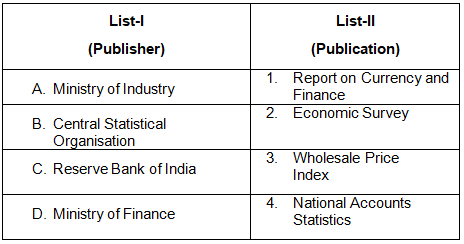
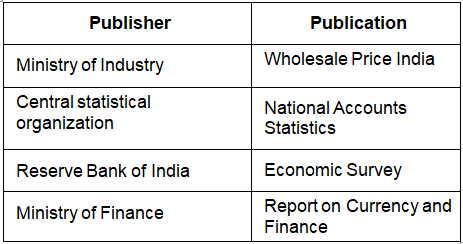
Q30: Match List-I with List-II and select the correct answer using the codes given below the lists: [2001]
Q31: A college student desires to get elected to the Municipal Council of his city. The validity of his nomination would depend on the important condition, among others, that: [2000] (a) he obtains permission from the principal of his college (b) he is a member of a political party (c) his name figures in the voters' list (d) he files a declaration owing allegiance to the Constitution of India
Solution:
Correct Answer is Option (c) Name in the voters list is the important condition.
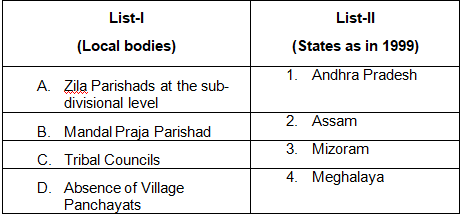
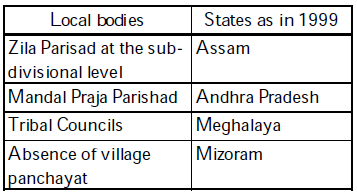
Q32: Match List-I with List-II and select the correct answer using the codes given below the lists: [2000]
Q33: In the new Panchayati Raj Bill enacted in 1993, there are several fresh provisions deviating from the past. Which one of the following is not one such provisions? [1999] (a) A number of added responsibilities in the area of agriculture, rural development, primary education and social forestry among other
(b) Elections being made mandatory for all posts at the time they are due (c) A statutory representation for women in the panchayats, upto a third of the strength (d) Regular remuneration to the panchayat members, so as to ensure their punctuality and accountability
Solution:
Correct Answer is Option (d) Provision given in option (d) is not included under 73rd Amendment Act 1993.
Which of the above statements are correct? [1999] (a) 1, 2, 3 and 4 (b) 2 and 4 (c) 2 and 3 (d) 1, 3 and 4
Solution:
Correct Answer is Option (d)
Here the possible answer is (d) because Statement 2 is incorrect as it is not mandatory that each state must have a State Human Rights Commission. But statement 4 is correct as Chairperson of the National Commission on Women is also the member of NHRC.
Q34: Which one of the following legislations does not deal with the protection of environment? [1999] (a) The Water (Cess) Act, 1977 (b) The Forest (Conservation) Act, 1980 (c) The Public Liability Insurance Act, 1991 (d) The Port Laws Amendment Act, 1997
Solution:
Correct Answer is Option (c)
The water (cess) Act, 1977 provides for the levy and collection of a cess on water consumed by persons carrying on certain industries and by local authorities, with a view to augment the resources of the Central Board and the State Boards for the prevention and control of water pollution. The Public Liability Insurance Act, 1991 provides for public liability insurance for the purpose of providing immediate relief to the persons affected by accident occurring while handling any hazardous substance and for matters connected therewith or incidental thereto.
Q35: Panchayat Raj was first introduced in India in October, 1959 in: [1998] (a) Rajasthan (b) Tamil Nadu (c) Kerala (d) Karnataka
Solution:
Correct Answer is Option (a)
Panchayati Raj System was first introduced in Nagaur district of Rajasthan on October 2, 1959 followed by Andhra Pradesh in 1959.
Q36: What is the system of governance in the Panchayati Raj set up? [1996] (a) Single tier structure of local self government at the village level . (b) Two tier system of local self government at the village and block levels (c) Three tier structure of local self government at the village, block and district levels (d) Four tier system of local self government at the village block, district and in the state levels
Solution:
Correct Answer is Option (c)
According to 73rd Amendment Act, three-tier system of Panchayats exists: Village level, District Panchayat at the district level, the intermediate Panchayat which stands between the village and District Panchayats in the States where the population is above 20 Lakhs.
Q37: Which one of the following is incorrect in respect of Local Government in India? [1995] (a) According to the Indian Constitution, local government is not an independent tier in the federal system (b) 30% of the seats in local bodies are reserved for women (c) Local government finances are to be provided by a Commission (d) Elections to local bodies are to be determined by a Commission
Solution:
Correct Answer is Option (b)
According to 73rd Amendment Act 1993, under Article 243D, not less than 1/3rd i.e. 33% seats should be reserved for women in local bodies.
Q38: Which of the following are the objectives of the Commission for Agricultural Costs and Prices (CACP)? [1995] 1. To stabilize agricultural prices 2. To ensure meaningful real income level to the farmers 3. To protect the interest of the consumers by providing essential agricultural commodities at reasonable rates through public distribution system
4. To ensure maximum price for the farmer (a) 1, 2 and 3 (b) 1, 2 and 4 (c) 1, 3 and 4 (d) 2, 3 and 4
Solution:
Correct Answer is Option (a)
The objective of the price policy underlying MSP is to bring a balanced and integrated price structure for agricultural commodities and not to ensure maximum price for the farmers.
FAQs on Panchayati Raj & Public Policy - Solved Questions (1995- 2025)
1. Which Panchayati Raj questions have appeared most frequently in UPSC exams over the past 30 years?
Ans. Land reforms, devolution of powers to gram panchayats, and 73rd Constitutional Amendment implementation dominate UPSC previous year questions on Panchayati Raj. Questions consistently test candidates' understanding of three-tier panchayat structures, fiscal federalism, and rural governance mechanisms. Reviewing topic-wise previous year questions helps identify recurring patterns and prioritise high-weightage areas for exam preparation.
2. What's the difference between Panchayati Raj and public policy, and why does UPSC ask about both together?
Ans. Panchayati Raj refers to local self-governance institutions at village, block, and district levels, while public policy encompasses decisions implementing these governance frameworks at ground level. UPSC connects them because effective rural development requires both strong panchayat structures and policies addressing education, health, and sanitation. Understanding their interdependence-how policies translate into panchayat action-is critical for scoring well on integrated governance questions.
3. How many questions on Panchayati Raj implementation and decentralisation have been asked in UPSC since 1995?
Ans. Approximately 40-50 direct and indirect questions on Panchayati Raj structures, decentralisation, and local governance have appeared across UPSC Prelims and Mains from 1995-2025. Decentralisation of administrative powers, PRIs' fiscal autonomy, and constitutional amendments form the core focus. Candidates should study solved questions chronologically to track how question complexity and policy emphasis have evolved over three decades.
4. What are the most commonly tested concepts in Panchayati Raj questions about rural development and resource allocation?
Ans. Resource allocation, gram sabha functioning, women's reservation in panchayats, and linkage to centrally-sponsored schemes feature repeatedly in solved UPSC questions. The 73rd Constitutional Amendment's impact on rural self-governance, fund devolution mechanisms, and overlapping roles between state and panchayat authorities appear across multiple exam years. Candidates benefit from mind maps and flashcards that visualise these relationships.
5. How should I use previous year Panchayati Raj questions to improve my answer-writing for UPSC Mains?
Ans. Study solved questions to identify key terminologies, case examples (Nagaland, West Bengal panchayat models), and policy frameworks examiners reward. Analyse how model answers structure arguments around constitutional provisions and real-world outcomes. Practice framing answers using evidence from solved questions spanning 1995-2025; this approach strengthens contextual depth and ensures alignment with UPSC's expected answer standards for governance topics.
Semester Notes, mock tests for examination, Previous Year Questions with Solutions, Important questions, shortcuts and tricks, Sample Paper, study material, Panchayati Raj & Public Policy - Solved Questions (1995- 2025), Summary, MCQs, pdf , video lectures, Panchayati Raj & Public Policy - Solved Questions (1995- 2025), Free, Extra Questions, Exam, Viva Questions, Panchayati Raj & Public Policy - Solved Questions (1995- 2025), ppt, past year papers, practice quizzes, Objective type Questions;