Government & Administration - Solved Questions (2012-2017)

Question 1: Democracy's superior virtue lies in the fact that it calls into activity [2017-I]
(a) the intelligence and character of ordinary men and women.
(b) the methods for strengthening executive leadership.
(c) a superior individual with dynamism and vision.
(d) a band of dedicated party workers.
Question 2: One of the implications of equality in society is the absence of [2017-I]
(a) Privileges
(b) Restraints
(c) Competition
(d) Ideology
Question 3: Which of the following are not necessarily the consequences of the proclamation of the President's rule in a State? [2017-I]
1. Dissolution of the State Legislative Assembly
2. Removal of the Council of Ministers in the State
3. Dissolution of the local bodies
Select the correct answer using the code given below:
(a) 1 and 2 only
(b) 1 and 3 only
(c) 2 and 3 only
(d) 1, 2 and 3
Question 4: Which one of the following is not a feature of Indian federalism? [2017-I]
(a) There is an independent judiciary in India.
(b) Powers have been clearly divided between the Centre and the States.
(c) The federating units have been given unequal representation in the Rajya Sabha.
(d) It is the result of an agreement among the federating units.
Question 5: Local self-government can be best explained as an exercise in [2017-I]
(a) Federalism
(b) Democratic decentralization
(c) Administrative delegation
(d) Direct democracy
Question 6: The main advantage of the parliamentary form of government is that [2017-I]
(a) the executive and legislature work independently.
(b) it provides continuity of policy and is more efficient.
(c) the executive remains responsible to the legislature.
(d) the head of the government cannot be changed without election.
Question 7: Out of the following statements, choose the one that brings out the principle underlying the Cabinet form of Government: [2017-I]
(a) An arrangement for minimizing the criticism against the Government whose responsibilities are complex and hard to carry out to the satisfaction of all.
(b) A mechanism for speeding up the activities of the Government whose responsibilities are increasing day by day.
(c) A mechanism of parliamentary democracy for ensuring collective responsibility of the Government to the people.
(d) A device for strengthening the hands of the head of the Government whose hold over the people is in a state of decline.
Question 8: The Parliament of India exercises control over the functions of the Council of Ministers through. [2017-I]
1. Adjournment motion
2. Question hour
3. Supplementary questions
Select the correct answer using the code given below:
(a) 1 only
(b) 2 and 3 only
(c) 1 and 3 only
(d) 1, 2 and 3
Question 9: With reference to the Parliament of India, consider the following statements: [2017-I]
1. A private member's bill is a bill presented by a Member of Parliament who is not elected but only nominated by the President of India.
2. Recently, a private member's bill has been passed in the Parliament of India for the first time in its history.
Which of the statements given above is/are correct?
(a) 1 only
(b) 2 only
(c) Both 1 and 2
(d) Neither 1 nor 2
Question 10: For election to the Lok Sabha, a nomination paper can be filed by [2017-I]
(a) anyone residing in India.
(b) a resident of the constituency from which the election is to be contested.
(c) any citizen of India whose name appears in the electoral roll of a constituency.
(d) any citizen of India.
Question 11: Consider the following statements: [2017-I]
1. In the election for Lok Sabha or State Assembly, the winning candidate must get at least 50 per cent of the votes polled, to be declared elected.
2. According to the provisions laid down in the Constitution of India, in Lok Sabha, the Speaker's post goes to the majority party and the Deputy Speaker's to the Opposition.
Which of the statements given above is/are correct?
(a) 1 only
(b) 2 only
(c) Both 1 and 2
(d) Neither 1 nor 2
Question 12: Right to vote and to be elected in India is a [2017-I]
(a) Fundamental Right
(b) Natural Right
(c) Constitutional Right
(d) Legal Right
Question 13: Consider the following statements: [2017-I]
1. The Election Commission of India is a five-member body.
2. Union Ministry of Home Affairs decides the election schedule for the conduct of both general elections and by-elections.
3. Election Commission resolves the disputes relating to splits/mergers of recognized political parties.
Which of the statements given above is/are correct?
(a) 1 and 2 only
(b) 2 only
(c) 2 and 3 only
(d) 3 only
Question 14: Consider the following statements: [2015-I]
1 The Legislative Council of a State in India can be larger in size than half of the Legislative Assembly of that particular State
2. The Governor of a State nominates the Chairman of Legislative Council of that particular State.
Which of the statements given above is/are correct?
(a) 1 only
(b) 2 only
(c) Both 1 and 2
(d) Neither 1 nor 2
Question 15: With reference to the Union Government, consider the following statements: [2015-I]
1. The Department of Revenue is responsible for the preparation of Union Budget that is presented to the Parliament.
2. No amount can be withdrawn from the Consolidated Fund of India without the authorization from the Parliament of India.
3. All the disbursements made from Public Account also need the authorization from the Parliament of India.
Which of the statements given above is / are correct?
(a) 1 and 2 only
(b) 2 and 3 only
(c) 2 only
(d) 1, 2 and 3
Question 16: There is a Parliamentary System of Government in India because the [2015-I]
(a) Lok Sabha is elected directly by the people
(b) Parliament can amend the Constitution
(c) Rajya Sabha cannot be dissolved
(d) Council of Ministers is responsible to the Lok Sabha
Question 17: Consider the following statements: [2015-I]
1. The Rajya Sabha has no power either to reject or to amend a Money Bill.
2. The Rajya Sabha cannot vote on the Demands for Grants.
3. The Rajya Sabha cannot discuss the Annual Financial Statement.
Which of the statements given above is / are correct?
(a) 1 only
(b) 1 and 2 only
(c) 2 and 3 only
(d) 1, 2 and 3
Question 18: When a bill is referred to a joint sitting of both the Houses of the Parliament, it has to be passed by [2015-I]
(a) a simple majority of members present and voting
(b) three-fourths majority of members present and voting
(c) two-thirds majority of the Houses
(d) absolute majority of the Houses
Question 19: Consider the following statements [2015-I]
1. The Executive Power of the Union of India is vested in the Prime Minister.
2. The Prime Minister is the ex officio Chairman of the Civil Services Board.
Which of the statements given above is / are correct?
(a) 1 only
(b) 2 only
(c) Both 1 and 2
(d) Neither 1 nor 2
Question 20: Consider the following statements : [2014 - I]
1. The President shall make rules for the more convenient transaction of the business of the Government of India, and for the allocation among Ministers of the said business.
2. All executive actions of the Government of India shall be expressed to be taken in the name of the Prime Minister.
Which of the statements given above is/are correct?
(a) 1 only
(b) 2 only
(c) Both 1 and 2
(d) Neither 1 nor 2
Question 21: The power to increase the number of judges in the Supreme Court of India is vested in [2014 - I]
(a) the President of India
(b) the Parliament
(c) the Chief Justice of India
(d) the Law Commission
Question 22: Consider the following statements regarding a No- Confidence Motion in India: [2014 - I]
1. There is no mention of a No-Confidence Motion in the Constitution of India.
2. A Motion of No-Confidence can be introduced in the Lok Sabha only.
Which of the statements given above is/are correct?
(a) 1 only
(b) 2 only
(c) Both 1 and 2
(d) Neither 1 nor 2
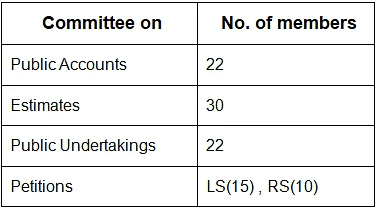
Question 23: Which one of the following is the largest Committee of the Parliament?
(a) The Committee on Public Accounts
(b) The Committee on Estimates
(c) The Committee on Public Undertakings
(d) The Committee on Petitions
Question 24: Which of the following are the discretionary powers given to the Governor of a State? [2014 - I]
1. Sending a report to the President of India for imposing the President's rule
2. Appointing the Ministers
3. Reserving certain bills passed by the State Legislature for consideration of the President of India
4. Making the rules to conduct the business of the State Government
Select the correct answer using the code given below.
(a) 1 and 2 only
(b) 1 and 3 only
(c) 2, 3 and 4 only
(d) 1, 2, 3 and 4
Question 25: Which of the following is/are the function/functions of the Cabinet Secretariat? [2014 - I]
1. Preparation of agenda for Cabinet Meetings
2. Secretarial assistance to Cabinet Committees
3. Allocation of financial resources to the Ministries
Select the correct answer using the code given below.
(a) 1 only
(b) 2 and 3 only
(c) 1 and 2 only
(d) 1, 2 and 3
Question 26: Consider the following statements : [2014 - I]
A Constitutional Government is one which
1. places effective restrictions on individual liberty in the interest of State Authority
2. places effective restrictions on the Authority of the State in the interest of individual liberty
Which of the statements given above is/are correct?
(a) 1 only
(b) 2 only
(c) Both 1 and 2
(d) Neither 1 nor 2
Question 27: Consider the following statements: [2013 - I]
1. The Chairman and the Deputy Chairman of the Rajya Sabha are not the members of that House.
2. While the nominated members of the two Houses of the Parliament have no voting right in the presidential election, they have the right to vote in the election of the Vice President.
Which of the statements given above is/are correct?
(a) 1 only
(b) 2 only
(c) Both 1 and 2
(d) Neither 1 nor 2
Question 28: What will follow if a Money Bill is substantially amended by the Rajya Sabha? [2013 - I]
(a) The Lok Sabha may still proceed with the Bill, accepting or not accepting the recommendations of the Rajya Sabha
(b) The Lok Sabha cannot consider the bill further
(c) The Lok Sabha may send the Bill to the Rajya Sabha for reconsideration
(d) The President may call a joint sitting for passing the Bill
Question 29: Which one of the following statements is correct? [2013 - I]
(a) In India, the same person cannot be appointed as Governor for two or more States at the same time
(b) The Judges of the High Court of the States in India are appointed by the Governor of the State just as the Judges of Supreme Court are appointed by the President
(c) No procedure has been laid down in the Constitution of India for the removal of a Governor from his/her post
(d) In the case of a Union Territory having a legislative setup, the Chief Minister is appointed by the Lt. Governor on the basis of majority support.
Question 30: Consider the following statements : Attorney General of India can [2013 - I]
1. take part in the proceedings of the Lok Sabha
2. be a member of a committee of the Lok Sabha
3. speak in the Lok Sabha
4. vote in the Lok Sabha
Which of the statements given above is/are correct?
(a) 1 only
(b) 2 and 4
(c) 1, 2 and 3
(d) 1 and 3 only
Question 31: The Parliament can make any law for whole or any part of India for implementing international treaties [2013 - I]
(a) with the consent of all the States
(b) with the consent of the majority of States
(c) with the consent of the States concerned
(d) without the consent of any State
Question 32: In the context of India, which of the following principles is/are implied institutionally in the parliamentary government? [2013 - I]
1. Members of the Cabinet are Members of the Parliament.
2. Ministers hold the office till they enjoy confidence in the Parliament.
3. Cabinet is headed by the Head of the State.
Select the correct answer using the codes given below.
(a) 1 and 2 only
(b) 3 only
(c) 2 and 3 only
(d) 1, 2 and 3
Question 33: Consider the following statements: [2013 - I]
1. The Council of Ministers in the Centre shall be collectively responsible to the Parliament.
2. The Union Ministers shall hold the office during the pleasure of the President of India.
3. The Prime Minister shall communicate to the President about the proposals for legislation.
Which of the statements given above is/are correct?
(a) 1 only
(b) 2 and 3 only
(c) 1 and 3 only
(d) 1, 2 and 3
Question 34: In the Parliament of India, the purpose of an adjournment
motion is [2012 - I]
(a) to allow a discussion on a definite matter of urgent public importance
(b) to let opposition members collect information from the ministers
(c) to allow a reduction of specific amount in demand for grant
(d) to postpone the proceedings to check the inappropriate or violent behaviour on the part of some members
Question 35: Consider the following statements: [2012 - I]
1. Union Territories are not represented in the Rajya Sabha.
2. It is within the purview of the Chief Election Commissioner to adjudicate the election disputes.
3. According to the Constitution of India, the Parliament consists of the Lok Sabha and the Rajya Sabha only.
Which of the statements given above is/are correct?
(a) 1 only
(b) 2 and 3
(c) 1 and 3
(d) None
Question 36: Regarding the office of the Lok Sabha Speaker, consider the following statements: [2012 - I]
1. He/She holds the office during the pleasure of the President.
2. He/She need not be a member of the House at the time of his/her election but has to become a member of the House within six months from the date of his/her election.
3. If he/she intends to resign, the letter of his/her resignation has to be addressed to the Deputy Speaker.
Which of the statements given above is /are correct?
(a) 1 and 2 only
(b) 3 only
(c) 1, 2 and 3
(d) None
Question 37: Which of the following can be said to be essentially the parts of 'Inclusive Governance'? [2012 - I]
1. Permitting the Non-Banking Financial Companies to do banking
2. Establishing effective District Planning Committees in all the districts
3. Increasing the government spending on public health
4. Strengthening the Mid-day Meal Scheme
Select the correct answer using the codes given below :
(a) 1 and 2 only
(b) 3 and 4 only
(c) 2, 3 and 4 only
(d) 1, 2, 3 and 4
Question 38: In India, other than ensuring that public funds are used efficiently and for intended purpose, what is the importance of the office of the Comptroller and Auditor General (CAG)? [2012 - I]
1. CAG exercises exchequer control on behalf of the Parliament when the President of India declares national emergency/financial emergency.
2. CAG reports on the execution of projects or programmes by the ministries are discussed by the Public Accounts Committee.
3. Information from CAG reports can be used by investigating agencies to frame charges against those who have violated the law while managing public finances.
4. While dealing with the audit and accounting of government companies, CAG has certain judicial powers for prosecuting those who violate the law.
Which of the statements given above is/are correct?
(a) 1, 3 and 4 only
(b) 2 only
(c) 2 and 3 only
(d) 1, 2, 3 and 4
Question 39: The Prime Minister of India, at the time of his/her appointment [2012 - I]
(a) need not necessarily be a member of one of the Houses of the Parliament but must become a member of one of the Houses within six months
(b) need not necessarily be a member of one of the Houses of the Parliament but must become a member of the Lok Sabha within six months
(c) must be a member of one of the Houses of the Parliament
(d) must be a member of the Lok Sabha
Question 40: A deadlock between the Lok Sabha and the Rajya Sabha calls for a joint sitting of the Parliament during the passage of [2012 - I]
1. Ordinary Legislation
2. Money Bill
3. Constitution Amendment Bill
Select the correct answer using the codes given below :
(a) 1 only
(b) 2 and 3 only
(c) 1 and 3 only
(d) 1, 2 and 3
FAQs on Government & Administration - Solved Questions (2012-2017)
| 1. What is the role of the government in a democratic system? |  |
| 2. What is the difference between government and administration? | |
| 3. How are government officials appointed in a democratic setup? | |
| 4. What are the different levels of government in a federal system? | |
| 5. How does the government ensure accountability and transparency in its functioning? | |




