Indian National Movement- Solved Questions - 2 (2003-2009)

Question 1:
In the context of the Indian freedom struggle, 16th October 1905 is well known for ................ ? [2009]
(a) The formal proclamation of the Swadeshi Movement was made in Calcutta town hall
(b) Partition of Bengal took effect
(c) Dadabhai Naoroji declared that the goal of the Indian National Congress was Swaraj
(d) Lokmanya Tilak started Swadeshi Movement in Poona
Question 2:
Who founded the Ahmedabad Textile Labour Association? [2009]
(a) Mahatma Gandhi
(b) Sardar Vallabhbhai Patel
(c) N.M. Joshi
(d) J.B. Kripalani
Question 3:
With which one of the following movements is the slogan "Do or die" associated? [2009]
(a) Swadeshi Movement
(b) Non-Cooperation Movement
(c) Civil Disobedience Movement
(d) Quit India Movement
Question 4:
Which one of the following began with the Dandi March? [2009]
(a) Home Rule Movement
(b) Non-Cooperation Movement
(c) Civil Disobedience Movement
(d) Quit India Movement
Question 5:
During the Indian Freedom Struggle, why did Rowlatt Act arouse popular indignation? [2009]
(a) It curtailed the freedom of religion
(b) It suppressed the Indian traditional education
(c) It authorized the government to imprison people without trial
(d) It curbed the trade union activities
Question 6:
Who of the following Prime Ministers sent Cripps Mission to India? [2009]
(a) James Ramsay MacDonald
(b) Stanley Baldwin
(c) Neville Chamberlain
(d) Winston Churchill
Question 7:
During the freedom struggle, Aruna Asaf Ali was a major woman organizer of underground activity in: [2009]
(a) Civil Disobedience Movement
(b) Non-Cooperation Movement
(c) Quit India Movement
(d) Swadeshi Movement
Question 8:
Consider the following statements: The Cripps Proposals include the provision for
1. Full independence for India.
2. Creation of constitution-making body.
Which of the statements given above is/are correct? [2009]
(a) 1 only
(b) 2 only
(c) Both 1 and 2
(d) Neither 1 nor 2
Question 9:
In the 'Individual Satyagraha', Vinoba Bhave was chosen as the first Satyagrahi. Who was the second? [2009]
(a) Dr. Rajendra Prasad
(b) Pandit Jawaharlal Nehru
(c) C. Rajagopalachari
(d) Sardar Vallabhbhai Patel
Question 10:
Assertion (A): The Congress Ministries in all the provinces resigned in the year 1939.
Reason (R): Congress did not accept the decision of the Viceroy to declare war against Germany in the context of the Second World War. [2008]
(a) Both A are R are true but R is the correct explanation of A
(b) Both A and R are true but R is not a correct explanation of A
(c) A is true but R is false
(d) A is false but R is true
Question 11:
Who among the following wrote the poem, Subh-e Azadi? [2008]
(a) Sahir Ludhiyanvi
(b) Faiz Ahmed Faiz
(c) Muhammad Iqbal
(d) Maulana Abul Kalam Azad
Question 12:
Where was the First Session of the Indian National Congress held in December 1885? [2008]
(a) Ahmedabad
(b) Bombay
(c) Calcutta
(d) Delhi
Question 13:
Which one of the following was a journal brought out by Abul Kalam Azad? [2008]
(a) Al-Hilal
(b) Comrade
(c) The Indian Sociologist
(d) Zamindar
Question 14:
Who among the following Gandhian followers was a teacher by profession? [2008
(a) AN Sinha
(b) Braj Kishore Prasad
(c) J B Kriplani
(d) Rajendra Prasad
Question 15:
Who was the Viceroy of India when the Rowlatt Act was passed? [2008]
(a) Lord Irwin
(b) Lord Reading
(c) Lord Chelmsford
(d) Lord Wavell
Question 16:
Who among the following used the phrase 'UN-British' to criticize the English colonial control of India? [2008]
(a) Anandmohan Bose
(b) Badruddin Tyabji
(c) Dadabhai Naoroji
(d) Pherozeshah Mehta
Question 17:
Who gave a systematic critique of the moderate politics of the Indian National Congress in a series of articles entitled New Lamps for Old? [2008]
(a) Aurobindo Ghosh
(b) R C Dutt
(c) Syed Ahmad Khan
(d) Viraraghavachari
Question 18:
Who suggested the reconstitution of the Viceroy Executive Council in which all the Portfolios including that of War Members were to be held by the Indian leaders? [2008]
(a) Simon Commission
(b) Shimla Conference
(c) Cripps Proposal
(d) Cabinet Mission
Question 19:
During the Indian Freedom Struggle, who of the following raised an army called 'Free Indian Legion'? [2008]
(a) Lala Hardayal
(b) Rashbehari Bose
(c) Subhas Chandra Bose
(d) V D Savarkar
Question 20:
Who among the following rejected the title of Knighthood and refused to accept a position in the Council of the Secretary of State for India? [2008]
(a) Motilal Nehru
(b) M G Ranade
(c) G K Gokhale
(d) BG Tilak
Question 21:
The song 'Amar Sonar Bangla' written during the Swadeshi Movement of India inspired the liberation struggle of Bangladesh and was adopted as the National Anthem of Bangladesh. Who wrote this song? [2007]
(a) Rajni Kanta Sen
(b) Dwijendralal Ray
(c) Mukunda Das
(d) Rabindranath Tagore
Question 22:
At which one of the following places did Mahatma Gandhi first start his Satyagraha in India? [ 2007]
(a) Ahmedabad
(b) Bardoli
(c) Champaran
(d) Kheda
Question 23:
Which one of the following aroused a wave of popular indignation that led to the massacre by the British at Jallianwala Bagh? [2007]
(a) The Arms Act
(b) The Public Safety Act
(c) The Rowlatt Act
(d) The Vernacular Press Act
Question 24:
Assertion (A): According to the Wavell Plan, the number of Hindu and Muslim members in the Executive Council was to be equal.
Reason (R): Wavell thought that this arrangement would have avoided the partition of India. [2007]
(a) Both A are R are true but R is the correct explanation of A
(b) Both A and R are true but R is not a correct explanation of A
(c) A is true but R is false
(d) A is false but R is true
Question 25:
Which Portfolio was held by Dr. Rajendra Prasad in the Interim Government formed in the year 1946? [2006]
(a) Defense
(b) External Affairs and Commonwealth Relations
(c) Food and Agriculture
(d) None of the above
Question 26:
Consider the following statements about Madam Bhikaji Cama: [2006]
1. Madam Cama unfurled the National Flag at the International Socialist Conference in Paris in the year 1907.
2. Madam Cama served as private secretary to Dadabhai Naoroji.
3. Madam Cama was born to a Parsi.
Which of the statement(s) given above is/are correct?
(a) 1, 2 and 3
(b) 2 and 3 only
(c) 1 and 2 only
(d) 3 only
Question 27:
Under whose presidency was the Lahore session of the Indian Congress held in the year 1929, wherein a resolution was adopted to gain complete independence from the British? [2006]
(a) Bal Gangadhar Tilak
(b) Gopal Krishna Gokhale
(c) Jawaharlal Nehru
(d) Motilal Nehru
Question 28:
Consider the following statements: [2005]
The Government of India Act, 1935 provided for
1. the provincial autonomy.
2. the establishment of a Federal court.
3. all India Federation at the center.
Which of the statements given above are correct?
(a) 1 and 2
(b) 2 and 3
(c) 1 and 3
(d) 1, 2 and 3
Question 29:
Which party was founded by Subhash Chandra Bose in the year 1939 after he broke away from Congress? [2005]
(a) Indian Freedom Party
(b) Azad Hind Fauj
(c) Revolutionary Front
(d) Forward Bloc
Question 30:
Consider the following statements: [2005]
1. In the First Round Table Conference, Dr. Ambedkar demanded separate electorates for the depressed classes.
2. In the Poona Act, special provisions for representation of the depressed people in the local bodies and civil services were made.
3. The Indian National Congress did not take part in the Third Round Table Conference.
Which of the statements given above is/are correct?
(a) 1 and 2
(b) 2 and 3
(c) 1 and 3
(d) 1, 2 and 3
Question 31:
Consider the following statements:
1. Lord Mountbatten was the Viceroy when the Shimla conference took place.
2. Indian Navy Revolt, 1946 took place when the Indian sailors in the Royal Indian Navy at Bombay and Karachi rose against the Government.
Which of the statements given above is/are correct? [2005]
(a) 1 only
(b) 2 only
(c) Both 1 and 2
(d) Neither 1 nor 2
Question 32:
Which of the following pairs are correctly matched? [2005]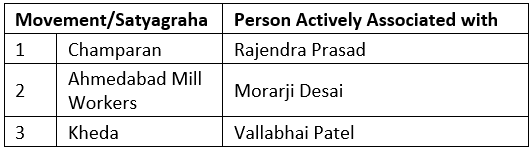
Select the correct answer using the code given below:
(a) 1 and 2
(b) 2 and 3
(c) 1 and 3
(d) 1, 2 and 3
Question 33:
Who among the following was not associated with the formation of the U.P. Kisan Sabha in February 1918? [2005]
(a) Indra Narain Dwivedi
(b) Gauri Shankar Misra
(c) Jawaharlal Nehru
(d) Madan Mohan Malviya
Question 34:
Who drafted the resolution on fundamental rights for the Karachi Session of Congress in 1931? [2005]
(a) Dr. B.R. Ambedkar
(b) Pandit Jawaharlal Nehru
(c) Dr. Rajendra Prasad
(d) Sardar Vallabhbhai Patel
Question 35:
In October 1920, who headed a group of Indians gathered at Tashkent to set up a communist party of India? [2005]
(a) H.K. Sarkar
(b) P.C. Joshi
(c) M.C. Chagla
(d) M.N. Roy
Question 36:
At which Congress session was the working committee authorized to launch a program of Civil Disobedience? [2005]
(a) Bombay
(b) Lahore
(c) Lucknow
(d) Tripura
Question 37:
In which one of the following provinces was a Congress ministry not formed under the Act of 1935? [2005]
(a) Bihar
(b) Madras
(c) Orissa
(d) Punjab
Question 38:
Consider the following statements: On the eve of the launch of the Quit India Movement, Mahatma Gandhi: [2005]
1. asked the government servants to resign.
2. asked the soldiers to leave their posts.
3. asked the Princes of the Princely states to accept the sovereignty of their own people.
Which of the statement given above is/are correct?
(a) 1 and 2
(b) 2 and 3
(c) 3 only
(d) 1, 2 and 3
Question 39:
Where were the Ghadar revolutionaries, who became active during the outbreak of World War I based? [2005]
(a) Central America
(b) North America
(c) West America
(d) South America.
Question 40:
Consider the following events during India's freedom struggle:
1. Chauri-Chaura Outrage
2. Minto-Morley Reforms
3. Dandi March
4. Montagu-Chelmsford Reforms
Which one of the following is the correct chronological order of the events above? [2004]
(a) 1, 3, 2, 4
(b) 2, 4, 1, 3
(c) 1, 4, 2, 3
(d) 2, 3, 1, 4
Question 41:
The name of the famous person of India who returned the Knighthood conferred on him by the British Government as a token of protest against the atrocities in Punjab in 1919 was: [2004]
(a) Tej Bahadur Sapru
(b) Ashutosh Mukherjee
(c) Rabindra Nath Tagore
(d) Syed Ahmed Khan
Question 42:
During the Indian freedom struggle, who among the following proposed that Swaraj should be defined as complete independence free from all foreign control? [2004]
(a) Mazharul Haque
(b) Maulana Hasrat Mohani
(c) Hakim Ajmal Khan
(d) Abul Kalam Azad
Question 43:
The Montagu-Chelmsford Report formed the basis of [2004]
(a) the Indian Councils Act, 1909
(b) the Government of India Act, 1919
(c) the Government of India Act, 1935
(d) the Indian Independence Act, 1947
Question 44:
Which one of the following statements is correct? [2004]
(a) The Constituent Assembly of India was elected by the Provincial Assemblies in the year 1946
(b) Jawaharlal Nehru, M.A. Jinnah, and Sardar Vallabhbhai Patel were members of the constituent Assembly of India
(c) The First Session of the Constituent Assembly of India was held in January 1947
(d) The Constitution of India was adopted on 2 6th January 1950
Question 45:
Consider the following statements: [2004]
1. The First Session of the Indian National Congress was held in Calcutta
2. The Second Session of the Indian National Congress was held under the presidentship of Dadabhai Naoroji
3. Both Indian National Congress and Muslim League held their sessions at Lucknow in 1916 and concluded the Lucknow Pact
Which of the statements given above is/are correct?
(a) 1 and 2
(b) 2 only
(c) 2 and 3
(d) 3 only
Question 46:
Consider the following statements: Some of the main features of the Government of India Act, 1935 were the:
1. abolition of diarchy in the Governor's provinces
2. power of the Governors to veto legislative action and to legislate on their own 3. abolition of the principle of communal representation.
Which of the statements given above is/are correct? [2004]
(a) 1 only
(b) 1 and 2
(c) 2 and 3
(d) 1, 2 and 3
Question 47:
When Congress leaders condemned the Montagu-Chelmsford Report, many moderates left the party to form the: [2003]
(a) Swarajya Party
(b) Indian Freedom Party
(c) Independence Federation of India
(d) Indian Liberal Federation
Question 48:
An important aspect of the Cripps Mission of 1942 was: [2003]
(a) that all Indian States should join the Indian Union as a condition to consider any degree of autonomy for India
(b) the creation of an Indian Union with Dominion status very soon after the end of Second World War
(c) the active participation and cooperation of the Indian people, communities, and political parties in the British war efforts as a condition for granting independence with full sovereign status to India after the war
(d) the framing of a constitution for the entire Indian Union, with no separate constitution for any province, and a Union Constitution to be accepted by all provinces
Question 49:
With reference to the Indian freedom struggle, which one of the following statements is not correct? [2003]
(a) The Rowlatt Act aroused a wave of popular indignation and led to the Jallianwala Bagh massacre
(b) Subhas Chandra Bose formed the Forward Bloc
(c) Bhagat Singh was one of the founders of the Hindustan Republican Socialist Association
(d) In 1931, the Congress Session at Karachi opposed the Gandhi-Irwin Pact
Question 50:
Assertion (A): In 1916, Maulana Mohammad Ali and Abul Kalam Azad resigned from the Legislative Council.
Reason (R): The Rowlatt Act was passed by the Government in spite of being opposed by all Indian members of the Legislative Council. [2003]
(a) Both A and R are true but R is the correct explanation of A
(b) Both A and R are true but R is not a correct explanation of A
(c) A is true but R is false
(d) A is false but R is true
FAQs on Indian National Movement- Solved Questions - 2 (2003-2009)
| 1. What were the main causes of the Indian National Movement? |  |
| 2. Who were the key leaders of the Indian National Movement? | |
| 3. What role did the Indian National Congress play in the movement? | |
| 4. How did the partition of India affect the Indian National Movement? | |
| 5. What were the major movements during the Indian National Movement? | |




