Indian National Movement- Solved Questions - 3 (1998-2003)

Question 1:
The leader of the Bardoli Satyagraha (1928) was: [2003]
(a) Sardar Vallabhbhai Patel
(b) Mahatma Gandhi
(c) Vithalbhai J. Patel
(d) Mahadev Desai
Question 2:
Who headed the Interim Cabinet formed in the year 1946? [2003]
(a) Rajendra Prasad
(b) Jawaharlal Nehru
(c) Sardar Vallabhbhai Patel
(d) Rajagopalachari
Question 3:
The members of the Constituent Assembly which drafted the Constitution of India were: [2002]
(a) nominated by the British Parliament
(b) nominated by the Governor-General
(c) elected by the Legislative Assemblies of various province
(d) elected by the Indian National Congress and Muslim League
Question 4:
The last opportunity to avoid the partition of India was lost with the rejection of [2002]
(a) Cripps Mission
(b) Rajagopalachari Formula
(c) Cabinet Mission
(d) Wavell Plan
Question 5:
Assertion (A): The effect of labor participation in the Indian nationalist upsurge of the early 1930s was weak.
Reason (R): The labor leaders considered the ideology of the Indian National Congress as bourgeois and reactionary. [2002]
(a) Both A and R are true but R is the correct explanation of A
(b) Both A and R are true but R is not a correct explanation of A
(c) A is true but R is false
(d) A is false but R is true
Question 6:
During the Indian freedom struggle, the Khudai Khidmatgars, also known as Red Shirts called for [2002]
(a) the Union of Pakhtun tribal areas in the north-west with Afghanistan
(b) the adoption of terrorist tactics and m eth ods for terrorizing and finally ousting the colonial rulers
(c) the adoption of communist revolution ideology for political and social reform
(d) the Pathan regional nationalist unity and a struggle against colonialism.
Question 7:
The President of the Indian National Congress at the time of partition of India was: [2002]
(a) C. Rajagopalachari
(b) J. B. Kripalani
(c) Jawaharlal Nehru
(d) Maulana Abul Kalam Azad
Question 8:
The real intention of the British for including the princely states in the Federal Union proposed by the India Act of 1935 was to: [2002]
(a) exercise more and direct political and administrative
(b) involve the princes actively in the administration of the colony
(c) finally, effect the complete political and administrative take-over of all the princely states by the British
(d) use the princes to counter-balance the anti-imperialist doctrines of the nationalist leaders
Question 9:
With reference to the Indian freedom struggle, which one of the following statements is not correct? [2002]
(a) Hakim Ajmal Khan was one of the leaders to start a nationalist and militant Ahrar movement
(b) When the Indian National Congress was formed, Syed Ahmed Khan opposed it
(c) The All-India Muslim League which was formed in 1906 vehemently opposed the partition of Bengal and separated electorates
(d) Maulana Barkataullah and Maulana Obeidullah Sindhi were among those who formed a provisional government of India in Kabul.
Question 10:
With reference to the period of the extremist nationalist movement in India with its spirit of Swadeshi, which one of the following statements is not correct? [2002]
(a) Liaquat Hussain led the Muslim peasants of Barisal in their agitation
(b) In 1889, the scheme of national education was formulated by Satish Chandra Mukherjee
(c) The Bengal National College was founded in 1906 with Aurobindo as the Principal
(d) Tagore preached the cult of Atmasakti, the main plank of which was social and economic regeneration of the villages
Question 11:
Who among the following was the President of the All India States' Peoples' Conference in 1939? [2001]
(a) Jaya Prakash Narayan
(b) Sheikh Abdullah
(c) Jawahar Lal Nehru
(d) Sardar Vallabhbhai Patel
Question 12:
A London branch of the All India Muslim League was established in 1908 under the presidency of [2001]
(a) Aga Khan
(b) Ameer Ali
(c) Liaquat Ali Khan
(d) M.A. Jinnah
Question 13:
Who among the following organized the famous Chittagong Armoury raid? [2001]
(a) Laxmi Sehgal
(b) Surya Sen
(c) Batukeshwar Datta
(d) J.M. Sengupta
Question 14:
Who among the following leaders proposed to adopt Complete Independence as the goal of the Congress in the Ahmedabad session of 1920? [2001]
(a) Abdul Kalam Azad
(b) Hasrat Mohani
(c) Jawahar Lal Nehru
(d) Mohandas Karamachand Gandhi
Question 15:
The Hunter Commission was appointed after the: [2001]
(a) Black-hole incident
(b) Jalianwalla Bagh massacre
(c) Uprising of 1857
(d) Partition of Bengal
Question 16:
Consider the following statements about the Indian National Congress: [2000]
1. Sarojini Naidu was the first woman to be the President of Congress
2. C.R. Das was in prison when he functioned as the President of Congress
3. The first British er to become the President of the Congress was Alan Octavian Hume
4. Alfred Webb was the President of the Congress in 1894.
Which of these statements are correct?
(a) 1 and 3
(b) 2 and 4
(c) 2, 3 and 4
(d) 1, 2, 3 and 4
Question 17:
The Balkan Plan for fragmentation of India was the brainchild of: [2000]
(a) W. Churchill
(b) M.A. Jinnah
(c) Lord Mountbatten
(d) V.P. Menon
Question 18:
At the time of partition of India, which one of the following provinces of British India came forward with a plan for a united and independent existence? [2000]
(a) Punjab
(b) Assam
(c) Bengal
(d) Bihar
Question 19:
While delivering the presidential address, the Congress President who advocated the introduction of Roman script for the Hindi language was: [2000]
(a) Mahatma Gandhi
(b) Jawaharlal Nehru
(c) Abul Kalam Azad
(d) Subhash Chandra Bose
Question 20:
Directions: The Following Items Consist of Two Statements, One Labelled As 'Assertion A' And the Other Labelled As 'Reason R', You Are to Examine these Two Statement Carefully and Decide If the Assertion 'A' And the Reason 'R' Are Individually True and If So, Whether the Reason Is a Correct Explanation of The Assertion. Select Your Answers to These Items Using the Codes Given Below and Mark Your Answer Sheet Accordingly. [2000]
Assertion (A): Lord Linlithgo described the August Movement of 1942 as the most serious revolt after the Sepoy mutiny.
Reason (R): Peasants joined the movement in large numbers in some places.
(a) Both A and R are true but R is the correct explanation of A
(b) Both A and R are true but R is not a correct explanation of A
(c) A is true but R is false
(d) A is false but R is true
Question 21:
Assertion (A): The basic weakness of the early nationalist movement lay in its narrow social base
Reason (R): If fighting for the narrow interests of the social groups which joined it. [2000]
(a) Both A and R are true but R is the correct explanation of A
(b) Both A and R are true but R is not a correct explanation of A
(c) A is true but R is false
(d) A is false but R is true
Question 22:
After returning from South Africa, Gandhiji launched his first successful satyagraha in [2000]
(a) Chauri-Chaura
(b) Dandi
(c) Champaran
(d) Bardoli
Question 23:
The native state of Tripura became involved in the freedom movement early in the 20th century because: [2000]
(a) the kings of Tripura were always anti-British
(b) the Bengal revolutionaries took shelter in Tripura
(c) the tribes of the state were fiercely freedom-loving
(d) there were already some groups fighting against the kingship and its protector, the British
Question 24:
As an alternative to the partition of India, Gandhiji suggested to Mountbatten that he: [2000]
(a) postponed granting of independence
(b) invited Jinnah to form the government
(c) invited Nehru and Jinnah to form the government together
(d) invite the army to take over for some time
Question 25:
The Indian National Army (I.N.A.) came into existence in 1943 in: [2000]
(a) Japan
(b) Burma
(c) Singapore
(d) Malaya
Question 26:
Which one of the following is not a feature of the Government of India Act of 1935? [2000]
(a) Diarchy at the Centre as well as in the provinces
(b) a bicameral legislature
(c) provincial autonomy
(d) an All-India federation
Question 27:
"In this instance, we could not play off the Mohammedans against the Hindus." To which one of the following events did this remark of Aitchison relate? [2000]
(a) Revolt of 1857
(b) Champaran Satyagraha (1917)
(c) Khilafat and Non-Cooperation Movement (1919-22)
(d) August Movement of 1942
Question 28:
Match List-I with List-II and select the correct answer using the codes given below the lists: [1999]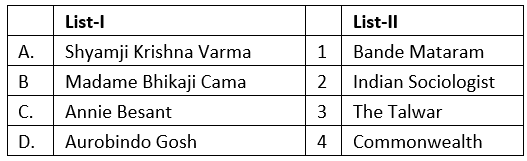
(a) A - 2; B - 3; C - 4; D - 1
(b) A - 3; B - 2; C - 1; D - 4
(c) A - 2; B - 3; C - 1; D - 4
(d) A - 3; B - 2; C - 4; D - 1
Question 29:
The Congress policy of pray and petition ultimately came to an end under the guidance of [1999]
(a) Aurobindo Ghosh
(b) Bal Gangadhar Tilak
(c) Lala Lajpat Rai
(d) Mahatma Gandhi
Question 30:
The first venture of Gandhi in all-India politics was the: [1999]
(a) Non-Cooperation Movement
(b) Rowlatt Satyagraha
(c) Champaran Movement
(d) Dandi March
Question 31:
Assertion (A): Lord Linlithgow described the August Movement of 1942 as the most serious rebellion since Sepoy Mutiny.
Reason (R): There was a massive upsurge of the peasantry in certain areas. [1999]
(a) Both A and R are true but R is the correct explanation of A
(b) Both A and R are true but R is not a correct explanation of A
(c) A is true but R is false
(d) A is false but R is true
Question 32:
The term "imperial preference" was applied to the: [1999]
(a) special privileges on British imports in India
(b) racial discrimination by the Britishers
(c) subordination of Indian interest to that of the British
(d) preference is given to British political agents over Indian princes
Question 33:
Which one of the following Indian leaders was dismissed by the British from the Indian Civil Service? [1999]
(a) Satyendranath Tagore
(b) Surendranath Banerji
(c) R.C. Dutt
(d) Subhash Chandra Bose
Question 34:
Which one of the following leaders of the Congress was totally in favor of the Cabinet Mission Plan? [1999]
(a) Mahatma Gandhi
(b) Jawaharlal Nehru
(c) Sardar Patel
(d) Maulana Abul Kalam Azad
Question 35:
Which Indian nationalist leader looked upon a war between Germany and Britain as a God-sent opportunity which would enable Indians to exploit the situation to their advantage? [1999]
(a) C. Rajagopalachari
(b) M.A. Jinnah
(c) Subhash Chandra Bose
(d) Jawaharlal Nehru
Question 36:
'It made its proposals in May. It still wanted a united India. There was to be a Federal Union composed of British provinces' [1999]
The above quotation is related to:
(a) Simon Commission
(b) Gandhi-Irwin Pact
(c) Cripps Mission
(d) Cabinet Mission
Question 37:
The most short-lived of all of Britain's constitutional experiments in India was the: [1999]
(a) Indian Council Act of 1861
(b) Indian Council Act of 1892
(c) Indian Council Act of 1909
(d) Government of India Act of 1919
Question 38:
'Abinava Bharat' a secret society of revolutionaries was organized by: [1999]
(a) Khudiram Bose
(b) V.D. Savarkar
(c) Prafulla Chaki
(d) Bhagat Singh
Question 39:
At the time of India's Independence, Mahatma Gandhi was: [1998]
(a) a member of Congress Working Committee
(b) not a member of the Congress
(c) the President of the Congress
(d) the General Secretary of the Congress
Question 40:
The Indian National Congress agreed in 1947 to the partition of the country mainly because [1998]
(a) the principle of the two-Nation theory was then acceptable to them
(b) it was imposed by the British Government and the Congress was helpless in this regard
(c) they wanted to avoid large-scale communal riots
(d) India would have otherwise lost the opportunity to attain freedom
FAQs on Indian National Movement- Solved Questions - 3 (1998-2003)
| 1. What were the main factors that led to the Indian National Movement? |  |
| 2. Who were the key leaders of the Indian National Movement? | |
| 3. What were the major events and campaigns during the Indian National Movement? | |
| 4. How did the Indian National Movement impact the socio-cultural fabric of India? | |
| 5. What were the significant outcomes of the Indian National Movement? | |




