Indian National Movement- Solved Questions - 4 (1995-1998)

Question 1:
When the Indian Muslims League was inducted into the interim government in 1946, Liyaqat Ali Khan was assigned the portfolio of [1998]
(a) foreign affairs
(b) home
(c) finance
(d) defense
Question 2:
Assertion (A): Gandhi stopped the Non -Cooperation Movement in 1922.
Reason (R): Violence at Chauri-Chaura led him to stop the movement. [1998]
(a) Both A and R are true but R is the correct explanation of A.
(b) Both A and R are true but R is not a correct explanation of A
(c) A is true but R is false
(d) A is false but R is true
Question 3:
Assertion (A): Congress rejected the Cripps proposals.
Reason (R): The Cripps Mission consisted solely of whites. [1998]
(a) Both A and R are true but R is the correct explanation of A
(b) Both A and R are true but R is not a correct explanation of A
(c) A is true but R is false
(d) A is false but R is true
Question 4:
Assertion (A): The first-ever Bill to make primary education compulsory in India was rejected in 1911.
Reason (R): Discontent would have increased if every cultivator could read. [1998]
(a) Both A and R are true but R is the correct explanation of A
(b) Both A and R are true but R is not a correct explanation of A
(c) A is true but R is false
(d) A is false but R is true
Question 5:
Assertion (A): The partition of Bengal in 1905 brought to an end the moderates' role in the Indian freedom movement.
Reason (R): The Surat session of the Indian National Congress separated the Extremists from the Moderates. [1998]
(a) Both A and R are true but R is the correct explanation of A
(b) Both A and R are true but R is not a correct explanation of A
(c) A is true but R is false
(d) A is false but R is true
Question 6:
Assertion (A): The Khilafat movement did bring the urban Muslims into the fold of the National Movement.
Reason (R): There was a predominant element of anti-imperialism in both the National and Khilafat Movement. [1998]
(a) Both A and R are true but R is the correct explanation of A
(b) Both A and R are true but R is not a correct explanation of A
(c) A is true but R is false
(d) A is false but R is true
Question 7:
Lord Mountbatten came to India as a Viceroy with specific instruction to: [1998]
(a) balkanize the Indian sub-continent
(b) keep India united if possible
(c) accept Jinnah's demand for Pakistan
(d) persuade Congress to accept the partition
Question 8:
Who was the leader of the Ghaddar Party? [1998]
(a) Bhagat Singh
(b) Lala Hardayal
(c) Bal Gangadhar Tilak
(d) V.D. Savarkar
Question 9:
"The Congress is tottering to its fall and one of my great ambitions while in India, is to assist it to a peaceful demise. "This statement is attributed to: [1998]
(a) Lord Dufferin
(b) Lord Curzon
(c) Lord Lytton
(d) None of the above
Question 10:
Which of the following pairs are correctly matched? [1998]
1. Theodore Beck: Mohammedan Anglo-Oriental College, Aligarh.
2. Ilbert Bill: Ripon
3. Pherozeshah Mehta: Indian National Congress
4. Badruddin Tyabji: Muslims League
Select the correct answer using the codes given below: Codes:
(a) 1, 2, 3 and 4
(b) 2 and 4
(c) 1, 3 and 4
(d) 1, 2 and 3
Question 11:
Which one of the following defines extremist ideology during the early phase of the Indian freedom movement? [1998]
(a) Stimulating the production of indigenous articles by giving them preference over imported commodities
(b) Obtaining self-government by aggressive means in place of petitions and constitutional ways
(c) Providing national education according to the requirements of the country
(d) Organising coups against the British empire through military revolt
Question 12:
What is the correct sequence of the following events?
1. The August offer
2. The I.N.A trial
3. The Quit India Movement
4. The Royal Indian Naval Ratings' Revolt.
Select the correct answer using the codes given below: Codes: [1998]
(a) 1, 3, 2, 4
(b) 3, 1, 2, 4
(c) 1, 3, 4, 2
(d) 3, 1, 4, 2
Question 13:
Which one of the following events, was characterized by Montague as 'Preventive Murder'? [1998]
(a) Killing of INA activities
(b) Massacre at Jallianwala Bagh
(c) Shooting of the Mahatma
(d) Shooting of Curzon-Wythe
Question 14:
The Indian Muslims, in general, were not attracted to the Extremist movement because of : [1998]
(a) influence' of Sir Sayed Ahmed Khan
(b) the anti-Muslim attitude of Extremist leaders
(c) the indifference is shown to Muslim aspirations
(d) extremists' policy of harping on the Hindu aspect
Question 15:
Simon Commission of 1927 was boycotted because [1998]
(a) there was no Indian member in the Commission
(b) it supported the Muslim League
(c) Congress felt that the people of India are entitled to Swaraj
(d) there were differences among the members
Question 16:
What is the correct sequence of the following events?
1. Tilak's Home Rule League [1998]
2. Karnagatamaru Incident 3. Mahatma Gandhi's arrival in India
Select the correct answer using the codes given below:
(a) 1, 2, 3
(b) 3, 2, 1
(c) 2,1, 3
(d) 2, 3, 1
Question 17:
M.C. Setalvad, B.N. Rao and Alladi Krishnaswamy Iyer were distinguished members of the: [1997]
(a) Swaraj Party
(b) All India National Liberal Federation
(c) Madras Labour Union
(d) Servants of India Society
Question 18:
Match List-I with List-II and select the correct answer: [1997]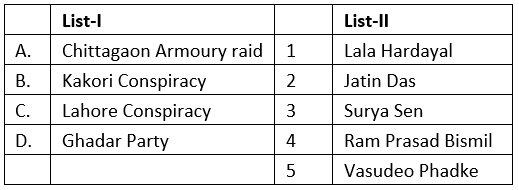
(a) A - 3; B - 4; C - 1; D - 5
(b) A - 4; B - 3; C - 2; D - 5
(c) A - 3; B - 4; C - 2; D - 1
(d) A - 2; B - 4; C - 3; D - 1
Question 19:
Match List-I with List-II and select the correct answer using the codes given below the lists: [1997]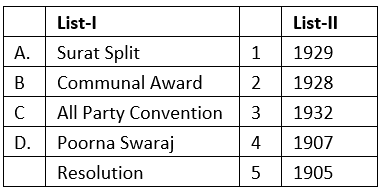
(a) A - 4; B - 3; C - 1; D - 5
(b) A - 4; B - 3; C - 2; D - 1
(c) A - 2; B - 5; C - 4; D - 1
(d) A - 1; B - 4; C - 2; D - 3
Question 20:
The Poona Pact which was signed between the British Government and Mahatma Gandhi in 1934 provided for:
(a) creation of dominion status for India
(b) separate electorates for the Muslims
(c) separate electorate for the Harijans
(d) joint electorate with reservation for Harijans
Question 21:
Match List-I with List-II and select the correct answer using the codes given below the lists: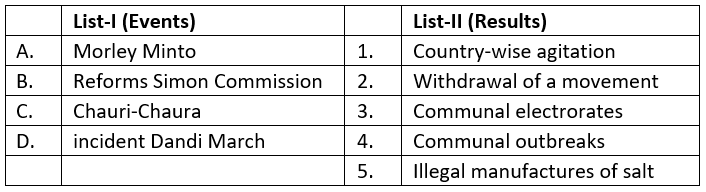
(a) A - 3; B - 4; C - 5; D - 2
(b) A - 4; B - 1; C - 2; D - 3
(c) A - 2; B - 3; C - 4; D - 5
(d) A - 3; B - 1; C - 2; D - 5
Question 22:
"A graduate at 18, professor and associate editor of the Sudharak at 20, Secretary of the Sarvajanik Sabha and of the Provincial Conference at 25, Secretary of the National Congress at 29, leading witness before an important Royal Commission at 31, Provincial legislator at 34, Imperial legislator at 36, President of the Indian National Congress at 39, a patriot whom Mahatma Gandhi himself regarded as his master". [1997]
This is how a biographer describes:
(a) Pandit Madan Mohan Malaviya
(b) Mahadev Govind Ranade
(c) Gopal Krishna Gokhale
(d) Bal Gangadhar Tilak
Question 23:
Match List-I with List-II and select the correct answer using the codes given below the lists: [1997]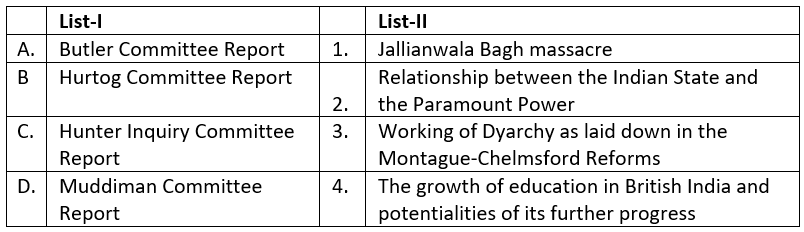
(a) A - 3; B - 2; C - 1; D - 4
(b) A - 1; B - 4; C - 2; D - 3
(c) A - 2; B - 1; C - 3; D - 4
(d) A - 2; B - 4; C - 1; D - 3
Question 24:
Who among the following suggested the winding up of the Indian National Congress after India attained independence? [1996]
(a) C. Rajagopalachari
(b) Acharya Kripalani
(c) Mahatma Gandhi
(d) Jayaprakash Narain
Question 25:
Consider the following statements: [1996]
The Non-Cooperation Movement led to:
1. Congress becoming a mass movement for the first time
2. Growth of Hindu-Muslim unity
3. Removal of fear of the British might from the minds of the people
4. British government's willingness to grant political concessions to Indians
Of these statements:
(a) 1, 2, 3 and 4 are correct
(b) 2 and 3 are correct
(c) 1 and 3 are correct
(d) 3 and 4 are correct
Question 26:
Match List I with II and select the correct answer using the codes given below the lists: [1996]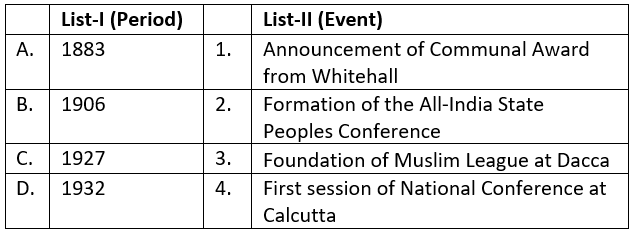
(a) A - 4; B - 3; C - 1; D - 2
(b) A - 3; B - 4; C - 1; D - 2
(c) A - 4; B - 3; C - 2; D - 1
(d) A - 3; B - 4; C - 2; D - 1
Question 27:
Match List-I with List-II and select the correct answer: [1996]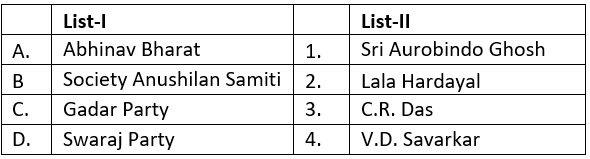
(a) A - 4; B - 1; C - 3; D - 2
(b) A - 1; B - 4; C - 3; D - 2
(c) A - 1; B - 4; C - 2; D - 3
(d) A - 4; B - 1; C - 2; D - 3
Question 28:
Which one of the following is not correct about the Cabinet Mission Plan? [1996]
(a) Provincial grouping
(b) Interim Cabinet of Indians
(c) Acceptance of Pakistan
(d) Constitution framing right
Question 29:
Consider the following statements about Jawaharlal Nehru: [1996]
1. He was the president of the Congress Party in 1947
2. He presided over the Constituent Assembly
3. He formed the first Congress Ministry in United Province before India's independence
Of these statements:
(a) 1, 2, and 3 are correct
(b) 1 and 3 are correct
(c) 1 and 2 are correct
(d) none is correct
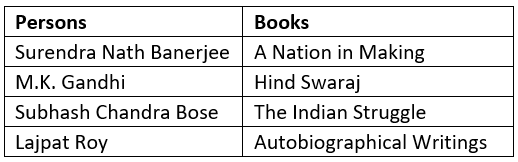
Question 30:
Match List-I with List-II and select the correct answer: [1996]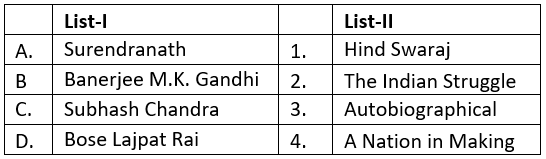
(a) A - 4; B - 1; C - 3; D - 2
(b) A - 1; B - 4; C - 3; D - 2
(c) A - 4; B - 1; C - 2; D - 3
(d) A - 1; B - 4; C - 2; D - 3
Question 31:
Who among the following was a prominent leader of the Congress Socialist Party? [1996]
(a) M.N. Roy
(b) Ganesh Shankar Vidyarthi
(c) Pattam Thanu Pillai
(d) Acharya Narendra Dev
Question 32:
The meeting of Indian and British political leaders during 1930-32 in London has often been referred to as the First, Second and Third Round Table Conferences. It would be incorrect to refer to them as such because: [1996]
(a) the Indian National Congress did not take part in two of them
(b) Indian parties other than the Indian National Congress, participating in the conference represented sectional interests and not the whole of India
(c) the British Labour Party had withdrawn from the conference thereby making the proceeding of the conference partisan
(d) It was an instance of a conference held in three sessions and not that of three separate conference
Question 33:
The Anarchical and Revolutionary Crime Act (1919) was popularly known as the: [1996]
(a) Rowlatt Act
(b) Pitt's India Act
(c) Indian Arms Act
(d) Ilbert Bill
Question 34:
B.R. Ambedkar was elected to the Constituent Assembly from: [1996]
(a) West Bengal
(b) Bombay President
(c) Madhya Bharat
(d) Punjab
Question 35:
Who among the following leaders did not believe in the drain theory of Dadabhai Naoroji? [1996]
(a) B.G. Tilak
(b) R.C. Dutt
(c) M.G. Ranade
(d) Sir Syed Ahmed Khan
Question 36:
Given below are two statements, one labelled as Assertion (A) and the other labelled as Reason (R).
Assertion (A): The British sovereignty continued to exist in free India.
Reason (R): The British sovereign appointed the last Governor-General of free India. In the context of the above two statements, which one of the following is correct? [1996]
(a) Both A and R are true but R is the correct explanation of A
(b) Both A and R are true but R is not a correct explanation of A
(c) A is true but R is false
(d) A is false but R is true
Question 37:
Which one of the following first mooted the idea of a constituent assembly to frame a constitution for India? [1996]
(a) Swaraj Party in 1934
(b) Congress Party in 1936
(c) Muslims League in 1942
(d) All Parties Conference in 1946
Question 38:
The Sarabandi (no tax) campaign of 1922 was led by: [1996]
(a) Bhagat Singh
(b) Chittaranjan Das
(c) Rajaguru
(d) Vallabhbhai Patel
Question 39:
Which one of the following pairs is not correctly matched? [1995]
(a) Jamnalal Bajaj-Satyagraha Ashram at Wardha
(b) Dadabhai Naoroji-Bombay Association
(c) Lala Lajpat Rai-National School at Lahore
(d) Bal Gangadhar Tilak-Satya Shodhak Sabha
Question 40:
In 1930, Mahatma Gandhi started Civil Disobedience Movement from: [1995]
(a) Sevagram
(b) Dandi
(c) Sabarmati
(d) Wardha
FAQs on Indian National Movement- Solved Questions - 4 (1995-1998)
| 1. What were the main factors that contributed to the Indian National Movement? |  |
| 2. Who were the prominent leaders of the Indian National Movement? | |
| 3. What were the major events during the Indian National Movement? | |
| 4. How did Mahatma Gandhi contribute to the Indian National Movement? | |
| 5. What were the outcomes of the Indian National Movement? | |




