Summary of Spectrum for Modern History for UPSC (Chapter-wise)

The book itself needs no introduction. Spectrum's Modern History is like a bible for UPSC Modern History Preparation for aspirants. It covers practically every facet of Modern History.
It's worth noting that the book simplifies the concept of Modern history and its numerous schedules for aspirants' ease of comprehension.
- While the Spectrum contains every little and crucial information that must be learned and retained until the exam, the aspirants are frequently swamped by the volume of the book.
- It is one of the most popular and comprehensive books on the Modern history for UPSC Preparation and has been a consistent bestseller for many years.
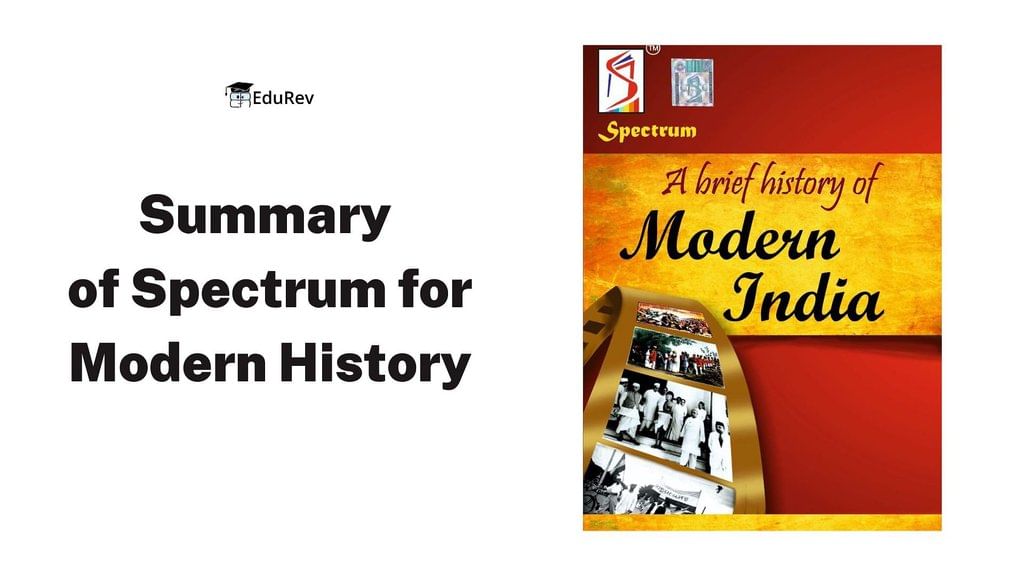
This is the reason that the experts of EduRev, who've mentored toppers like Anudeep Durishetty (AIR 1 2017) have prepared Spectrum's chapter-wise summaries to help students in their UPSC preparation. You can find chapter-wise summaries for all the chapters of Spectrum's Modern History for UPSC preparation here:
- Spectrum Summary: Sources for the History of Modern India
- Spectrum Summary: Major Approaches the History of Modern India
- Spectrum Summary: Advent of the Europeans in India
- Spectrum Summary: India on the Eve of British Conquest
- Spectrum Summary: Expansion & Consolidation of British Power in India- 1
- Spectrum Summary: Expansion & Consolidation of British Power in India- 2
- Spectrum Summary: The Revolt of 1857
- Spectrum Summary: General Features of Socio-Religious Reform Movements
- Spectrum Summary: General Survey of Socio-Cultural Reform Movements
- Spectrum Summary: Beginning of Modern Nationalism in India
- Spectrum Summary: The Foundation & the Moderate Phase of the INC
- Spectrum Summary: Era of Militant Nationalism (1905-1909)
- Spectrum Summary: First Phase of Revolutionary Activities (1907-1917)
- Spectrum Summary: First World War & Nationalist Response
- Spectrum Summary: Emergence of Gandhi
- Spectrum Summary: Non-Cooperation Movement & Khilafat Aandolan
- Spectrum Summary: Emergence of Swarajists, Socialist Ideas, Revolutionary Activities & New Forces
- Spectrum Summary: Simon Commission & the Nehru Report
- Spectrum Summary: Civil Disobedience Movement & Round Table Conferences
- Spectrum Summary: Debates Movement on the Future Strategy after Civil Disobedience
- Spectrum Summary: Congress Rules in Provinces
- Spectrum: Summary of Nationalist Response in the wake of World War II
- Spectrum: Summary of Quit India movement, Demand for Pakistan and the INA
- Spectrum: Summary of Post-War National Scenario
- Spectrum: Summary of Independence with Partition
- Spectrum: Summary of Survey of British Policies in India
- Spectrum: Summary of Constitutional, Administrative and Judicial Developments
- Spectrum Summary: The Economic Impact of British Rule in India
- Spectrum: Summary of Development of Indian Press
- Spectrum: Summary of Development of Education
- Spectrum: Summary of Peasant Movements 1857-1947
- Spectrum: Summary of The movement of the working class
- Spectrum: Summary of Challenges before The New-Born Nation
- Spectrum: Summary of First General Election
- Spectrum: Summary of The Indian States
- Spectrum: Summary of Making of the Constitution for India
- Spectrum: Summary of the Evolution of Nationalist Foreign Policy
Please note that 10%-20% of the above-mentioned documents are free while others are locked and can be accessed by subscribing to the EduRev Infinity package for UPSC.
You can also find summaries of other important books on EduRev:
- UPSC level MCQs for all chapters of Laxmikanth for Indian Polity UPSC
- Summary of Nitin Singhania for Art & Culture for UPSC (all chapters)
- Summary for Ramesh Singh for Indian Economy for UPSC (all chapters)
- Summary for Shankar IAS Notes for Environment for UPSC (all chapters)
- Summary of Spectrum for Modern History for UPSC (all chapters)
- Summary for GC Leong for Geography for UPSC (all chapters)
FAQs on Summary of Spectrum for Modern History for UPSC (Chapter-wise)
| 1. What are the main periods covered in Spectrum's Modern History summary for UPSC preparation? |  |
| 2. How do I use Spectrum Modern History chapter-wise notes to remember important dates and events? | |
| 3. What's the difference between Spectrum's coverage of the British Raj and nationalist movements? | |
| 4. Which topics in Spectrum Modern History summary appear most frequently in UPSC previous year questions? | |
| 5. How can I connect Spectrum Modern History summaries with NCERT textbooks for comprehensive UPSC preparation? | |


