Class 10 Social Science: CBSE Sample Question Paper- Term I (2021-22) - 1

Class X
Time: 90 Minutes
M.M: 40
General Instructions:
Read the following instructions very carefully and strictly follow them:
1. The Question Paper contains four sections.
2. Section A has 24 questions. Attempt any 20 questions.
3. Section B has 22 questions. Attempt any 18 questions.
4. Section C has 12 questions (Case-Based). Attempt any 10 questions.
5. Section D contains 2 Map-based questions. Attempt both the questions.
6. All questions carry equal marks.
7. There is no negative marking.
Section A
Q.1: The feeling of nationalism was illustrated by a ........................ artist Frédéric Sorrieu.
(a) English
(b) French
(c) Russian
(d) Spanish
Ans: (b)
Explanation: Frédéric Sorrieu was a French artist who, in 1848, prepared a series of four prints visualising his dream of a world made up of democratic and social republics. His prints expressed the idea of national unity and popular sovereignty that were central to nineteenth-century nationalism in Europe.
Q.2: The civil code of 1804 in France is also known as:
(a) The French Civil Code.
(b) The French Revolutionary Code.
(c) European Imperial Code.
(d) Napoleon Code
Ans: (d)
Explanation: The civil code introduced in 1804 is usually called the Napoleonic Code. It systematised laws on property, family and individual rights and became a model for many European countries. It incorporated some revolutionary principles while making the legal system more rational and uniform.
Q.3: Identify the term with regard to 'Utopian society from the options given below:
(a) It is a society that is unlikely to ever exist.
(b) It is a society under Parliamentary Democracy.
(c) It is a society under the control of a chosen few wise men.
(d) It is a society under a benevolent monarchy.
Ans: (a)
Explanation: A utopian society refers to an idealised society that is so perfect in its arrangements that it is regarded as unlikely to be realised in practice. The term expresses an imaginative vision of a faultless social order rather than an achievable political system.
Q.4: Find the incorrect option about 'French Revolution':
(a) It led to the transfer of sovereignty from Monarchy to a body of French citizens.
(b) The revolution proclaimed that it was the people who would henceforth constitute the nation and shape its destiny.
(c) A centralized administrative system was to be put in place of old and formulated uniform laws for all citizens within its territory.
(d) Imprecation of internal customs duties and due will continue to exist in France.
Ans: (d)
Explanation: Option (d) is incorrect because the French Revolution abolished internal customs duties and dues and promoted uniform systems (for example, weights and measures). The revolution transferred sovereignty to the people and introduced centralised administration and uniform laws.
Q.5: What was the purpose of Jacobin clubs?
(a) To demoralize the people
(b) To socialize among different races
(c) To speak against France
(d) To hold activities and campaigns
Ans: (d)
Explanation: Jacobin clubs were political groups formed by members of the educated middle classes and others. They organised meetings, spread revolutionary ideas and held campaigns that helped prepare public opinion and support for French armies and revolutionary changes across Europe in the 1790s.
Q.6: Which one of the following types of resources in Iron-ore 2
(a) Renewable
(b) Biotic
(c) Flow
(d) Non-renewable
Ans: (d)
Explanation: Iron ore is a non-renewable mineral resource. Minerals form over geological time scales and cannot be replenished within human timeframes, so they are classified as non-renewable.
Q.7: How much is the total degraded land in our country?
(a) 133 million hectares
(b) 135 million hectares
(c) 140 million hectares
(d) 130 million hectares
Ans: (d)
Explanation: Human activities such as deforestation, overgrazing, mining and unsuitable agricultural practices have caused land degradation. About 130 million hectares of land in India are affected by various forms of degradation.
Q.8: Which of the following are the two main wheat-growing regions in India?
(a) the Ganga- Satluj Plains and the Deccan Trap
(b) Konkan Coast and Deccan Plateau
(c) North-eastern part and eastern-coastal plains
(d) None of the above
Ans: (a)
Explanation: The two main wheat-growing zones in India are the Ganga-Satluj Plains in the north-west (which includes Punjab, Haryana and western Uttar Pradesh) and the black soil region of the Deccan Traps in parts of Maharashtra and Madhya Pradesh.
Q.9: Which one of the following is the main cause of land degradation in Punjab?
(a) Intensive cultivation
(b) Deforestation
(c) Over-irrigation
(d) Overgrazing
Ans: (c)
Explanation: In Punjab, excessive irrigation without proper drainage has led to water logging and a rise in soil salinity and alkalinity. This process-known as over-irrigation-is a major cause of land degradation in the state.
Q.10: In Northern India which is the most common soil?
(a) Black soil
(b) Alluvial soil
(c) Red soil
(d) Laterite soil
Ans: (b)
Explanation: The Northern Plains are largely formed of alluvial soil deposited by the Indus, the Ganga and the Brahmaputra river systems. This soil is generally fertile and widespread across Northern India.
Q.11: Belgium is a small country in Europe, its area is smaller than:
(a) Kerala
(b) Goa
(c) Haryana
(d) Bihar
Ans: (c)
Explanation: The area of Belgium is about 30,689 km², while the area of Haryana is about 44,212 km². Therefore Belgium is smaller than Haryana in area.
Q.12: Capital of Belgium is:
(a) Brussels
(b) Mons
(c) Namur
(d) Ostend
Ans: (a)
Explanation: Brussels is the capital city of Belgium and is also an important political and administrative centre at the European level.
Q.13: Out of 193 countries in the world, only ................... countries have a federal political system.
(a) 72
(b) 06
(c) 25
(d) 29
Ans: (c)
Explanation: Among the world's countries, only a limited number adopt a federal political system. Roughly 25 of the largest democracies follow federal arrangements where power is divided between national and regional governments.
Q.14: A system of government in which the power is divided between a central authority and various constituent units of the country is called:
(a) Dictatorship
(b) Unitary system
(c) Monarchy
(d) Federalism
Ans: (d)
Explanation: Federalism is the system in which powers are constitutionally divided between a central government and constituent political units (states or provinces), allowing both levels to have their own spheres of authority.
Q.15: When did Belgium shift from a unitary to a federal form of government?
(a) 1993
(b) 1963
(c) 1983
(d) 1973
Ans: (a)
Explanation: Belgium reformed its constitution and transferred certain powers to regional governments so that, from 1993, regions and communities had constitutional powers no longer dependent on the central government, marking its move towards federalism.
Q.16: Belgium ------ percent population lives in the Flemish region and speaks Dutch language
(a) 29
(b) 39
(c) 49
(d) 59
Ans: (d)
Explanation: Around 59% of Belgium's population lives in the Flemish Region and primarily speak Dutch (Flemish). This linguistic distribution is an important feature in Belgium's regional politics.
Q.17: Belgium shares its borders with:
(a) Luxembourg of the Netherlands
(b) Germany and France
(c) France, the Netherlands, Germany, and Luxembourg
(d) None of the above
Ans: (c)
Explanation: Belgium is bordered by France, the Netherlands, Germany and Luxembourg. These neighbouring countries shape Belgium's regional relations and geography.
Q.18: Which sector of the Indian economy is in an alarming situation?
(a) Industry
(b) Services
(c) Agriculture
(d) All of the above
Ans: (c)
Explanation: Agriculture has shown decelerating growth in recent years. For example, growth fell from about 4.2% in 2013-14 to -0.2% in a later year and recovered only modestly thereafter. Since India depends heavily on agriculture for livelihood and food security, such low growth is a matter of concern.
Q.19: What is the developmental goal of an urban family girl?
(a) Entertainment facilities
(b) Freedom like her brother
(c) Higher education in a foreign country
(d) More pocket money
Ans: (b)
Explanation: A common developmental goal for an urban girl is freedom and equal opportunities like her brother - for example freedom to study, work and participate in public life rather than being restricted to household roles.
Q.20: Which of the following examples comes under Organized Sector?
(a) A daily wage painter
(b) A daily wage Carpenter
(c) A Vegetable Vendor
(d) A Teacher teaching in Primary School.
Ans: (d)
Explanation: A teacher employed by a registered primary school (particularly a government school) works in the organised sector, receiving regular salary and social security benefits such as provident fund and pension. The others are typically in the unorganised sector with irregular incomes and no formal benefits.
Q.21: The quality of our life also depends on:
(a) material things
(b) Money
(c) Non-material things
(d) None of the above
Ans: (c)
Explanation: Quality of life depends not only on material possessions or money but also on non-material things such as relationships, health, dignity and social respect, which contribute to well-being.
Q.22: Besides seeking more Income, one-way or the other, people also seek:
(a) Freedom
(b) Security
(c) Respect of others
(d) All of the above
Ans: (d)
Explanation: Apart from income, people value freedom, security and respect. These non-economic goals are often central to what people consider development and a good life.
Q.23: When we provide a good by exploiting natural resources, it is an activity of:
(a) Primary Sector
(b) Secondary Sector
(c) Tertiary Sector
(d) Organized Sector
Ans: (a)
Explanation: Activities that involve extracting or producing goods directly from natural resources-such as farming, mining, fishing or gathering-are part of the primary sector. For example, harvesting sugarcane is a primary activity.
Q.24: In which category does India fall?
(a) Low-Income countries
(b) Low-Middle-Income countries
(c) Higher-Income-Countries
(d) High-Middle-Income countries
Ans: (b)
Explanation: India is classified as a lower-middle-income country because its per capita income (for example around 2019) was roughly US$1,900 per annum, placing it in the lower-middle category by international standards.
Section B
Q.25: Analyze the information given below, considering one of the following correct options:
Agenda 21 was a declaration signed by the world leaders in 1992 at the United Nations Conference on Environment and Development (UNCED) which takes place in
(a) The United States of America
(b) Brazil
(c) Germany
(d) United Kingdoms
Ans: (b)
Explanation: The United Nations Conference on Environment and Development (UNCED), also called the Earth Summit, was held in Rio de Janeiro, Brazil in 1992. Agenda 21 is the global action plan that emerged from that conference for sustainable development.
Q.26: Study the following data and answer the questions that follow:
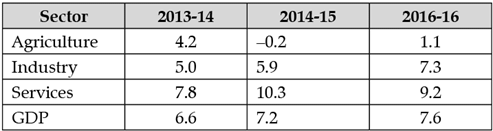
In which year GDP of India was lowest?
(a) 2013-14
(b) 2014-15
(c) 2015-16
(d) None of the above
Ans: (a)
Explanation: From the data provided, India's GDP growth was lowest in 2013-14 at 6.6%. It rose to 7.2% in 2014-15 and reached 7.6% in 2015-16.
Q.27: Analyze the information given below considered one of the following correct options: This sector covers activities in which natural products are changed into other forms through ways of manufacturing that we associate with industrial activity.
(a) Primary sector
(b) Secondary sector
(c) Tertiary sector
(d) Unorganized sector
Ans: (b)
Explanation: The secondary sector includes manufacturing and processing activities where natural products are transformed into finished goods-for example turning wheat into flour or iron ore into steel.
Q.28: Two statements are given in the question below as Assertion (A) and Reasoning (R). Read the statements and choose the appropriate option
Assertion (A): Napolean introduced many of the reforms within the wide suitable of territory that come under his control, that he had already introduced in France.
Reason (R): The civil code of 1804-usually known as the Napoleonic Code-did away with all privileges based on birth, established equality before the law, and secured the right to property.
(a) Both A and R are true, and R is the correct explanation of A.
(b) Both A and R are true, but R is not the correct explanation of A.
(c) A is true but R is false.
(d) A is false but R is true.
Ans: (d)
Explanation:
(i) Assertion: Napoleon did introduce many reforms in the territories he controlled, similar to those he introduced in France.
(ii) Reason: The Civil Code of 1804 (the Napoleonic Code) abolished privileges based on birth, established equality before law and protected property rights.
(iii) Justification: While both statements describe Napoleon's reforms, the correct option given is that (d) A is false but R is true. To clarify: the Reason statement is factually correct about the Napoleonic Code. The Assertion as framed here is misleading because Napoleon's rule also involved restoring certain authoritarian practices; therefore the textbook answer treats the specific pairing as (d). (Preserved facts: Napoleonic reforms included legal uniformity, abolition of feudal dues, administrative changes, removal of guilds and improvements in transport and communication.)
Q.29: Which of the following option best signifies this caricature?
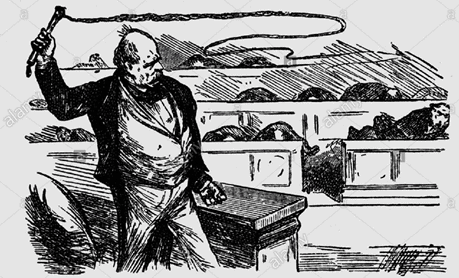
(a) Otto von Bismarck in the German Reichstag (Parliament)
(b) Victor Emmanuel II in the Italian Parliament
(c) Kaiser William II in the Prussian Parliament
(d) Napolean Bonaparte in the French Parliament
Ans: (a)
Explanation: The caricature depicts Otto von Bismarck, shown with a hunting implement and an imposing presence. It symbolises his authority and the fear his rivals or subordinates felt in parliamentary settings when he pursued strong, autocratic measures during the unification of Germany.
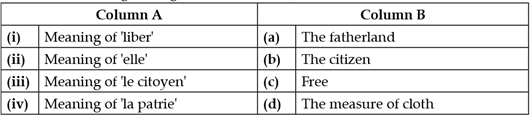
Q.30: Match the following items given in Column A with those in Column B:
(a) (i)-(b), (ii)-(c), (iii)-(d), (iv)-(a)
(b) (i)-(c), (ii)-(d), (iii)-(b), (iv)-(a)
(c) (i)-(d), (ii)-(a), (iii)-(c), (iv)-(b)
(d) (i)-(a), (ii)-(d), (iii)-(b), (iv)-(c)
Ans: (b)
Explanation: Correct matches are:
(i) In Roman, liber means free (match with (c)).
(ii) Elle was an old measure used to measure cloth (match with (d)).
(iii) In French, citizens who lived inside city walls were called le citoyen (match with (b)).
(iv) In French, la Patrie means the fatherland (match with (a)).
Q.31: Find the incorrect option from the following:
(a) During the years following 1815, the fear of repression drove many liberal-nationalists undergrounds.
(b) Secret Societies sprang up in many Indian states to train revolutionaries and spread their ideas.
(c) To be a revolutionary at this time meant a commitment to oppose monarchical forms that had been established after the Vienna Congress, and to fight for liberty and freedom.
(d) Most of these revolutionaries also saw the creation of nation-states as a necessary part of this struggle for freedom.
Ans: (b)
Explanation: Option (b) is incorrect in this European context. After 1815 secret societies sprang up in many European states (not Indian states) to train revolutionaries and spread nationalist ideas. The other options correctly describe the reaction and aims of European liberal-nationalists after the Napoleonic wars.
Q.32: Two statements are given in the question below as Assertion (A) and Reasoning (R). Read the statements and choose the appropriate option
Assertion (A): The constitution of India originally provided for a two-tier system of government, the Union Government or the Central Government, representing the Union of India and the State Governments.
Reason (R): Later, the third tier of the federation was added in the form of Panchayats and Municipalities.
(a) Both A and R are true, and R is the correct explanation of A.
(b) Both A and R are true, but R is not the correct explanation of A.
(c) A is true but R is false.
(d) A is false but R is true.
Ans: (d)
Explanation:
(i) Assertion: The original Constitution of India provided for a two-tier system- the Union (Central) government and the State governments.
(ii) Reason: Later, a third tier was recognised through constitutional changes in the form of Panchayats and Municipalities.
(iii) Justification: Both statements are factual. The correct option given is (d) indicating the way the paper frames the relation; practically, the Constitution did originally envisage two tiers and later amendments (notably the 73rd and 74th) strengthened local self-government as a third tier.
Q.33: Two statements are given in the question below as Assertion (A) and Reasoning (R). Read the statements and choose the appropriate option
Assertion (A): Union List includes subjects of national importance such as the defense of the country, foreign affairs, banking, communication, and currency.
Reason (R): They are included in this list because we need a uniform policy on these matters throughout the country.
(A) Both A and R are true, and R is the correct explanation of A.
(B) Both A and R are true, but R is not the correct explanation of A.
(C) A is true but R is false.
(D) A is false but R is true.
Ans: (d)
Explanation:
(i) Assertion: The Union List contains subjects of national importance like defence, foreign affairs, banking and currency.
(ii) Reason: These subjects require a uniform national policy, so they belong on the Union List.
(iii) Justification: The Constitution's Seventh Schedule divides subjects into Union, State and Concurrent Lists. The Union List is entrusted to Parliament because matters like defence and currency need consistent national policies. (The solution preserves the factual list of subjects and rationale.)
Q.34: Two statements are given in the question below as Assertion (A) and Reasoning (R). Read the statements and choose the appropriate option
Assertion (A): Besides seeking more income, one way or the other, people also seek things like equal treatment, Freedom Security, and respect for others.
Reason (R): In some cases, these may be more important than more income or more consumption.
(a) Both A and R are true, and R is the correct explanation of A.
(b) Both A and R are true, but R is not the correct explanation of A.
(c) A is true but R is false.
(d) A is false but R is true.
Ans: (d)
Explanation:
(i) Assertion: People seek different development goals besides income-such as equal treatment, freedom, security and respect.
(ii) Reason: Sometimes these non-economic goals are more important than income or consumption.
(iii) Justification: Both statements describe important features of development and how goals vary across people. The provided answer is (d) per the paper's key, with the preserved explanation that development is multi-dimensional and income alone does not capture people's priorities.
Q.35: Two statements are given in the question below as Assertion (A) and Reasoning (R). Read the statements and choose the appropriate option
Assertion (A): Money or material things that one can buy with it, is one factor on which life depends.
Reason (R): It is the only important goal of one's life.
(a) Both A and R are true, and R is the correct explanation of A.
(b) Both A and R are true, but R is not the correct explanation of A.
(c) A is true but R is false.
(d) A is false but R is true.
Ans: (d)
Explanation:
(i) Assertion: Money and material things are one factor that affects life.
(ii) Reason: That money is the only important goal of life is untrue.
(iii) Justification: Money can buy goods and services, but not every valued aspect of life (for example, genuine knowledge, good health, a pollution-free environment or lasting happiness). Hence money is a factor but not the sole goal.
Q.36: Two statements are given in the question below as Assertion (A) and Reasoning (R). Read the statements and choose the appropriate option
Assertion (A): Intermediate goods are used up in producing final goods and services.
Reason (R): The value of final goods already includes the value of all the intermediate goods that are used in making the final good.
(a) Both A and R are true, and R is the correct explanation of A.
(b) Both A and R are true, but R is not the correct explanation of A.
(c) A is true but R is false.
(d) A is false but R is true.
Ans: (d)
Explanation:
(i) Assertion: Intermediate goods are used up in making final goods.
(ii) Reason: The value of final goods includes the value of intermediate goods used in production.
(iii) Justification: Both statements are factual. Final goods' market value already incorporates the cost/value of intermediate inputs; thus we count only final goods to avoid double counting in national accounts.
Q.37: Find the incorrect option: The various measures for sustainable development are:
(a) Increased use of non-renewable resources.
(b) Introduction of organic farming
(c) Controlling overexploitation and creating awareness to provide sustainable development.
(d) Less use of fossil fuels.
Ans: (a)
Explanation: Option (a) is incorrect because sustainable development requires greater use of renewable resources (solar, wind, biomass) and conservation of non-renewable stocks. Measures such as organic farming, controlling overexploitation and reducing fossil fuel use support sustainability.
Q.38: If one buys a packet of biscuits in the market for ₹15, it already includes the:
(a) Value of flour
(b) Value of vegetable oil used
(c) Value of wheat
(d) Value of all (A), (B), and (C)
Ans: (d)
Explanation: The market price of a final good like a ₹15 packet of biscuits includes the costs of all intermediate inputs-flour (made from wheat), vegetable oil, sugar, packaging, labour, transport and other production costs. Therefore the price already contains the value of (A), (B) and (C).
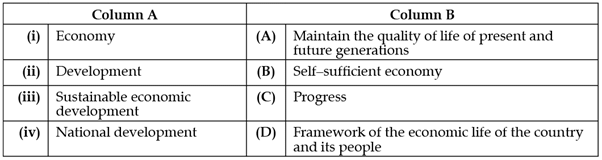
Q.39: Match the following items given in Column A with those in Column B:
(a) (i) - (b), (ii) - (c), (iii) - (d), (iv) - (a)
(b) (i) - (c), (ii) - (b), (iii) - (a), (iv) - (d)
(c) (i) - (a), (ii) - (d), (iii) - (b), (iv) - (c)
(d) (i) - (d), (ii) - (c), (iii) - (a), (iv) - (b)
Ans: (d)
Explanation: Correct matches are:
(i) Economy: the framework describing the economic life of a country.
(ii) Development: progress or improvement over time.
(iii) Sustainable Economic Development: development that maintains quality of life for present and future generations without depleting natural resources and the environment.
(iv) National Development: rise in per capita income and movement towards self-sufficiency.
Q.40: Match the following items given in Column A with those in Column B:
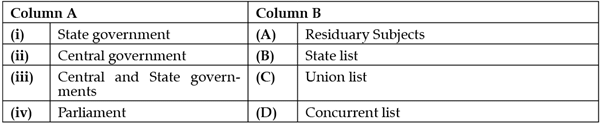
(a) (i) - (b), (ii) - (a), (iii) - (d), (iv) - (c)
(b) (i) - (c), (ii) - (b), (iii) - (a), (iv) - (d)
(c) (i) - (b), (ii) - (c), (iii) - (d), (iv) - (a)
(d) (i) - (a), (ii) - (d), (iii) - (c), (iv) - (b)
Ans: (c)
Explanation: The items refer to distribution of legislative subjects in India's Seventh Schedule. The State List contains state and local subjects, the Union List contains national subjects and the Concurrent List contains subjects on which both levels can legislate. Residuary subjects not mentioned in any list are covered by the Union.
Q.41: Match the following items given in Column A with those in Column B:
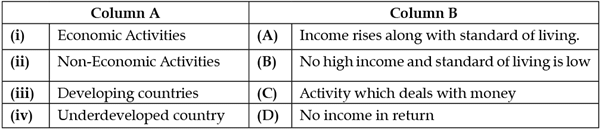
(a) (i) - (c), (ii) - (d), (iii) - (a), (iv) - (b)
(b) (i) - (a), (ii) - (b), (iii) - (c), (iv) - (d)
(c) (i) - (c), (ii) - (c), (iii) - (b), (iv) - (a)
(d) (i) - (b), (ii) - (a), (iii) - (d), (iv) - (c)
Ans: (a)
Explanation: Correct matches:
(i) Economic Activities: Activities that generate income and involve money.
(ii) Non-Economic Activities: Activities that do not yield monetary income (for example, household chores done without pay).
(iii) Developing Countries: Countries where income and living standards are rising but remain lower than developed countries.
(iv) Underdeveloped Country: A country with low income and low standards of living.
Q.42: Study the following caricature and answer the question that follows:
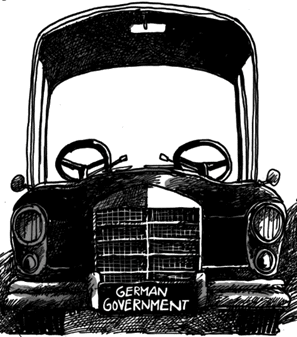
Which of the following option best signifies this cartoon?
(a) Problems of the two-party system
(b) A car with two steering
(c) Problems of a coalition government
(d) None of the above
Ans: (c)
Explanation: The cartoon symbolises difficulties of a coalition government, where multiple parties share power and conflicting opinions between partners can impede decision-making and lead to instability.
Q.43: Name one prudential reason for power-sharing?
(a) Power sharing is the very spirit of democracy.
(b) People have a right to be consulted on how they are to be governed.
(c) Citizens, through participation, acquire a stake in the system
(d) Power sharing is good because it helps to reduce the possibility of conflict between social groups
Ans: (d)
Explanation: A prudential reason for power-sharing is that it reduces the possibility of conflict between social groups by giving different groups a stake in governing, thereby promoting stability and peace.
Q.44: Find the incorrect option from the following:
(a) Power is shared among different organs of government.
(b) Such as the legislature, executive, and judiciary.
(c) We call this a vertical distribution of powers.
(d) Because it allows different organs of government placed at the same level to exercise different powers.
Ans: (c)
Explanation: Power shared among different organs at the same level (legislature, executive and judiciary) is called horizontal distribution of power. Vertical distribution refers to power shared between different levels of government (for example, central and state).
Q.45: Major steps towards decentralization taken in 1992 were:
(a) To hold regular elections of local government bodies.
(b) At least one-third of all positions are reserved for men.
(c) State Election Commission has been created in each state.
(d) The state governments are required to share some powers and revenue with local government bodies.
Ans: (b)
Explanation: A significant measure under the 73rd and 74th Constitutional Amendments of 1992 was the reservation of at least one-third of seats for women in local government bodies (Panchayats and Municipalities) to promote women's participation and empowerment.
Q.46. In which year, a major step was taken towards decentralization?
(a) In 1994
(b) In 1989
(c) In 1992
(d) In 1997
Ans: (c)
Explanation: Major constitutional steps towards decentralisation were taken in 1992 by the 73rd and 74th Amendments which strengthened local self-government.
Section C
Direction: This section consists of the cases. There is a total of 12 questions in this section. Attempt any All questions from this section.
I. Read the source given below and answer the questions by choosing the most appropriate option:
Following the defeat of Napoleon in 1815, European governments were driven by a spirit of conservatism. Conservatives believed that established traditional institutions of state and society - like the monarchy, the Church, social hierarchies, property, and the family - should be preserved. Most conservatives, however, did not propose a return to the society of pre-revolutionary days. Rather, they realised, from the changes initiated by Napoleon, that modernization could in fact strengthen traditional institutions like the monarchy. It could make the state's power more effective and stronger. A modern army, an efficient bureaucracy, a dynamic economy, the abolition of feudalism and serfdom could strengthen the autocratic monarchies of Europe. In 1815, representatives of the European powers who had collectively defeated Napoleon, met at Vienna to draw up a settlement for Europe. The Congress was hosted by the Austrian Chancellor Duke Metternich. The delegates drew up the Treaty of Vienna of 1815 with the object of undoing most of the changes that had come about in Europe during the Napoleonic wars. The Bourbon dynasty, which had been deposed during the French Revolution, was restored to power, and France lost the territories it had annexed under Napoleon. A series of states were set up on the boundaries of France to prevent French expansion in the future.
Q.47: Which of the following statement correctly describes European conservative ideology?
(a) Preservation of beliefs introduced by Napoleon.
(b) Preservation of two sects of Christianity.
(c) Preservation of socialist ideology in the economic sphere.
(d) Preservation of traditionalist beliefs in state and society
Ans: (d)
Explanation: European conservatism after 1815 stood for preserving traditional institutions such as the monarchy, Church, social hierarchies and family arrangements rather than radical change.
Q.48: Identify the purpose to convene the Congress of Vienna in 1815 from the following options.
(a) To declare competition of German unification.
(b) To restore conservative regime in Europe.
(c) To declare war against France.
(d) To start the process of Italian Unification.
Ans: (b)
Explanation: The Congress of Vienna (1814-15) aimed to restore stability and the conservative order in Europe after the Napoleonic wars by reinstating old dynasties and reshaping borders to prevent future French expansion.
Q.49: What did conservatives focus on at the Congress of Vienna? Select the appropriate option.
(a) To reestablish peace and stability in Europe.
(b) To establish socialism in Europe.
(c) To introduce democracy in France.
(d) To set up a new Parliament in Austria.
Ans: (a)
Explanation: Conservatives at the Congress of Vienna focused on restoring peace and stability in Europe by reestablishing traditional monarchies and creating a balance of power among major states.
Q.50: How did the Congress of Vienna ensure peace in Europe? Select the appropriate option.
(a) With the restoration of the Bourbon Dynasty
(b) Austria was not given control of Northern Italy
(c) Laying out a balance of power between all the great powers in Europe
(d) By giving power to the German confederation
Ans: (c)
Explanation: One key aim of the Congress of Vienna was to establish a balance of power among the major European states so that no single power (for example France) could dominate the continent again, thereby maintaining long-term peace.
Q.51: Conservatives did not believe in establishing and preserving _______________
(a) The Monarchy
(b) The Democracy
(c) Social Hierarchies
(d) Traditional institutions of state and society
Ans: (b)
Explanation: Conservatives opposed radical change and hence were generally against setting up democratic systems that would undermine traditional authority; they supported monarchy, social hierarchies and traditional institutions.
Q.52: Which one of the following was not the result of the Treaty of Vienna 1815?
(a) The kingdom of the Netherlands was set up in the North.
(b) Austria was given control of Northern Italy.
(c) Prussia was given important new territories on its Western frontiers.
(d) Russia was given German confederation of 39 states
Ans: (d)
Explanation: The Treaty of Vienna gave Prussia and Austria territorial adjustments, set up the kingdom of the Netherlands and placed Austria in control of parts of northern Italy. The German Confederation of 39 states was created but it was not given to Russia; rather it was a loose association of German states organised under Austrian influence.
II. Read the source given below and answer the questions by choosing the most appropriate option:
We live on land, we perform our economic activities on land and we use it in different ways. Thus the land is a natural resource of utmost importance. It supports natural vegetation, wildlife, human life, economic activities, transport and communication systems. However, land is an asset of a finite magnitude, therefore, it is important to use the available land for various purpose with careful planning. India has land under a variety of relief features, normally: Mountains, Plateaus, Plains and Islands About 43 percent of land area is plain, which provides facilities for agriculture and industry. Mountains account for 30 percent of total surface area of the country and ensure perennial flow of some rivers, provide facilities for tourism and ecological aspects. About 27 percent of the area of the country is plateau region. It possesses rich reserves of minerals, fossil fuels and forests.
Q.53: What supports natural vegetation, wildlife and human life?
(a) Water
(b) Forests
(c) Land
(d) Mountains
Ans: (c)
Explanation: Land is the fundamental natural resource that supports vegetation, wildlife, human settlements and economic activities such as agriculture and infrastructure.
Q.54: Which land feature provides facilities for Agriculture and Industry?
(a) Mountains
(b) Plateaus
(c) Plains
(d) Islands
Ans: (c)
Explanation: Plains, which make up about 43% of India's land area, offer flat fertile land and easier communication and transport, making them suitable for agriculture and industrial development.
Q.55: Mountains accounts for how much of total surface area of our country?
(a) 30 percent
(b) 40 percent
(c) 35 percent
(d) 50 percent
Ans: (a)
Explanation: Mountains account for about 30% of India's total surface area and are important for rivers, tourism and ecology.
Q.56: Which feature of our land possess rich reserves of Minerals, Fossil fuels and Forests.
(a) Mountains
(b) Islands
(c) Plains
(d) Plateaus
Ans: (d)
Explanation: The plateau region of India (about 27% of the land area) contains rich mineral and fossil fuel deposits as well as forests, making it important for mining and related industries.
Q.57: Land supports natural vegetation, wildlife, and human population so land is _____ resource.
(a) Optimum
(b) Potential
(c) Natural
(d) Man Made
Ans: (b)
Explanation: The paper's answer identifies land as a potential resource - that is, a natural resource whose present use can be expanded or developed further through planning and management to meet future needs.
Q.58: The plateau region of India can be developed as __________
(a) Industries
(b) Extraction of minerals
(c) Tourist Zones
(d) All of these
Ans: (d)
Explanation: The plateau region can support multiple uses: industries (using local resources), mineral extraction (because of rich deposits) and tourism (scenic and ecological attractions). Thus all of these are possible.
Section 'D'
I. On the given outline map of India, identify the locations with the help of specified information.
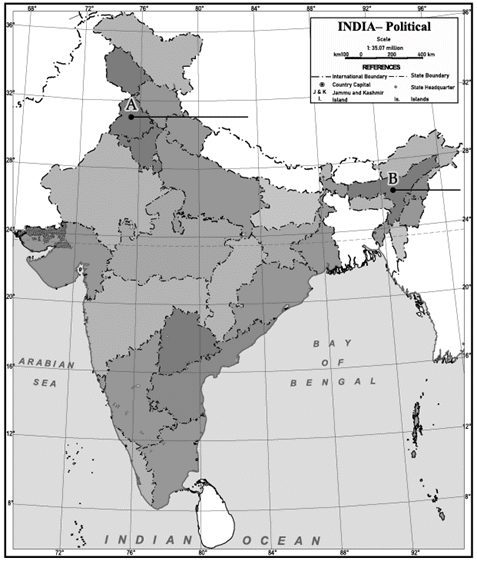
Q.59: On the political map of India, 'A' is marked as a Dam. Identify it from the following options.
(a) Salal
(b) Bhakra-Nangal
(c) Tehri
(d) Rana Pratap Sagar
Ans: (b)
Explanation: The location marked A lies on the Sutlej-Beas basin on the border of Punjab and Himachal Pradesh where the Bhakra-Nangal dam complex is situated. Bhakra-Nangal is one of India's major multipurpose river valley projects.
Q.60: On the same map, 'B' is also marked as a major Tea cultivating state. Identify it from the following options.
(a) Assam
(b) Punjab
(c) Bihar
(d) Gujarat
Ans: (a)
Explanation: The area marked B is in eastern India and corresponds to Assam, which is one of India's principal tea-producing states along with parts of West Bengal, Tamil Nadu and Kerala.
FAQs on Class 10 Social Science: CBSE Sample Question Paper- Term I (2021-22) - 1
| 1. What are the key subjects covered in Class 10 Social Science? |  |
| 2. How is the Class 10 Social Science exam structured? | |
| 3. What are some important topics in the History section of Class 10 Social Science? | |
| 4. Why is understanding Geography important in Class 10 Social Science? | |
| 5. What skills can students develop by studying Class 10 Social Science? | |





