UPSC Exam  >  UPSC Notes  >  How to study Ramesh Singh for Indian Economy for UPSC

How to study Ramesh Singh for Indian Economy for UPSC

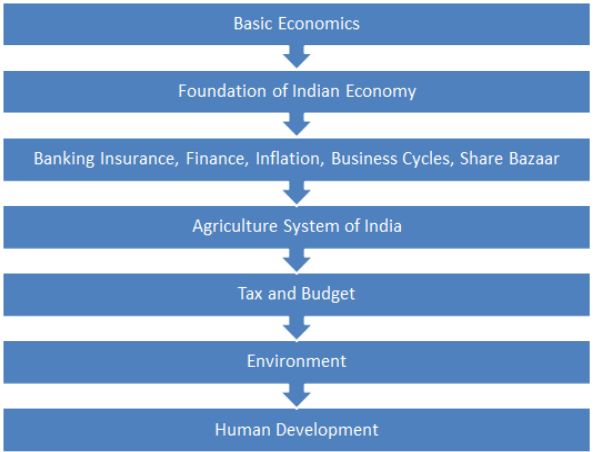
The flow of the Chapters will cover all the topics and reading in this way will help you to relate between topics and understand it better:
How to study Ramesh Singh for Indian Economy for UPSC


The Chapters are given according to latest edition (i.e. 13th edition) and the flow of reading should be like as given below:

Chapter 1: Introduction
Chapter 2: Growth, Development & Happiness

  • Chapter 1 & Chapter 2 will cover Basic Economics.

Chapter 3: Evolution of the Indian Economy
Chapter 9: Industry & Infrastructure
Chapter 6: Economic Reforms
Chapter 4: Economic Planning
Chapter 5: Planning in India

  • Foundation of Indian Economy will be covered in Chapter 3, Chapter 9, Chapter 6, Chapter 4 & Chapter 5.

Chapter 7: Inflation & Business Cycle
Chapter 11: Indian Financial Market

Chapter 12: Banking in India
Chapter 13: Insurance in India
Chapter 14: Security Market in India

  • Banking Insurance, Finance, Inflation, Business Cycles, Share Bazaar content will be covered in Chapter 7, Chapter 11, Chapter 12, Chapter 13 & Chapter 14.

Chapter 8: Agriculture & Food Management
Chapter 10: Services Sector

  • Agriculture System of India and Service Sector is covered in Chapter 8 & Chapter 10.

Chapter 15: External Sector in India
Chapter 16: International Economic Organisations & India

Chapter 17: Tax Structure in India

Chapter 18: Public Finance in India

  • Tax and Budget are covered in Chapter 17 & Chapter 18

Chapter 19: Sustainability & Climate Change: India & the World

  • Environment is covered in Chapter 19

Chapter 20: Human Development in India

  • Human Development is covered in Chapter 20

Chapter 21: Burning Socio Economic Issues

MCQs(PT), Model Answers (main) are also given in the book.

The document How to study Ramesh Singh for Indian Economy for UPSC is a part of UPSC category.
All you need of UPSC at this link: UPSC

FAQs on How to study Ramesh Singh for Indian Economy for UPSC

1. How should I start studying Ramesh Singh's Indian Economy book for UPSC preparation?
Ans. Begin with the National Income and basic macroeconomic concepts chapter, as it forms the foundation for understanding India's economy. Read Ramesh Singh systematically rather than randomly, focusing on definitions, key statistics, and policy frameworks. Take notes on important economic indices, Five-Year Plan priorities, and sectoral contributions to GDP. This structured approach builds conceptual clarity before tackling complex topics like monetary policy and fiscal management.
2. What are the most important topics in Ramesh Singh that appear frequently in UPSC exams?
Ans. Inflation, unemployment, poverty, agricultural economics, industrial policy, monetary and fiscal policy, and India's foreign trade feature regularly in UPSC question papers. Banking sector reforms, GST implementation, and structural changes in the Indian economy are also high-priority areas. Focus extra attention on recent economic survey data and budget announcements related to these topics. Cross-reference Ramesh Singh's explanations with current Economic Surveys to grasp how theory applies to India's actual policy landscape.
3. How do I memorise all the statistics and economic data in Ramesh Singh without getting overwhelmed?
Ans. Use flashcards and mind maps to organise economic indicators by category-growth rates, inflation figures, unemployment data, sectoral percentages-rather than memorising randomly. Reference EduRev's curated flashcards and visual mind maps for key economic statistics from Ramesh Singh. Create comparison charts showing trends across Five-Year Plans and recent years. This active organisation technique improves retention while building pattern recognition skills essential for analytical questions.
4. Should I read Ramesh Singh cover-to-cover or skip chapters, and how much time should studying this book take?
Ans. Study Ramesh Singh selectively based on UPSC syllabus weightage rather than linearly. Prioritise chapters on national income accounting, inflation dynamics, employment trends, agricultural systems, and fiscal-monetary frameworks. Skip overly theoretical sections lacking exam relevance. Supplement with Economic Survey summaries and Budget documents for contemporary context. This targeted approach balances comprehensive understanding with exam-focused efficiency without extending study duration unnecessarily.
5. How do I connect Ramesh Singh's theory to current economic issues asked in UPSC mains and prelims?
Ans. After reading each chapter in Ramesh Singh, immediately consult the latest Economic Survey to find real-world applications of those concepts. Cross-reference policy announcements, RBI monetary policy decisions, and Union Budget initiatives with theoretical frameworks Ramesh Singh explains. This practice bridges textbook knowledge and contemporary examples, strengthening answers for both prelims MCQs and mains essays on inflation management, unemployment reduction, or sectoral development challenges.
Download as PDF

Top Courses for UPSC

Related Searches
How to study Ramesh Singh for Indian Economy for UPSC, study material, ppt, Extra Questions, Free, Semester Notes, Previous Year Questions with Solutions, MCQs, Viva Questions, Objective type Questions, practice quizzes, Sample Paper, Exam, mock tests for examination, How to study Ramesh Singh for Indian Economy for UPSC, video lectures, Important questions, How to study Ramesh Singh for Indian Economy for UPSC, Summary, pdf , past year papers, shortcuts and tricks;
