Grade 11 Exam > Grade 11 Notes > Physics > Index: Motion in a Plane
Index: Motion in a Plane

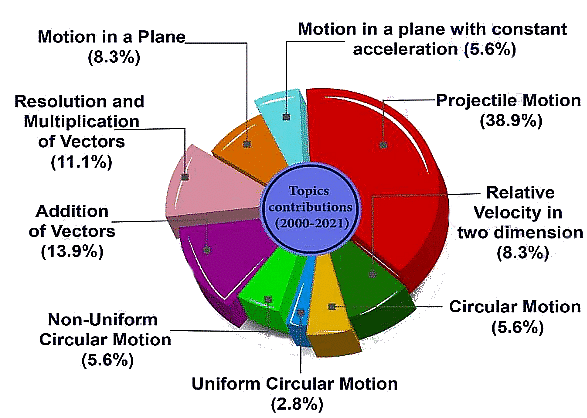
"Motion in a Plane" chapter of Physics has a 3% weightage in NEET Exam from 2000 - 2024.
The following chart shows the topic-wise weightage of "Motion in a Plane" in the NEET exam:
1. Introduction
2. Scalars and vectors
- Test: Introductory Vectors
- Doc: Vector & Scalar Quantities
- Video: What is a Vector?
- Video: Comparison of Vector and Scalar
3. Addition and subtraction of vectors - graphical method
- Video: Addition and Subtraction of Vectors (using triangular and parallelogram laws)
- Video: Addition and Subtraction of Vectors (Calculation)
- Doc: Method
4. Resolution of vectors
5. Vector addition - analytical method
- Video: Addition & Subtraction of Vectors (Triangular & Parallelogram Laws)
- Doc: Addition & Subtraction of Vectors (Triangular & Parallelogram Laws) - Graphical
6. Motion in a plane
- Video: Relative Velocity in a Plane
- Test: Motion In Two Dimensions
- Test: Motion In Plane - Introduction To Vectors
7. Motion in a plane with constant acceleration
Relative velocity in two dimensions
- Test: Relative Motion
- Video: Relative Velocity in Two Dimensions
- Doc: Relative Velocity in Two Dimensions
- Test: Relative Velocity in Two Dimensions
8. Projectile motion
- Video: Projectile Motion
- Doc: Projectile Motion
- Test: Projectile Motion
9. Uniform circular motion
- Video: Uniform Circular Motion
- Doc: Uniform Circular Motion
- Test: Uniform Circular Motion
10. General
- Doc: Important Formulas & Rapid Revision: Motion in a Plane
- Doc: Short & Long Answer Question: Motion in a Plane- 1
- Doc: Short & Long Answer Question: Motion in a Plane- 2
11. H.C. Verma, D.C. Pandey & Irodov Solutions
- Doc: DC Pandey Solutions: Projectile Motion- 1
- Doc: DC Pandey Solutions: Projectile Motion- 2
- Doc: Irodov Solutions: Relativistic Mechanics- 1
- Doc: Irodov Solutions: Relativistic Mechanics- 2
- Doc: Irodov Solutions: Relativistic Mechanics- 3
12. Tests of the Chapter: Motion in a Plane
- Test: Motion in a Plane
- Test: Motion in a Plane- 1
- Test: Motion in a Plane- Assertion & Reason Type Questions
- Test: Motion in a Plane- Case Based Type Questions
- Test: Level - 1 Motion In A Plane (With Solutions) - 1
13. Past year paper | Doc and test
- Doc: Previous year questions (2014-21): Motion in a Plane
- Test: 28 Year NEET Questions: Motion in a Plane- 1
- Test: 28 Year NEET Questions: Motion in a Plane- 2
14. NCERT Textbook and Solutions
The document Index: Motion in a Plane is a part of the Grade 11 Course Physics for Grade 11.
All you need of Grade 11 at this link: Grade 11
FAQs on Index: Motion in a Plane
| 1. What is motion in a plane and how is it different from motion in a straight line? |  |
Ans.Motion in a plane refers to the movement of an object through two dimensions, which involves both horizontal and vertical displacements. In contrast, motion in a straight line only involves one dimension, moving along a single path without any change in direction.
| 2. How do we represent motion in a plane using vectors? | |
Ans.Motion in a plane is represented using vectors, which have both magnitude and direction. Each component of the motion (horizontal and vertical) can be represented as a vector, and the overall motion can be analyzed using vector addition to find the resultant vector.
| 3. What are the equations of motion in a plane? | |
Ans.The equations of motion in a plane are similar to those in one-dimensional motion but consider the components separately. For uniformly accelerated motion, we can use the equations: 1. \( v = u + at \) (velocity) 2. \( s = ut + \frac{1}{2}at^2 \) (displacement) 3. \( v^2 = u^2 + 2as \) (relation between velocity and displacement) where \( u \) is initial velocity, \( v \) is final velocity, \( a \) is acceleration, and \( s \) is displacement.
| 4. How is projectile motion related to motion in a plane? | |
Ans.Projectile motion is a type of motion in a plane where an object moves under the influence of gravity after being projected. It can be analyzed as two independent motions: horizontal motion with constant velocity and vertical motion with constant acceleration due to gravity.
| 5. What factors affect the trajectory of a projectile in motion in a plane? | |
Ans.The trajectory of a projectile is affected by several factors, including the initial velocity, the angle of projection, air resistance, and the acceleration due to gravity. The initial velocity and angle determine the range and height of the projectile's path.
About this Document

4.85/5 Rating

Apr 30, 2026 Last updated
Related Exams
Document Description: Index: Motion in a Plane for Grade 11 2026 is part of Physics for Grade 11 preparation. The notes and questions for Index: Motion in a Plane have been prepared according to the Grade 11 exam syllabus. Information about Index: Motion in a Plane covers topics like and Index: Motion in a Plane Example, for Grade 11 2026 Exam. Find important definitions, questions, notes, meanings, examples, exercises and tests below for Index: Motion in a Plane.
Introduction of Index: Motion in a Plane in English is available as part of our Physics for Grade 11 for Grade 11 & Index: Motion in a Plane in Hindi for Physics for Grade 11 course. Download more important topics related with notes, lectures and mock test series for Grade 11 Exam by signing up for free. Grade 11: Index: Motion in a Plane
Description
Index: Motion in a Plane of Physics covers all the important topics, helping you prepare for the Grade 11 exam on EduRev. Start for free!
Information about Index: Motion in a Plane
In this doc you can find the meaning of Index: Motion in a Plane defined & explained in the simplest way possible. Besides explaining types of Index: Motion in a Plane theory, EduRev gives you an ample number of questions to practice Index: Motion in a Plane tests, examples and also practice Grade 11 tests



Related Searches
Exam, Index: Motion in a Plane, Extra Questions, Free, Index: Motion in a Plane, Viva Questions, ppt, Objective type Questions, MCQs, past year papers, mock tests for examination, Previous Year Questions with Solutions, practice quizzes, Sample Paper, pdf , Important questions, Summary, Semester Notes, video lectures, shortcuts and tricks, study material, Index: Motion in a Plane;