CBSE Class 5 > Class 5 Notes > Mathematics > Mind Map: Symmetry
Mind Map: Symmetry

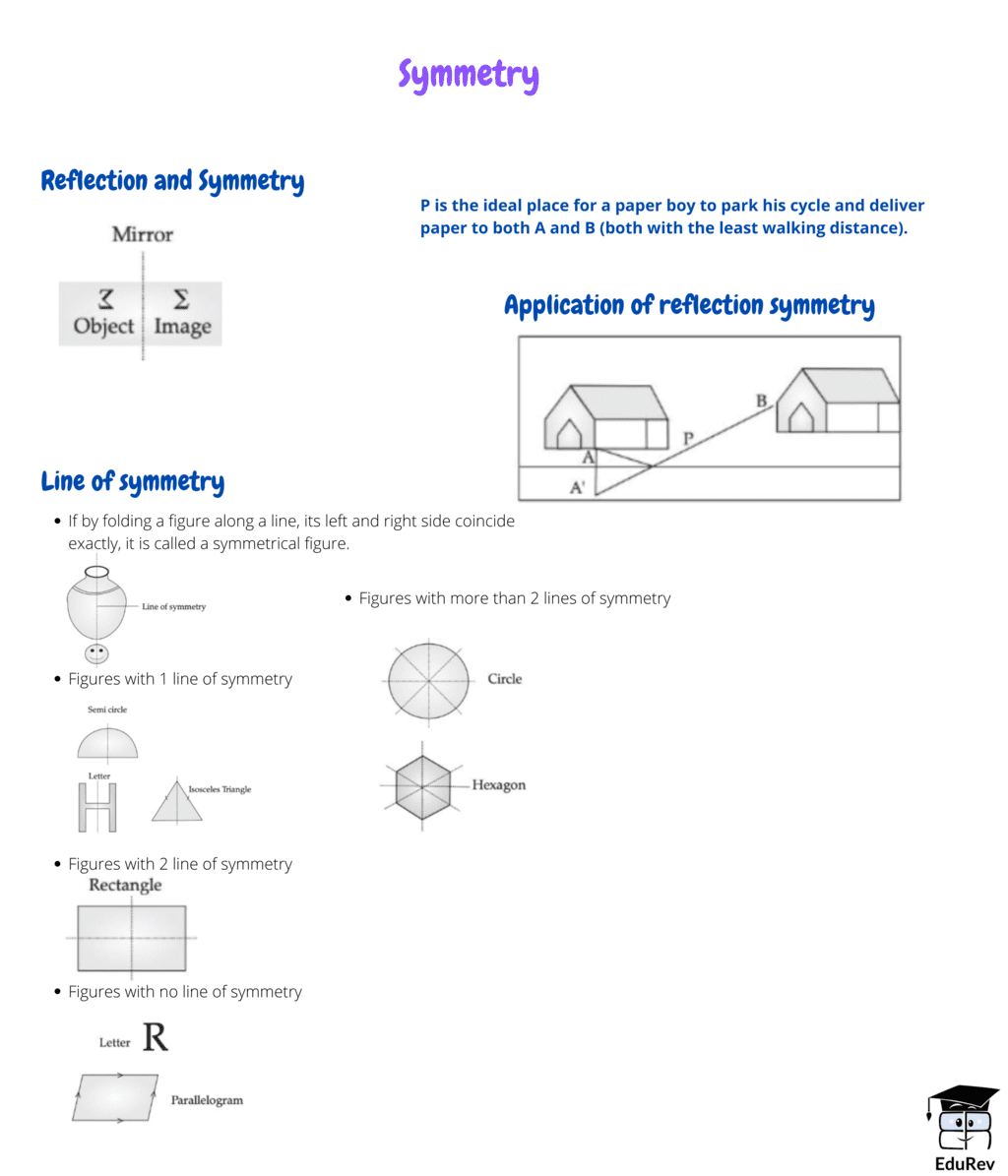
The document Mind Map: Symmetry is a part of the Class 5 Course Mathematics for Class 5.
All you need of Class 5 at this link: Class 5
FAQs on Mind Map: Symmetry
| 1. What is symmetry? |  |
Ans. Symmetry refers to a balanced arrangement of objects or elements that are the same on both sides of an axis or center. It is a property that describes the harmony and proportional arrangement of components in an object or design.
| 2. How many types of symmetry are there? | |
Ans. There are three types of symmetry: reflectional symmetry, rotational symmetry, and translational symmetry. Reflectional symmetry occurs when an object is mirrored along a line. Rotational symmetry occurs when an object can be rotated around a fixed point and still maintain its original shape. Translational symmetry occurs when an object can be shifted or translated without changing its appearance.
| 3. What is reflectional symmetry? | |
Ans. Reflectional symmetry, also known as line symmetry or mirror symmetry, occurs when an object can be divided into two parts that are mirror images of each other. In other words, if a line is drawn through the object, one side is a reflection of the other. Examples of reflectional symmetry can be found in nature, such as butterfly wings or human faces.
| 4. What is rotational symmetry? | |
Ans. Rotational symmetry occurs when an object can be rotated around a fixed point and still maintain its original shape. The fixed point is called the center of rotation, and the angle of rotation is usually a multiple of 360 degrees. Objects with rotational symmetry can have multiple lines of symmetry or rotational axes. Examples include a perfect circle, a star shape, or a windmill.
| 5. What is translational symmetry? | |
Ans. Translational symmetry refers to the property of an object or pattern that remains unchanged when it is shifted or translated in a certain direction. In other words, if an object can be moved along a straight line without changing its appearance, it exhibits translational symmetry. This type of symmetry is commonly observed in tessellations or repeating patterns, such as a tiled floor or a brick wall.
About this Document

4.84/5 Rating

Apr 29, 2026 Last updated
Related Exams
Document Description: Mind Map: Symmetry for Class 5 2026 is part of Mathematics for Class 5 preparation. The notes and questions for Mind Map: Symmetry have been prepared according to the Class 5 exam syllabus. Information about Mind Map: Symmetry covers topics like and Mind Map: Symmetry Example, for Class 5 2026 Exam. Find important definitions, questions, notes, meanings, examples, exercises and tests below for Mind Map: Symmetry.
Introduction of Mind Map: Symmetry in English is available as part of our Mathematics for Class 5 for Class 5 & Mind Map: Symmetry in Hindi for Mathematics for Class 5 course. Download more important topics related with notes, lectures and mock test series for Class 5 Exam by signing up for free. Class 5: Mind Map: Symmetry
Description
Mind Map: Symmetry of Mathematics provides you one-page visual summary of the chapter covering all the important topics. Download the PDF from EduRev.
Information about Mind Map: Symmetry
In this doc you can find the meaning of Mind Map: Symmetry defined & explained in the simplest way possible. Besides explaining types of Mind Map: Symmetry theory, EduRev gives you an ample number of questions to practice Mind Map: Symmetry tests, examples and also practice Class 5 tests



Related Searches
Extra Questions, Mind Map: Symmetry, Previous Year Questions with Solutions, past year papers, Important questions, Summary, mock tests for examination, Free, shortcuts and tricks, study material, Mind Map: Symmetry, Exam, Mind Map: Symmetry, Sample Paper, Objective type Questions, ppt, pdf , video lectures, Semester Notes, practice quizzes, MCQs, Viva Questions;