UPSC Exam > UPSC Notes > Class 6 to 12 NCERT Mindmaps Preparation > Mind Map: Diversity in Living Organisms
Mind Map: Diversity in Living Organisms

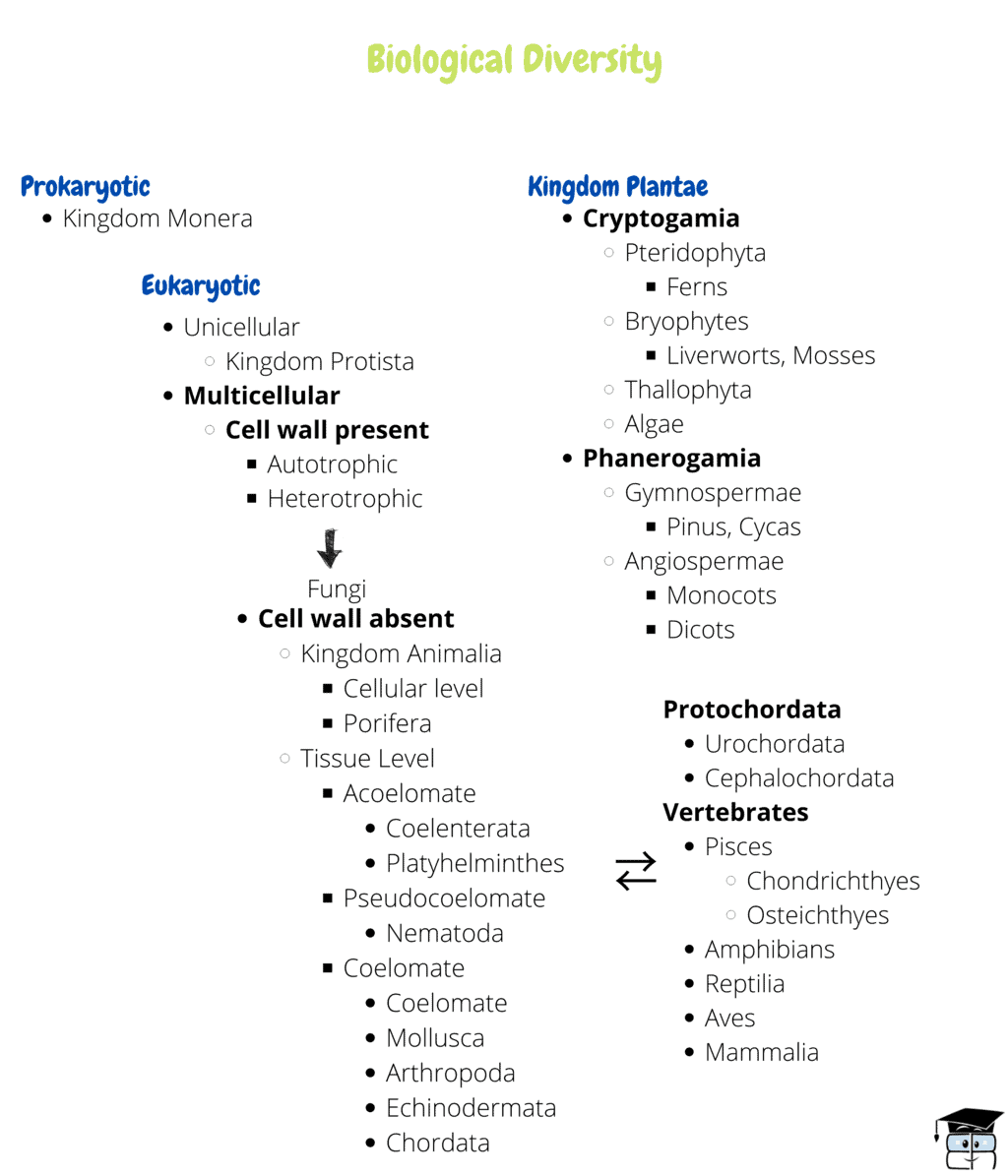
The document Mind Map: Diversity in Living Organisms is a part of the UPSC Course Class 6 to 12 NCERT Mindmaps for UPSC Preparation.
All you need of UPSC at this link: UPSC
FAQs on Mind Map: Diversity in Living Organisms
| 1. What is diversity in living organisms? |  |
Ans. Diversity in living organisms refers to the wide variety of different species, their characteristics, and the ecosystems they inhabit. It includes the differences in terms of morphology, anatomy, physiology, behavior, and genetic composition among organisms. This diversity is essential for the stability and functioning of ecosystems.
| 2. Why is it important to study diversity in living organisms? | |
Ans. Studying diversity in living organisms is important for several reasons. Firstly, it helps us understand the evolutionary relationships between different species and how they have adapted to their environments. This knowledge is crucial for conservation efforts and understanding the impact of human activities on biodiversity. Additionally, studying diversity allows scientists to discover new species, understand ecological interactions, and develop applications in fields such as medicine, agriculture, and biotechnology.
| 3. How do scientists classify living organisms? | |
Ans. Scientists classify living organisms using a hierarchical system called taxonomy. This system categorizes organisms into various levels, including kingdom, phylum, class, order, family, genus, and species. Organisms are classified based on their similarities in terms of morphology, anatomy, genetics, and evolutionary relationships. The classification system helps in organizing and understanding the vast diversity of living organisms.
| 4. What are the major kingdoms of living organisms? | |
Ans. The major kingdoms of living organisms are: 1. Kingdom Animalia: Comprising multicellular, heterotrophic organisms that obtain nutrients by ingestion. 2. Kingdom Plantae: Consisting of multicellular, autotrophic organisms that carry out photosynthesis. 3. Kingdom Fungi: Including multicellular or unicellular organisms that obtain nutrients by external digestion and absorption. 4. Kingdom Protista: Comprising unicellular or simple multicellular organisms with diverse characteristics. 5. Kingdom Monera: Consisting of unicellular organisms, including bacteria and archaea.
| 5. How does diversity in living organisms contribute to ecosystem stability? | |
Ans. Diversity in living organisms contributes to ecosystem stability by promoting resilience and balance. Each species plays a unique role in the ecosystem, such as providing food, regulating populations, decomposing organic matter, and maintaining nutrient cycles. A diverse ecosystem can better withstand disturbances, such as climate change or the introduction of invasive species, as the loss of one species can be compensated by others. Additionally, diverse ecosystems tend to be more productive and have higher resistance against diseases and pests.
About this Document

4.74/5 Rating

Apr 29, 2026 Last updated
Document Description: Mind Map: Diversity in Living Organisms for UPSC 2026 is part of Class 6 to 12 NCERT Mindmaps for UPSC Preparation preparation. The notes and questions for Mind Map: Diversity in Living Organisms have been prepared according to the UPSC exam syllabus. Information about Mind Map: Diversity in Living Organisms covers topics like and Mind Map: Diversity in Living Organisms Example, for UPSC 2026 Exam. Find important definitions, questions, notes, meanings, examples, exercises and tests below for Mind Map: Diversity in Living Organisms.
Introduction of Mind Map: Diversity in Living Organisms in English is available as part of our Class 6 to 12 NCERT Mindmaps for UPSC Preparation for UPSC & Mind Map: Diversity in Living Organisms in Hindi for Class 6 to 12 NCERT Mindmaps for UPSC Preparation course. Download more important topics related with notes, lectures and mock test series for UPSC Exam by signing up for free. UPSC: Mind Map: Diversity in Living Organisms
Description
Mind Map: Diversity in Living Organisms of Class 6 to 12 NCERT Mindmaps provides you one-page visual summary of the chapter covering all the important topics. Download the PDF from EduRev.
Information about Mind Map: Diversity in Living Organisms
In this doc you can find the meaning of Mind Map: Diversity in Living Organisms defined & explained in the simplest way possible. Besides explaining types of Mind Map: Diversity in Living Organisms theory, EduRev gives you an ample number of questions to practice Mind Map: Diversity in Living Organisms tests, examples and also practice UPSC tests



Related Searches
Extra Questions, Mind Map: Diversity in Living Organisms, pdf , Objective type Questions, Important questions, Previous Year Questions with Solutions, past year papers, ppt, Mind Map: Diversity in Living Organisms, video lectures, Mind Map: Diversity in Living Organisms, Sample Paper, Viva Questions, Exam, MCQs, Free, study material, Semester Notes, practice quizzes, shortcuts and tricks, mock tests for examination, Summary;