UPSC Exam > UPSC Notes > Class 6 to 12 NCERT Mindmaps Preparation > Mind Map: Improvement in Food Resources
Mind Map: Improvement in Food Resources

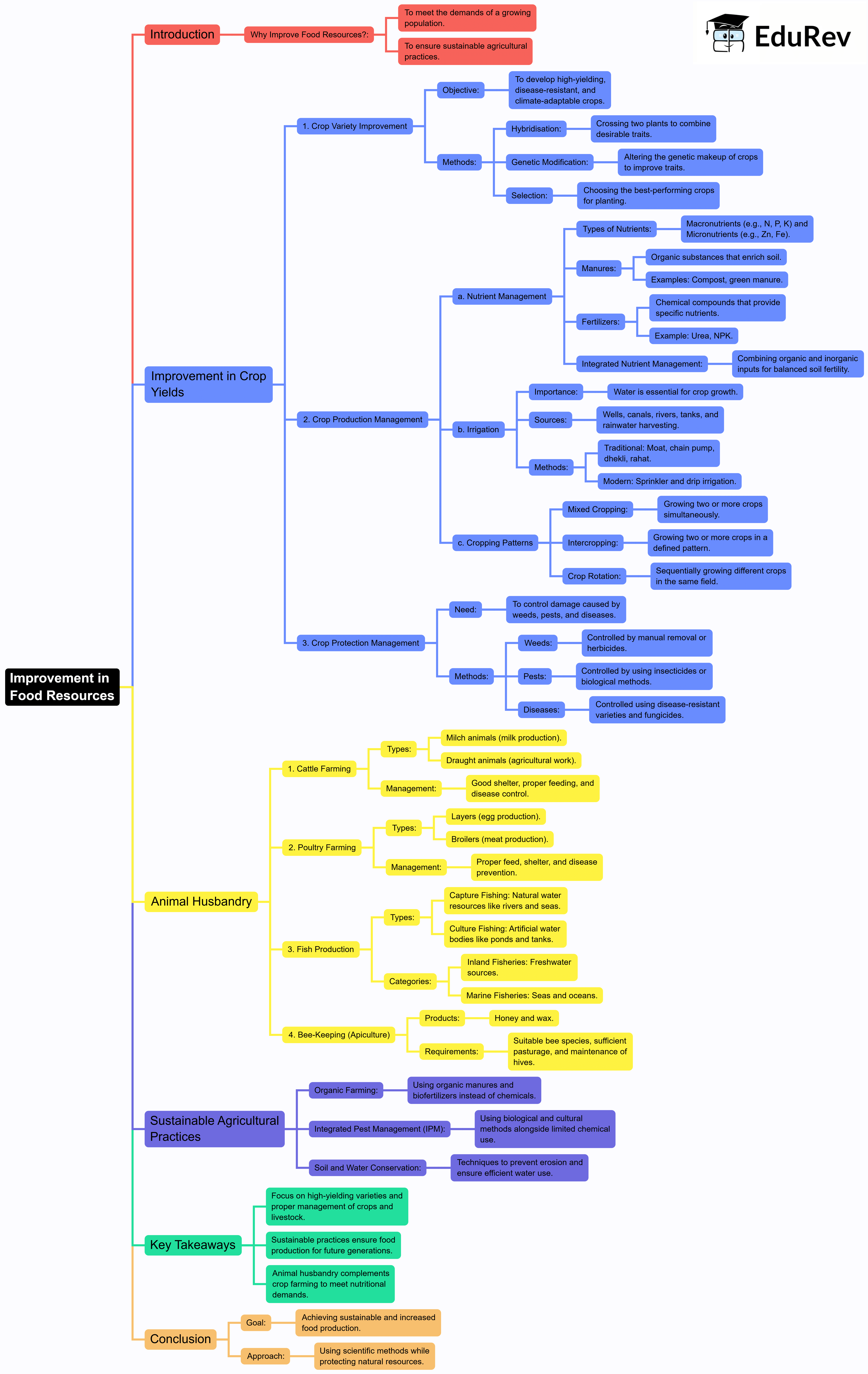
The document Mind Map: Improvement in Food Resources is a part of the UPSC Course Class 6 to 12 NCERT Mindmaps for UPSC Preparation.
All you need of UPSC at this link: UPSC
FAQs on Mind Map: Improvement in Food Resources
| 1. What are the main methods to improve food production in agriculture? |  |
Ans. Food production improvement involves crop management, better farming techniques, and resource optimization. Key methods include crop rotation, use of high-yielding variety (HYV) seeds, proper irrigation, organic and inorganic fertilizers, and integrated pest management. These strategies enhance soil fertility, increase yield per hectare, and ensure sustainable agricultural practices for better food security.
| 2. How do high-yielding varieties help increase crop yield compared to traditional seeds? | |
Ans. High-yielding variety seeds produce significantly more grain, vegetables, or fruits per plant than traditional varieties. HYV seeds respond better to fertilizers, irrigation, and modern farming techniques, making them disease-resistant and climate-adapted. The Green Revolution in India demonstrated how HYV crops like wheat and rice dramatically boosted national food production and agricultural output.
| 3. What's the difference between manure and fertilizers in improving soil quality? | |
Ans. Manure is organic matter from animal waste that improves soil structure and water retention, while fertilizers are chemical compounds providing nitrogen, phosphorus, and potassium directly to plants. Manure enhances microbial activity and long-term soil health; fertilizers offer quick nutrient availability. Combined use-organic farming integrated with selective fertilizer application-optimizes crop growth and sustainable food production practices.
| 4. Why is crop rotation important for food resource improvement? | |
Ans. Crop rotation alternates different plant families on the same land to prevent soil nutrient depletion and reduce pest buildup naturally. Legume crops fix atmospheric nitrogen, restoring soil fertility without excessive fertilizer dependency. This practice maintains soil health, reduces disease incidence, and ensures consistent yields across multiple seasons, making it essential for long-term agricultural sustainability and food security.
| 5. What role do irrigation and water management play in improving agricultural output? | |
Ans. Proper irrigation ensures consistent water supply during critical crop growth stages, directly increasing yield and preventing crop failure during droughts. Techniques like drip irrigation and sprinkler systems reduce water wastage while maintaining soil moisture. Effective water management allows farmers to cultivate multiple crops annually and expand cultivation to previously unsuitable areas, significantly boosting total food production capacity.
About this Document

3.1K Views

4.84/5 Rating

Apr 19, 2026 Last updated
Document Description: Mind Map: Improvement in Food Resources for UPSC 2026 is part of Class 6 to 12 NCERT Mindmaps for UPSC Preparation preparation. The notes and questions for Mind Map: Improvement in Food Resources have been prepared according to the UPSC exam syllabus. Information about Mind Map: Improvement in Food Resources covers topics like and Mind Map: Improvement in Food Resources Example, for UPSC 2026 Exam. Find important definitions, questions, notes, meanings, examples, exercises and tests below for Mind Map: Improvement in Food Resources.
Introduction of Mind Map: Improvement in Food Resources in English is available as part of our Class 6 to 12 NCERT Mindmaps for UPSC Preparation for UPSC & Mind Map: Improvement in Food Resources in Hindi for Class 6 to 12 NCERT Mindmaps for UPSC Preparation course. Download more important topics related with notes, lectures and mock test series for UPSC Exam by signing up for free. UPSC: Mind Map: Improvement in Food Resources
Description
Mind Map: Improvement in Food Resources of Class 6 to 12 NCERT Mindmaps provides you one-page visual summary of the chapter covering all the important topics. Download the PDF from EduRev.
Information about Mind Map: Improvement in Food Resources
In this doc you can find the meaning of Mind Map: Improvement in Food Resources defined & explained in the simplest way possible. Besides explaining types of Mind Map: Improvement in Food Resources theory, EduRev gives you an ample number of questions to practice Mind Map: Improvement in Food Resources tests, examples and also practice UPSC tests
Top Courses for UPSC
Related Searches
Mind Map: Improvement in Food Resources, Exam, Free, video lectures, Summary, MCQs, study material, ppt, Semester Notes, Important questions, pdf , past year papers, mock tests for examination, Viva Questions, Sample Paper, shortcuts and tricks, Extra Questions, practice quizzes, Previous Year Questions with Solutions, Mind Map: Improvement in Food Resources, Objective type Questions, Mind Map: Improvement in Food Resources;