UPSC Exam > UPSC Notes > Class 6 to 12 NCERT Mindmaps Preparation > Mind Map: What is Democracy? Why Democracy?
Mind Map: What is Democracy? Why Democracy?

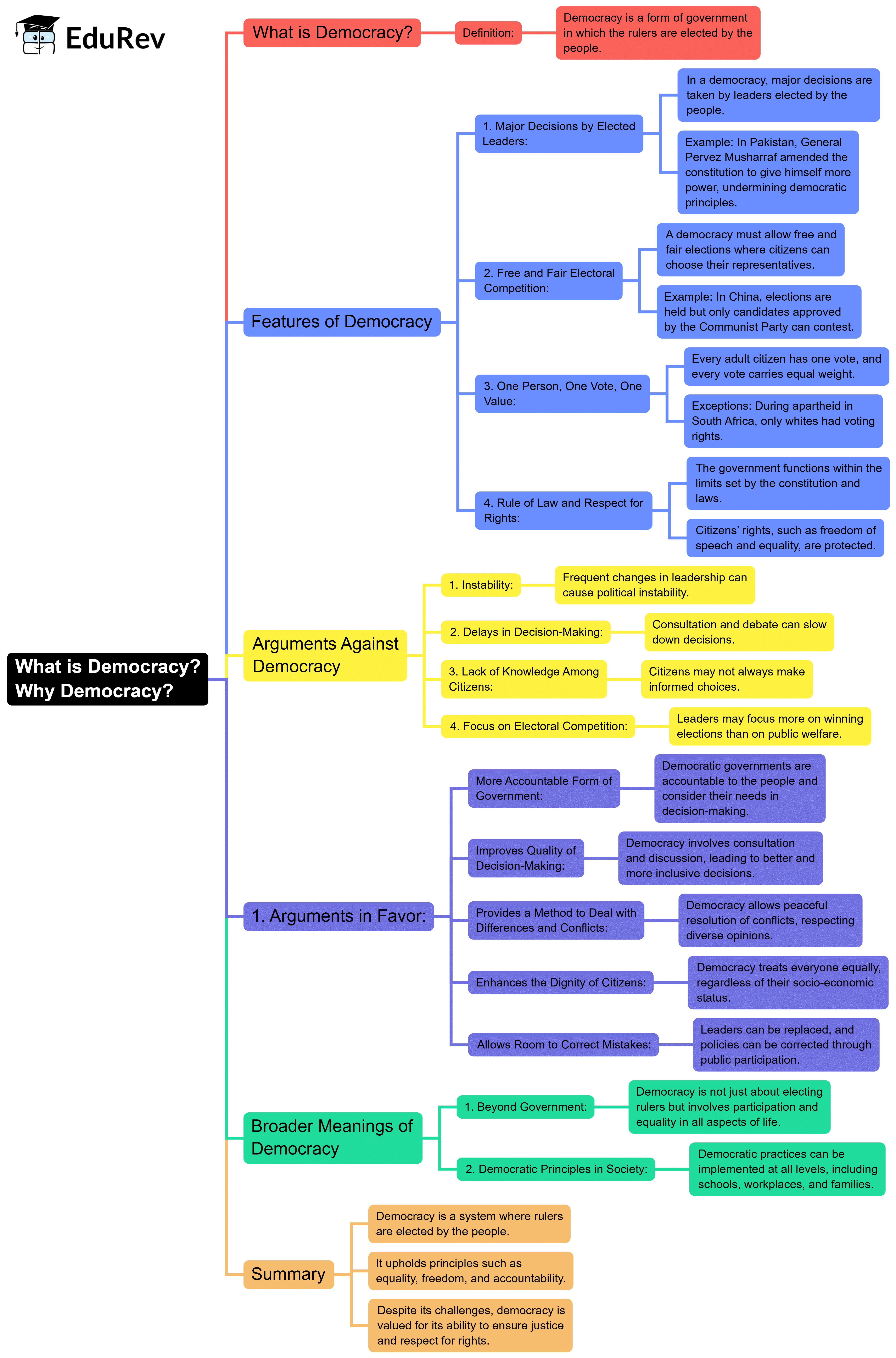
The document Mind Map: What is Democracy? Why Democracy? is a part of the UPSC Course Class 6 to 12 NCERT Mindmaps for UPSC Preparation.
All you need of UPSC at this link: UPSC
FAQs on Mind Map: What is Democracy? Why Democracy?
| 1. What exactly is democracy and how does it work in simple terms? |  |
Ans. Democracy is a system of government where power rests with the people, who exercise authority through voting and participation. Citizens elect representatives to make decisions on their behalf, ensuring that government reflects the will of the majority. Key features include free elections, individual rights, and accountability of leaders to the public.
| 2. Why do countries like India choose democracy instead of other forms of government? | |
Ans. Countries adopt democracy because it protects individual freedoms, ensures equal participation in decision-making, and allows peaceful transfer of power. Democratic systems provide checks and balances, preventing concentration of authority in one person or group. Citizens gain voice in governance, making democracy fundamentally more inclusive and responsive to public needs than authoritarian alternatives.
| 3. What are the main characteristics and principles that define a democratic system? | |
Ans. Democratic systems rest on universal adult suffrage, regular free elections, rule of law, and constitutional frameworks protecting rights. Core principles include sovereignty of the people, separation of powers, and judicial independence. Transparency, accountability, and minority protection distinguish democracies from other governance forms. These elements ensure citizens maintain control over their representatives and government decisions remain legitimate.
| 4. How does democracy compare to dictatorship and other non-democratic forms of rule? | |
Ans. Unlike dictatorships where power concentrates in one ruler without public consent, democracy distributes authority among elected representatives accountable to citizens. Monarchies and autocracies lack regular elections or citizen participation in governance. Democracy guarantees fundamental rights and peaceful power transitions; authoritarian systems rely on force or heredity. This distinction makes democratic governance fundamentally different in structure, legitimacy, and protection of individual freedoms.
| 5. Why is democracy considered the best form of government for protecting citizens' rights and freedoms? | |
Ans. Democracy safeguards citizen rights through constitutional protections, independent judiciary, and elected accountability mechanisms that authoritarian systems lack. Citizens can challenge unjust laws, access information, and participate in decision-making affecting their lives. Regular elections and multiple political parties prevent power abuse and ensure leaders remain responsive. These structural features make democracy uniquely capable of protecting individual freedoms while maintaining stable governance and rule of law.
About this Document

2.5K Views

4.68/5 Rating

Apr 20, 2026 Last updated
Related Exams
Document Description: Mind Map: What is Democracy? Why Democracy? for UPSC 2026 is part of Class 6 to 12 NCERT Mindmaps for UPSC Preparation preparation. The notes and questions for Mind Map: What is Democracy? Why Democracy? have been prepared according to the UPSC exam syllabus. Information about Mind Map: What is Democracy? Why Democracy? covers topics like and Mind Map: What is Democracy? Why Democracy? Example, for UPSC 2026 Exam. Find important definitions, questions, notes, meanings, examples, exercises and tests below for Mind Map: What is Democracy? Why Democracy?.
Introduction of Mind Map: What is Democracy? Why Democracy? in English is available as part of our Class 6 to 12 NCERT Mindmaps for UPSC Preparation for UPSC & Mind Map: What is Democracy? Why Democracy? in Hindi for Class 6 to 12 NCERT Mindmaps for UPSC Preparation course. Download more important topics related with notes, lectures and mock test series for UPSC Exam by signing up for free. UPSC: Mind Map: What is Democracy? Why Democracy?
Description
Mind Map: What is Democracy? Why Democracy? of Class 6 to 12 NCERT Mindmaps provides you one-page visual summary of the chapter covering all the important topics. Download the PDF from EduRev.
Information about Mind Map: What is Democracy? Why Democracy?
In this doc you can find the meaning of Mind Map: What is Democracy? Why Democracy? defined & explained in the simplest way possible. Besides explaining types of Mind Map: What is Democracy? Why Democracy? theory, EduRev gives you an ample number of questions to practice Mind Map: What is Democracy? Why Democracy? tests, examples and also practice UPSC tests



Related Searches
Mind Map: What is Democracy? Why Democracy?, MCQs, practice quizzes, Objective type Questions, mock tests for examination, Previous Year Questions with Solutions, Semester Notes, Sample Paper, Mind Map: What is Democracy? Why Democracy?, pdf , Exam, past year papers, video lectures, Viva Questions, Mind Map: What is Democracy? Why Democracy?, Important questions, shortcuts and tricks, ppt, study material, Extra Questions, Free, Summary;