CBSE Class 10 > Class 10 Notes > Lab Manual: Surface Area of a Cylinder
Lab Manual: Surface Area of a Cylinder

Objective
To find the curved surface area and total surface area of a cylinder experimentally.Prerequisite Knowledge
- Area of a rectangle.
- Area of a circle.
- Concept of surface area of a cylinder.
Materials Required
A white chart paper, a cylinder made of paper, a pair of scissors, a ruler, fevicol.
Procedure
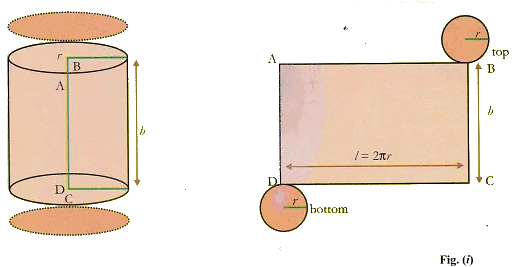
- Remove the top and bottom circles of the cylinder.
- Make a vertical cut in the curved surface and lay the cylinder flat to get a rectangle as shown.
- Measure the length and breadth of the rectangle so formed.
Observation
- Top and bottom of cylinders are circles.
Therefore Area of 2 circles = πr2, where r is the radius of base circle of cylinder - Length of rectangle = circumference of base of cylinder = 2πr
- Breadth of rectangle = height = h
- Area of rectangle = πr x h = curved surface area of cylinder
- Total surface area of cylinder =2πrh + πr2
= 2πr(h + r)
Result
- Curved surface area of a cylinder = 2πrh
- Total surface area of a cylinder = 2πr(h + r)
Learning Outcome
This activity' clears the concept of curved surface area (lateral surface area) and total surface area of a cylinder.
Activity Time
Calculate the total surface area in terms of radius, where 'tf represents the diameter of the cylinder.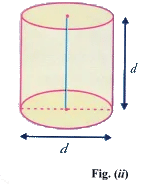
FAQs on Lab Manual: Surface Area of a Cylinder
| 1. What's the formula for finding the total surface area of a cylinder? |  |
Ans. The total surface area of a cylinder equals 2πr(r + h), where r is the radius and h is the height. This formula combines the areas of two circular bases (2πr²) and the curved lateral surface (2πrh). Students often use this standard formula in CBSE Class 10 geometry problems to calculate the complete outer surface coverage of cylindrical objects.
| 2. How do I find just the curved surface area without the circular bases? | |
Ans. The curved surface area (or lateral surface area) of a cylinder is calculated using 2πrh, where r represents the radius and h represents the height. This measures only the outer curved portion, excluding both the top and bottom circular ends. Understanding this distinction helps students solve problems where only the side surface needs measurement.
| 3. Why do we multiply by 2πr in the cylinder surface area formula? | |
Ans. When a cylinder is unfolded, its curved surface becomes a rectangle with length 2πr (the circumference of the circular base) and width h (height). Multiplying these dimensions gives the lateral surface area. Adding the areas of two circular bases (2πr² total) yields the complete surface area formula. This geometric visualisation clarifies why each component appears in the calculation.
| 4. What's the difference between lateral surface area and total surface area for a cylinder? | |
Ans. Lateral surface area includes only the curved side surface (2πrh), while total surface area includes the curved side plus both circular bases (2πr² + 2πrh, or 2πr(r + h)). For practical lab manual experiments in Class 10, distinguishing these measurements is essential because different real-world applications require different calculations-pipes need lateral area, but closed containers need total surface area.
| 5. How do I solve cylinder surface area problems when given diameter instead of radius? | |
Ans. Convert diameter to radius by dividing by two (r = d/2), then apply the standard surface area formulas. Students frequently encounter diameter values in CBSE exam questions and worksheets. Once radius is determined, substitute into either the curved surface formula (2πrh) or total surface area formula (2πr(r + h)) to complete calculations accurately.
About this Document

Apr 19, 2026 Last updated
Related Exams
Document Description: Lab Manual: Surface Area of a Cylinder for Class 10 2026 is part of Class 10 preparation. The notes and questions for Lab Manual: Surface Area of a Cylinder have been prepared according to the Class 10 exam syllabus. Information about Lab Manual: Surface Area of a Cylinder covers topics like and Lab Manual: Surface Area of a Cylinder Example, for Class 10 2026 Exam. Find important definitions, questions, notes, meanings, examples, exercises and tests below for Lab Manual: Surface Area of a Cylinder.
Introduction of Lab Manual: Surface Area of a Cylinder in English is available as part of our Class 10 preparation & Lab Manual: Surface Area of a Cylinder in Hindi for Class 10 courses. Download more important topics, notes, lectures and mock test series for Class 10 Exam by signing up for free. Class 10: Lab Manual: Surface Area of a Cylinder
Description
Lab Manual: Surface Area of a Cylinder of covers all the important topics, helping you prepare for the Class 10 exam on EduRev. Start for free!
Information about Lab Manual: Surface Area of a Cylinder
In this doc you can find the meaning of Lab Manual: Surface Area of a Cylinder defined & explained in the simplest way possible. Besides explaining types of Lab Manual: Surface Area of a Cylinder theory, EduRev gives you an ample number of questions to practice Lab Manual: Surface Area of a Cylinder tests, examples and also practice Class 10 tests.
Related Searches
MCQs, Lab Manual: Surface Area of a Cylinder, study material, Previous Year Questions with Solutions, Semester Notes, Lab Manual: Surface Area of a Cylinder, Sample Paper, Exam, Objective type Questions, shortcuts and tricks, ppt, Extra Questions, Important questions, Viva Questions, pdf , Lab Manual: Surface Area of a Cylinder, mock tests for examination, Summary, past year papers, video lectures, Free, practice quizzes;