How to Answer a Factual Passage

Introduction
A factual passage typically presents a series of facts, data, or information on a specific subject. The aim is to check the reader's understanding and ability to extract and interpret key details.
Key Steps to Answering a Factual Passage
Read the Passage Carefully:
- First Reading: Read the passage quickly to get a general understanding.
- Second Reading: Read again slowly and underline key points, such as important dates, names, places, and definitions.
- Highlight Key Information: Focus on facts like figures, comparisons, and logical connections.
Understand the Question:
Identify Question Type - Determine whether the question is asking for:
- Specific Information (dates, names, events)
- Inferences (meaning implied by the author)
- Explanations (why something happened, how it works)
- Summarization (briefly stating main ideas)
Focus on Key Words: Look for keywords or phrases in the question that directly relate to the passage content.
Answering the Question:
- Be Precise and Concise: Provide a direct response based on the passage. Avoid adding unnecessary information.
- Use Information from the Passage: Extract the information directly from the passage or paraphrase it.
- Quote or Paraphrase Accurately: If the question asks for a specific detail, quote it accurately. If it asks for a general explanation, paraphrase the relevant part.
- Avoid Personal Opinion: Factual passages require answers based solely on the information given. Do not include opinions unless asked.
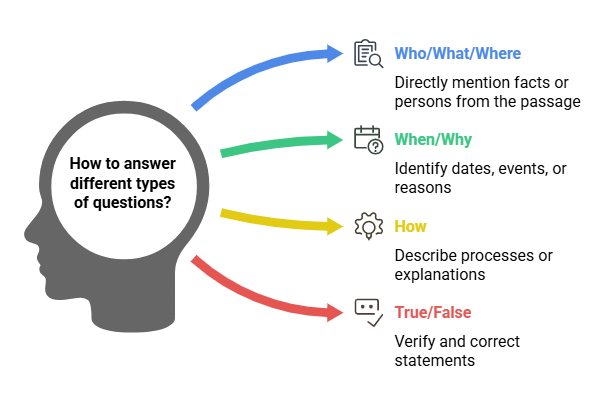
Types of Questions and How to Answer:
1. Who / What / Where Questions
Tip: Directly pick the person, place, or thing mentioned in the passage.
Question: "Who discovered gravity?"
Answer: "Gravity was discovered by Sir Isaac Newton."Question: "What is the capital of France?"
Answer: "The capital of France is Paris."Question: "Where is the Great Barrier Reef located?"
Answer: "The Great Barrier Reef is located off the coast of Queensland, Australia."
2. When / Why Questions
Tip: Look for dates, reasons, or causes mentioned in the passage.
Question: "When did World War II end?"
Answer: "World War II ended in 1945."Question: "Why do birds migrate?"
Answer: "Birds migrate to find food and favorable breeding conditions."Question: "When was the first computer invented?"
Answer: "The first computer was invented in the 1940s."
3. How Questions
Tip: Explain the process or steps clearly.
Question: "How does the water cycle work?"
Answer: "The water cycle works through evaporation, condensation, and precipitation."Question: "How is electricity generated in a hydroelectric power plant?"
Answer: "Electricity is generated by using the flow of water to turn turbines, which then produce electrical energy."Question: "How do vaccines protect the body?"
Answer: "Vaccines protect the body by stimulating the immune system to produce antibodies against a disease."
4. True / False or Correct the Statement
Tip: Compare the statement with facts and correct any mistakes.
Question: "The Eiffel Tower is in London."
Answer: "False. The Eiffel Tower is in Paris, France."Question: "Water boils at 90°C."
Answer: "False. Water boils at 100°C at sea level."Question: "Sharks are mammals."
Answer: "False. Sharks are fish, not mammals."
Organize Your Answer:
- Structure: Follow the structure of the question. If the question asks for multiple points, list them clearly.
- Keep it Short and to the Point: Avoid unnecessary elaboration. Provide enough information to answer the question completely.
Check Your Answer:
- After answering, recheck the passage and your answer.
- Make sure your response is directly supported by the passage.
- Ensure proper grammar, spelling, and punctuation.
Examples of Passage-Based Questions
1. Identify-Type Questions
Tip: Pick the fact or detail directly from the passage.
Passage: "The Taj Mahal was built by Emperor Shah Jahan in memory of his wife Mumtaz Mahal."
Question: "Who built the Taj Mahal?"
Answer: "The Taj Mahal was built by Emperor Shah Jahan."Passage: "Mount Everest is the highest mountain in the world, standing at 8,848 meters."
Question: "What is the height of Mount Everest?"
Answer: "Mount Everest stands at 8,848 meters."Passage: "The Amazon rainforest is home to millions of species of plants and animals."
Question: "Where can millions of species of plants and animals be found?"
Answer: "Millions of species of plants and animals can be found in the Amazon rainforest."
2. Explanation-Based Questions
Tip: Describe the process, reason, or cause in your own words.
Passage: "The heart pumps blood throughout the body, supplying oxygen and nutrients to all organs."
Question: "Explain the function of the heart."
Answer: "The heart functions by pumping blood throughout the body, providing oxygen and nutrients to organs."Passage: "Rain is formed when water vapor in the air condenses into droplets and falls to the ground."
Question: "Explain how rain is formed."
Answer: "Rain is formed when water vapor in the air condenses into droplets, which then fall to the ground."Passage: "Recycling helps reduce waste and conserves natural resources."
Question: "Why is recycling important?"
Answer: "Recycling is important because it reduces waste and helps conserve natural resources."
3. True/False or Correct-the-Statement Questions
Tip: Check the passage carefully and verify the statement.
Passage: "Venus is the second planet from the Sun and has a very thick atmosphere."
Question: "Venus is the third planet from the Sun."
Answer: "False. Venus is the second planet from the Sun."Passage: "Sharks are cold-blooded animals that live in water."
Question: "Sharks are warm-blooded animals."
Answer: "False. Sharks are cold-blooded animals."
Conclusion
Answering a factual passage requires:
- Close reading and understanding of the passage.
- Extraction of specific information and interpretation.
- Clear and concise responses based on facts from the text.
By following these steps, you can effectively answer factual passage questions.
FAQs on How to Answer a Factual Passage
| 1. How do I identify the main idea in a factual passage for Class 10 exams? |  |
| 2. What's the difference between finding explicit and implicit information in a factual passage? | |
| 3. How should I structure my answers when responding to factual passage comprehension questions? | |
| 4. What mistakes do students usually make when answering factual passage questions for CBSE exams? | |
| 5. How can I improve my speed and accuracy when tackling factual passage questions in timed exams? | |





