Lakhmir Singh & Manjit Kaur: Crop Production And Management- 1

Very Short Answer Type Questions
Q1: Which agricultural practice is carried out with the help of a sickle?
Ans: A sickle is a hand-held agricultural tool used for harvesting, or reaping crops.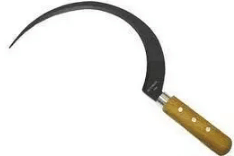 Harvesting in our country is either done manually by sickle or by a machine called harvester. The other agricultural practices which are done by sickle are: preparing hay and also cutting some crops.
Q2 : What name is given to the cutting and gathering of a food crop like wheat or paddy?
Ans: The cutting and gathering of mature food crop like wheat or paddy is known as harvesting.
Q3: Name the tool (or implement) used in the traditional harvesting of crops.
Ans: Sickle is general purpose of harvesting tool which is used in the traditional harvesting of crops.
Q4: Name the process of beating out the grains from harvested crop.
Ans: The process of beating out the grains from the harvested crop plants is called threshing.
Q5: Name the machine used in recovering the grain from already cut crop.
Ans: A machine called combine is used for harvesting and threshing (Cutting of standing crop and recovering grains).
Q6: Name the machine which does the cutting of standing crops and recovers the grain too.
Ans: A machine called combine is used for harvesting and threshing (Cutting of standing crop and recovering grains).
Q7: Name the process in which grains are separated from chaff and hay with the help of wind.
Ans: The process in which grains are separated from chaff with the help of wind is called winnowing.
Q8: Name three food materials obtained from animals.
Ans: The food materials that we obtain from animals are milk, meat and eggs.
Q9: Name two domestic animals which are used to obtained milk.
Ans: Cow and buffalo are two domestic animals which are used to obtained milk.
Q10: Name one meat yielding animal and one egg yielding animal.
Ans: Goat is meat yielding animal and hen is egg yielding animal.
Q11: Name an animal food obtained from insect.
Ans: Honey is an animal food obtained from insect called "bees".
Q12: What name is given to that branch of agriculture which deals with feeding, shelter, health and breeding of domestic animals?
Ans: The branch of agriculture which deals with feeding, shelter, health and breeding of domestic animals is called animal husbandry.
Q13: Name one major food nutrient provided by fish.
Ans: Fish is good for health. We get cod liver oil from fish which is rich in vitamin D.
Q14: Name the vitamin/vitamins present in cod liver oil.
Ans: Cod liver oil of fish is rich in vitamin D.
Q15: Name one Government agency which is involved in procuring food grains (like wheat and rice) from farmers and storing them properly.
Ans: The government agency like food corporation of India (FCI) buy food grains from farmers and storing them properly.
Q16: What type of organisms grow on stored food grains having higher moisture content?
Ans: Organisms fungus and moulds grow on stored food grains having higher moisture content.
Q17: Which crop is generally grown between two cereals crops in crop rotation to restore the fertility of soil?
Ans: Leguminous crops like pulses, beans, peas are generally grown between two cereals crops in crop rotation to restore the fertility of soil.
Q18: State one advantages of growing a leguminous crop between two cereals crops.
Ans: Rotation of crops (leguminous and non-leguminous crops) in the same field replenishes the soil with nitrogen naturally and increases the soil fertility.
Q19: Name the nitrogen-fixing bacteria present in root nodules of leguminous plants.
Ans: The nitrogen-fixing bacteria present in root nodules of leguminous plants is rhizobium bacteria.
Q20: Which agricultural practice comes first: harvesting or weeding?
Ans: Agricultural practice weeding comes first.
Q21: Which is the first step in the cultivation of a crop?
Ans: The preparation of soil is the first step in the cultivation of a crop.
Q22: For what purpose is a hoe used?
Ans: It is a simple tool which is used for removing weeds and for loosening the soil.
Q23: Name the implement used in sowing.
Ans: The implement used for sowing is seed drill.
Q24: Name the practice used for cultivating paddy.
Ans: The practice used for cultivating paddy is transplantation.
Q25: Name the two types of substances which are added two the fields by the farmers to maintain the fertility of soil.
Ans: Manure and fertilizers are added to the fields by the farmers to maintain the fertility of soil.
Q26: Some grass is growing in a wheat field. What will it be known as?
Ans: These grass is known as weed.
Q27: Name one crop which can tolerate standing water (water-logging) in the field and one which cannot.
Ans: Paddy crop (rice crop) can tolerate standing water in the field whereas crops like wheat, gram cannot.
Q28: Which is the best time for the removal of weeds?
Ans: The best time for the removal of weeds is before they produce flowers and seeds.
Q29: Name two methods of irrigation with conserve water.
Ans: (i) sprinkler system
(ii) Drip system
Q30: Fill in the following blanks:
(a) The same kind of plants grown and cultivated on a large scale at a place is called ___________.
(b) The first step before growing crops is ___________ of soil.
(c) For growing a crop, sufficient sunlight, ___________, and ___________ from the soil are essential.
(d) Damaged seeds would ___________ on top of water.
(e) Crop rotation helps in the replenishment of soil with ___________
(f) The supply of water to crops at different intervals is called ___________
(g) The unwanted plants present in a crop field are called ___________
(h) Dried ___________ leaves are used for storing food grains at home.
(i) Many people living in the ___________ areas consume fish as a major part of their diet.
(a) crop
(b) preparation
(c) nutrients; water
(d) float
(e) nitrogen
(f) irrigation
(g) weeds
(h) neem
(i) coastal
FAQs on Lakhmir Singh & Manjit Kaur: Crop Production And Management- 1
| 1. What are the main steps involved in crop production and management for CBSE Class 8? |  |
| 2. How do farmers decide which crops to grow and what does crop selection depend on? | |
| 3. What's the difference between manure and fertiliser in crop production? | |
| 4. Why is soil preparation so important before sowing seeds in farming? | |
| 5. What farming tools and equipment are used for different stages of crop production? | |