Story Writing


A good story captures the reader's interest, carries them through events that make sense, and leaves them with a clear impression - a feeling, a thought or a message. This chapter explains how to plan and write short stories suitable for Class 7 students, and includes several model moral tales that illustrate structure, language and the use of morals.
What is a Story?
A story is a sequence of events presented in an organised way to interest, entertain or teach the reader. A short story normally has a clear beginning, a middle (where events develop), and an end (where the outcome or moral is shown). Stories can be fictional or based on real incidents. In school writing, a story often focuses on a single main event or problem and its resolution.
Essential Elements of a Story
A well-written short story for Class 7 should contain the following elements, each of which you should think about before you begin to write.
Characters
Characters are the people or animals who take part in the story. Decide who the main character is, who the supporting characters are, and what each one wants or fears. For example, in a moral tale the main character might be a brave child, a foolish merchant, a clever animal or a cruel master.
Setting
Setting refers to where and when the story takes place. A clear setting gives the reader a picture of the scene: a village, a forest, a temple, a cave, or a city market. Mention details that matter to the plot (weather, time of day, place). Keep setting details short and useful.
Plot
Plot is the sequence of events. It usually begins with a situation, introduces a problem or conflict, builds up to a turning point or climax, and ends with a resolution. Plan the plot in simple stages so the events flow logically.
Conflict
Conflict gives the story interest. It may be between characters (man vs man), within a character (man vs self), with nature (man vs nature), or with society (man vs society). The conflict should be clear and lead to an outcome.
Climax and Resolution
The climax is the most exciting point - the turning point that decides how the problem will be solved. The resolution shows the consequences and closes the story. For moral stories, the resolution often carries the lesson or moral.
Theme or Moral
The theme is the central idea or message of the story. In simple moral tales, this is often an explicit moral, such as "Union is strength" or "Do good, find good."
Point of View (Narration)
Decide the point of view: first person ("I") for personal accounts, or third person ("he/she/they") for general storytelling. The third person is common in fables and moral tales because it gives the writer freedom to describe events and characters.
Planning a Story - Step by Step
Before writing, spend a few minutes planning. A simple plan prevents confusion and helps you keep to a clear sequence.
1. Choose the idea
Think of a single incident, problem, or lesson you want to present: a lost goat, a trapped animal, a quarrelling family, an act of kindness. Keep the idea focused.
2. Decide the main characters and setting
Choose one or two main characters and a clear setting. This keeps the story manageable.
3. Outline the plot
Write a short outline in three parts: beginning (introduce characters and situation), middle (introduce conflict or complication), and end (climax and resolution). A sentence or two for each part is enough.
4. Plan the opening line
Start with an opening that sets the scene quickly and grabs interest. Examples: "In a small village lived a Brahmin named Mitra." or "There was a temple in a garden where many carpenters worked."
5. Think of a clear ending
Decide how the problem will be solved and whether a moral will be stated. A clear ending prevents weak, unfinished conclusions.
Language, Style and Presentation
Use simple, correct English suited to Class 7. The following points will help you write clearly and attractively.
Tense
For most short stories use the simple past tense (He walked, They met, The goat was taken) when narrating events that have already happened. Use present tense only for general statements or when intentionally creating immediacy.
Sentences and Paragraphs
Use short to medium-length sentences. Each paragraph should contain a single main idea or event. Begin a new paragraph when the place, time, or speaker changes.
Dialogue and Direct Speech
Direct speech makes characters vivid. Use quotation marks correctly and begin a new paragraph for each change of speaker. Example: "Ho Brahmin," said the man. "Why are you carrying a dog?"
Descriptive Language
Use concrete details that matter to the plot (a goat balanced on shoulders, a wedge in a log, a stag's horns). Avoid unnecessary adjectives. "Show, don't tell": describe actions and appearance instead of simply saying "he was brave".
Linking Words
Use simple linking words to show sequence and cause: then, after a while, as a result, however, although, therefore. These help the reader follow events.
Vocabulary and Tone
Choose words suitable for classmates: not too childish, not too advanced. Keep a neutral, instructive tone unless you are deliberately writing a humorous or dramatic story.
Types of Short Stories Useful for Students
Stories for school writing commonly include:
- Short moral tales or fables (animals with human qualities, teaching a lesson).
- Anecdotes (short true or imagined incidents revealing a character trait).
- Simple imaginative stories (based on a single unusual idea).
- Real-life incidents (biographical or historical events told simply).
Common Mistakes to Avoid
Students often make these errors; watch for them when you write and revise.
- Unclear sequence of events - write in order and use linking words.
- Too many characters - limit to a few and develop them briefly.
- Weak openings or endings - plan a clear start and a satisfying finish.
- Mixing tenses - keep narration in one consistent tense.
- Long, run-on sentences - keep sentences clear and well-punctuated.
How to Revise Your Story
After writing, always check and improve your work.
- Read your story aloud to check flow and natural language.
- Check tense consistency and punctuation, especially full stops, commas and quotation marks.
- Remove unnecessary words and repeat information only if it adds meaning.
- Ensure the conflict, climax and resolution are clear.
- Ask yourself: Does every paragraph move the story forward?
Model Moral Stories (Read and Analyse)
The following short tales illustrate simple planning and clear morals. Read each carefully and note the main character, the conflict, the climax and the moral. Each story is followed by a short note on what students can learn from it.
1. The Brahmin and the Crooks

In a small village in India, there lived a Brahmin named Mitra. Once he went to a nearby village to visit a devotee. The devotee gave him a goat. The Brahmin decided to offer the goat as a sacrifice to the gods.
The Brahmin started his journey homewards. He carried the goat on his shoulders. Three crooks saw him. They made a plan to get the goat from the Brahmin.
The first crook stood in the Brahmin's path. He said to him, "Ho Brahmin, why on earth are you carrying a profane dog on your shoulder?" The Brahmin got angry. He said, "Are you blind? Can't you see that it's a goat?" The crook had played his part, and replied, "You may have it anyway you want."
A little farther, the second crook approached and said, "Ho Brahmin, shame on you, why do you carry a dog?" The Brahmin looked at him angrily, and he too went away. However, this time, the Brahmin had begun to doubt his own senses. After a while, the Brahmin met the third crook who said what the other two crooks had already said. The Brahmin threw his burden of the goat away and went ahead. The waiting crooks caught hold of the goat.
Note for students: This story shows how repeated false statements can make a person doubt what he knows. A clear opening, a simple trick (conflict), and a short outcome (resolution) make this a good model for a moral story.
2. The Monkey and the Wedge
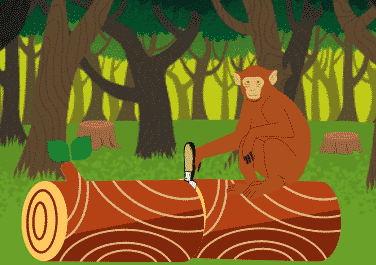
There was a temple in a garden. There were many carpenters who were doing some wood-work in the temple. They would start work in the morning, take a break for the mid-day meal, and return to resume work till evening.
One day a group of monkeys arrived at the site and watched the workers leaving for their mid-day meals. One of the carpenters was sawing a huge log of wood. Since it was only half done, he placed a wedge in between to prevent the log from closing up.
When all the workers were gone, the monkeys came down to the site. They started playing with the instruments. One monkey became curious about the wedge. He sat down on the log so that he was between the two parts of the half-split log. Then he started pulling at the wedge. All of a sudden, the wedge came out. As a result, the half-split log closed in and the monkey got caught in the gap of the log. He died instantly.
One who interferes in others' work, surely comes to grief.
Note for students: This fable is short and grim. It teaches caution and contains a clear cause-and-effect sequence. Use such simple causality when you write short moral tales.
3. The Stag and his Horns

In a dense forest, there lived a beautiful stag. He saw his reflection in the water. He admired his beautiful horns but felt sad for his thin, ugly legs. He wondered why God gave him these legs with those horns.
Then he saw a pack of hounds coming towards him. He ran with all the force at his command. After a while, he slackened his speed as he felt safe. He became a little careless. The result was that his horns got entangled into some bushes. He could not free himself. Soon the hounds caught hold of him. While being killed, there was just one thought on his mind: "What I thought was ugly had saved my life but what I thought was beautiful, took my life."
Handsome is that handsome does.
Note for students: This story contrasts appearance and usefulness. The closing line (moral) helps readers remember the lesson. Notice how the narrative focuses on the single moment that changes the stag's fate.
4. Climber Saves the Den
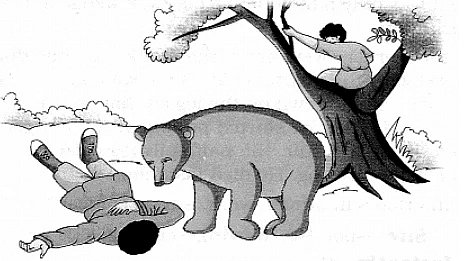
The wolf Starlight had left his den with his wife Aurora for a short time. Their three cubs were left in the den. When they returned, they were horrified to see a very big bear sitting at the mouth of their cave. The bear seemed to be relaxing and was in no mood to go away. Starlight and Aurora wanted to unite with their cubs but did not know how.
Their cub named Climber peeped out. He saw a fur-clad mountain in the centre of his playground. He did not know what it was. All that he knew was that this mountain had no right to be there. So he decided to set things right.
Climber shot from the mouth of the den. He hurled himself fully into the old bear's back. The big bear was completely taken by surprise. Uttering a grunt of terror, he fled.
Note for students: This short tale highlights bravery and surprise as tools to solve a problem. The story is suitable for practising action verbs and direct descriptions.
5. The Cunning Mediator
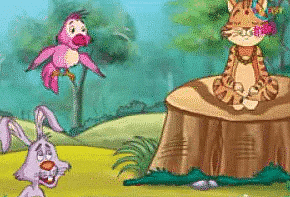
A partridge lived in a certain tree. One day he went away with some more partridges in search of food. Then a hare came to the tree. Seeing the empty hole, he made it his home.
After a few days, the partridge returned. He asked the hare to vacate. The hare did not yield. At last both of them decided to go to someone trustworthy to decide the case.
They came to a wild tomcat who pretended to be holy. They said, "Please decide according to the holy scriptures who is right. You may, then eat up the one who has sinned."
The tomcat said that he had denounced violence. He would, therefore, not eat either of them and settle the dispute with the knowledge he had gained. "Come close and explain the dispute," he said. The partridge and the hare came close and sat explaining the reason of dispute. The tomcat killed both of them and made a meal out of them.
Beware of a rascal who pretends to be holy.
Note for students: This fable warns against trusting a hypocrite. It is an example of how an evident character trait (the tomcat's hypocrisy) leads to the story's climax and moral.
6. The Slave and the Lion
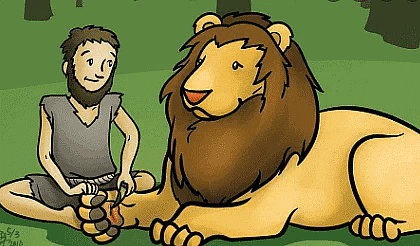
Martin was a slave. He was very unhappy as his master did not treat him well. So one day the slave ran away into the forest. In the forest, he saw a lion. The lion was crying with pain. Martin went near the lion. He saw a thorn in the lion's foot. The slave took the thorn away. The lion stopped crying and went to his den. Martin moved ahead.
Martin was caught by his master's men after about a month. The cruel master ordered that Martin be thrown before a hungry lion. The hungry lion was brought in a cage. From this cage, he was thrown into a deep pit. Martin had already been thrown there. The lion rushed at him but when it came close to Martin, he started licking his feet. It was the same lion who was relieved of the thorn and pain by Martin. The lion remembered the slave's kindness and was now returning it.
Do good, find good.
Note for students: This story shows the idea of gratitude and repayment for kindness. It is an example of how a single good deed can become central to the plot and resolution.
7. A Farmer and his Sons

A farmer had good fertile fields. He had four sons but he was very unhappy because they would fight and quarrel among themselves. When he was on his death bed, he called his sons and asked one of them to bring four sticks. Then he asked his second son to tie them in a bundle. The son did so. The farmer asked his third son to give the bundle to the fourth. Now the farmer asked the fourth son to break it. The son tried his best but could not break the bundle. One by one, each of the four sons tried to break the bundle but in vain.
Now the farmer asked his sons to untie the bundle. He gave each of them a stick and asked them to break it. They easily did so. The farmer asked his sons to learn a lesson from it. As long as they were united, no one could cause them any harm.
Union is strength.
Note for students: This is a classic example of using a simple demonstration to teach a moral. The physical action of trying to break the bundle makes the lesson memorable and easy to explain in a short student story.
Exercises: Practice Writing
Use the following prompts to practise planning and writing a short story. For each prompt, spend five to ten minutes planning before you write. Aim for 120-180 words for a Class 7 short story.
- Write a story about a villager who finds a mysterious box in the field and must decide whether to open it.
- Write a short fable in which an animal learns that boasting brings trouble. Give it a clear moral sentence at the end.
- Write an anecdote about a child who helps an elderly neighbour and what happens as a result.
- Expand one of the model stories above (for example, "The Monkey and the Wedge") by adding a short beginning or a short conversation between an animal and a carpenter. Keep the moral the same.
Checklist Before Submission
- Does your story have a clear beginning, middle and end?
- Is the main conflict clear and does the climax resolve it?
- Is the tense consistent and is punctuation correct?
- Are paragraphs used to separate scenes or speakers?
- Have you kept the language simple and suitable for Class 7 readers?
- If your story closes with a moral, is it clearly stated and linked to the events?
Summary
Good story writing begins with a clear idea and a simple plan. Focus on a small number of characters, a clear setting, and a single problem or incident that leads to a meaningful outcome. Use appropriate tenses, short paragraphs, and correct punctuation. Read and learn from short tales such as those above; they are excellent models for writing your own moral or imaginative stories. Practise regularly, revise carefully, and always check that the story reads smoothly from beginning to end.
FAQs on Story Writing
| 1. What are the essential elements of a story? |  |
| 2. How can I effectively plan a story step by step? | |
| 3. What are some common mistakes to avoid when writing a story? | |
| 4. How can I revise my story effectively? | |
| 5. What types of short stories are particularly useful for students? | |




