The Noun Numbers


- Only countable nouns have plural forms. Singular countable nouns can usually be made plural by adding the suffix -s or -es.
- Regular nouns form their plural by adding -s or -es. For example: table → tables, glass → glasses.
- Irregular nouns form their plurals differently (not by simply adding -s or -es), e.g. man → men, child → children.
The Plural of a Noun formed by adding s to the Singular
Most countable nouns form the plural by adding -s to the singular form. This is the simplest and most common rule and applies to most nouns that do not end in special letters or patterns.
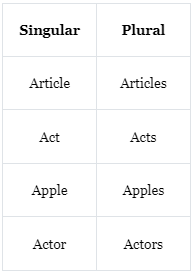
Examples
- book → books
- pen → pens
- cat → cats
Singular to Plural using es
Nouns that end in s, ss, sh, ch, x, or z form their plural by adding -es. The extra syllable makes pronunciation easier.
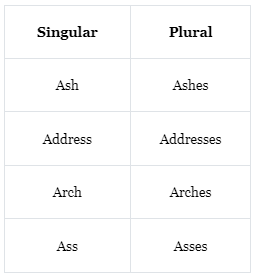
Examples
- bus → buses
- class → classes
- brush → brushes
- church → churches
- box → boxes
- quiz → quizzes
Nouns ending in -y
If a singular noun ends in -y with a vowel before it (a, e, i, o, u), form the plural by adding -s. If it ends in -y with a consonant before it, change -y to -ies.
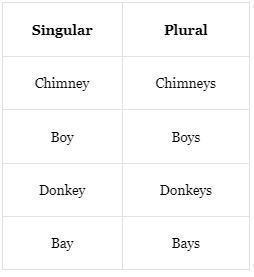
Examples
- boy → boys (vowel before y)
- toy → toys (vowel before y)
- city → cities (consonant before y)
- lady → ladies (consonant before y)
Nouns ending in -o
When a singular noun ends in -o, the plural is sometimes formed by adding -s and sometimes by adding -es. A common classroom rule is: if the letter before -o is a consonant, many nouns take -es; if it is a vowel, they usually take -s. There are exceptions (some words accept both forms).
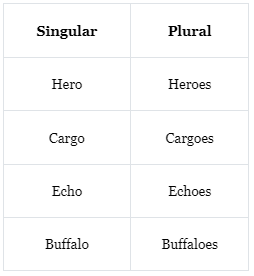
Examples
- hero → heroes
- tomato → tomatoes
- photo → photos (exception - vowel or accepted -s)
- studio → studios
Plural of Nouns by a change of the inside vowels
Certain nouns form their plural by changing the vowel(s) in the middle of the word rather than by adding an ending. These are irregular plurals and are important to learn.
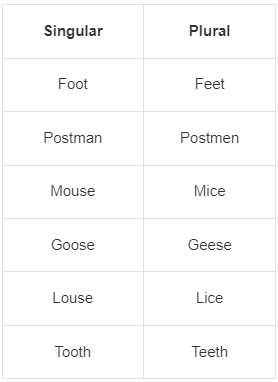
Common examples
- man → men
- woman → women
- tooth → teeth
- foot → feet
- mouse → mice
- goose → geese
Other Irregular Plural Forms
There are various irregular plural patterns students should be familiar with:
- Change + add: child → children
- Completely changed form: person → people
- Old/foreign endings: datum → data, criterion → criteria (these are less common in everyday Class 7 usage but worth noting)
- No change in form for some nouns: sheep → sheep, deer → deer, species → species, series → series
Nouns used only in the singular (Uncountable Nouns)
Some nouns are generally treated as uncountable (mass nouns). They do not have plural forms and are usually used with singular verbs. They refer to substances, concepts, collective categories, or abstract ideas.
Common uncountable nouns include: abuse, advice, luggage, machinery, money, poetry, jewellery, scenery, vacation, word, furniture, fruit, meal, fun, freedom, music, joy, permission, progress, rice, wheat, bread, milk, butter, glass, silver, gold, education, homework, employment, etc.
Usage note: To count uncountable nouns, use expressions such as a piece of, a cup of, a loaf of, some, much, a bit of.
Nouns used as both singular and plural (Collective and Plural-only Nouns)
Certain nouns can be treated as singular or plural depending on meaning and the emphasis on the group as a unit or on its members. These include collective nouns and nouns that are plural in form but may be singular or plural in meaning.
Examples include: committee, government (govt), police, wages, jury, means, politics, pains, public, etc.
- The jury was unanimous in its opinion. (Here jury is taken as one unit - singular verb.)
- The jury were divided in their opinion. (Here members of the jury are emphasised - plural verb.)
- The committee has agreed on this issue. (Committee as a single body - singular verb.)
- The committee are divided on this issue. (Committee members considered individually - plural verb.)
Other useful plural rules and notes
Nouns ending in -f or -fe
Many nouns ending in -f or -fe form the plural by changing -f/ -fe to -ves, but there are exceptions that simply take -s.
Examples
- wife → wives
- leaf → leaves
- wolf → wolves
- roof → roofs (exception)
- chief → chiefs (exception)
Compound nouns
Compound nouns usually form plurals by making the principal noun plural. When the principal word is not obvious, make the most important or head noun plural.
Examples
- mother-in-law → mothers-in-law
- passer-by → passers-by
- book-shelf → book-shelves
Nouns that are always plural (plural-only nouns)
Some nouns exist only in plural form and take plural verbs. They often refer to objects with two parts or groups of items.
Examples
- scissors, trousers, spectacles, tongs
- police (can mean the police force - treated as plural)
- wages (salary - plural form only)
Agreement of verbs with plural forms and collective nouns
Pay attention to whether a noun is treated as a single unit or as several individuals, and choose the verb accordingly. In Indian English and many British usages, collective nouns are often treated as singular when the unit acts together and plural when attention is on individuals.
How to learn and practise noun numbers
Memorise regular rules first (add -s, add -es, change -y to -ies), then learn irregular plurals by heart. Use reading and exercises to notice patterns and exceptions. When in doubt, consult a reliable dictionary for the plural form of uncommon nouns.
Summary
Countable nouns usually form plurals with -s or -es; some change internally (irregular plurals) and some remain unchanged. Uncountable nouns do not have plural forms. Collective nouns may be singular or plural in meaning - choose the verb form that matches the intended sense.
FAQs on The Noun Numbers
| 1. What are prime numbers? |  |
| 2. How do you determine if a number is prime? | |
| 3. What is the largest prime number known to date? | |
| 4. Are there infinitely many prime numbers? | |
| 5. What is the significance of prime numbers in cryptography? | |




