The Active And Passive Voice


The change of voice helps us express the same idea in different ways by shifting the focus of a sentence. When a sentence is changed from Active to Passive, attention moves from the doer of the action to the receiver of the action. Learning these rules makes writing clearer, helps avoid repetition, and improves overall understanding of English grammar.
Rules for the Change of Voice
- When a verb is changed from the Active into Passive, the object of the active sentence becomes the subject of the passive sentence.
- Nominative case of a pronoun in the active sentence changes into the objective case in the passive sentence (for example, I → me, we → us, he → him, she → her, they → them).
- Only transitive verbs (verbs that take an object) normally have passive voice. If an intransitive verb becomes transitive in some context, it can then have a passive form.
- The main verb is changed to its past participle (third form), and a suitable form of the verb "to be" (is, am, are, was, were, be, been, being) is used before it according to the tense and the number (singular/plural) of the new subject.
- The agent (doer of the action) is usually introduced by the preposition "by". When the agent is unknown or unimportant, the agent (and "by" phrase) is often omitted.
- Only eight tenses can normally be changed into passive voice. The Future Continuous tense and the three Perfect Continuous tenses do not have passive forms.
How to Change an Active Sentence into Passive
- Identify the subject, verb and object in the active sentence.
- Make the object of the active sentence the subject of the passive sentence.
- Change the verb to the appropriate form: use the past participle (third form) of the main verb and put the correct form of "to be" before it according to the tense and the new subject's number.
- Change the original subject into an object using the objective case and place it after the verb with the preposition "by" if the agent is needed.
- Adjust pronouns and auxiliary verbs to match the new subject and the sentence tense.
- Omit the agent (the "by" phrase) when it is not necessary or when the agent is unknown or unimportant.
Tenses and Their Passive Forms
Simple Present Tense
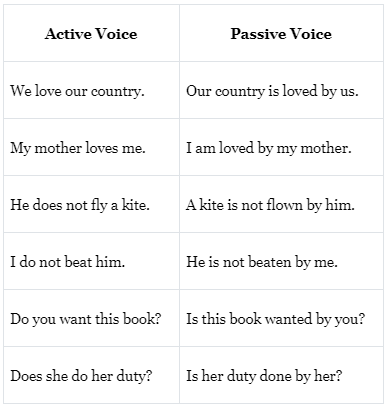
The simple present active form is: Subject + base verb (s/es). The passive form is: Object (as subject) + am/is/are + past participle.
Examples:
- Active: She writes a letter. - Passive: A letter is written by her.
- Active: They play football every day. - Passive: Football is played by them every day.
- Question (active): Do you speak English? - Passive: Is English spoken by you?
Simple Past Tense
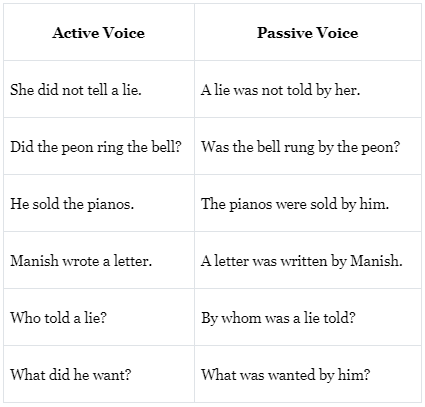
The simple past active form is: Subject + past form of verb. The passive form is: Object (as subject) + was/were + past participle.
Examples:
- Active: He broke the window. - Passive: The window was broken by him.
- Active: They painted the house last month. - Passive: The house was painted by them last month.
- Question (active): Did she finish the work? - Passive: Was the work finished by her?
Simple Future Tense
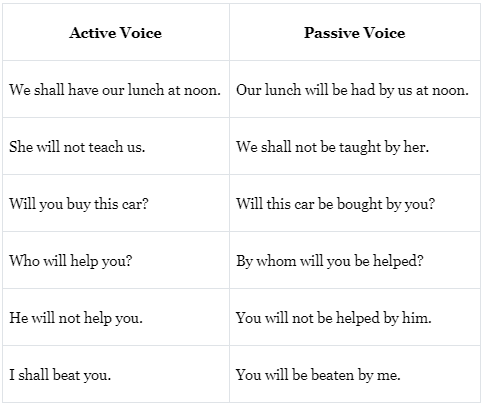
The simple future active form is: Subject + will/shall + base verb. The passive form is: Object (as subject) + will/shall + be + past participle.
Examples:
- Active: They will complete the project. - Passive: The project will be completed by them.
- Active: I shall send the letter tomorrow. - Passive: The letter shall be sent by me tomorrow.
Present Continuous Tense
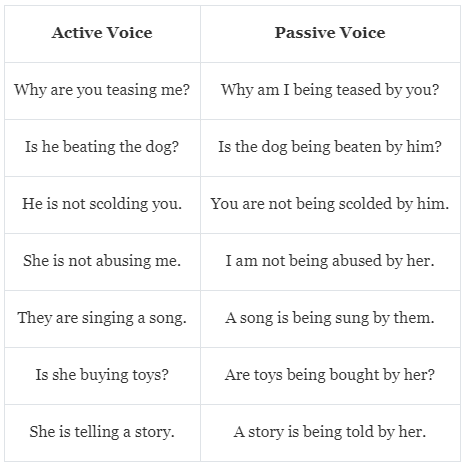
The present continuous active form is: Subject + am/is/are + present participle (verb+ing). The passive form is: Object (as subject) + am/is/are + being + past participle.
Examples:
- Active: She is reading the book. - Passive: The book is being read by her.
- Active: They are repairing the road. - Passive: The road is being repaired by them.
Past Continuous Tense
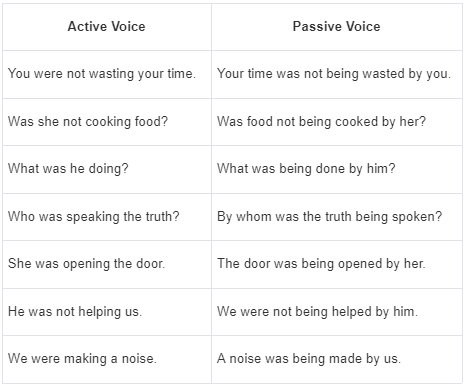
The past continuous active form is: Subject + was/were + present participle (verb+ing). The passive form is: Object (as subject) + was/were + being + past participle.
Examples:
- Active: He was cleaning the room. - Passive: The room was being cleaned by him.
- Active: They were discussing the problem. - Passive: The problem was being discussed by them.
Present Perfect Tense
The present perfect active form is: Subject + has/have + past participle. The passive form is: Object (as subject) + has/have + been + past participle.
Examples:
- Active: She has written three letters. - Passive: Three letters have been written by her.
- Active: They have finished the work. - Passive: The work has been finished by them.
Past Perfect Tense
The past perfect active form is: Subject + had + past participle. The passive form is: Object (as subject) + had + been + past participle.
Examples:
- Active: She had repaired the car. - Passive: The car had been repaired by her.
- Active: They had completed the test. - Passive: The test had been completed by them.
Future Perfect Tense
The future perfect active form is: Subject + will/shall + have + past participle. The passive form is: Object (as subject) + will/shall + have + been + past participle.
Examples:
- Active: They will have finished the work by Monday. - Passive: The work will have been finished by them by Monday.
Tenses That Do Not Have Passive Forms
The Future Continuous tense and the three Perfect Continuous tenses (Present Perfect Continuous, Past Perfect Continuous, Future Perfect Continuous) do not have passive forms in standard English.
Other Important Points
Modal Verbs
When a sentence contains a modal verb (can, could, may, might, shall, should, will, would, must), the passive is formed by modal + be + past participle.
Examples:
- Active: They can solve the problem. - Passive: The problem can be solved by them.
- Active: You must obey the rules. - Passive: The rules must be obeyed by you.
Agent Omission
If the agent is unknown, obvious, or unimportant, the "by" phrase is omitted. The sentence still remains grammatically correct and often more natural.
Examples:
- Active: Someone stole my bike. - Passive: My bike was stolen.
- Active: People speak English all over the world. - Passive: English is spoken all over the world.
Pronouns and Case Changes
Personal pronouns must change from the nominative to the objective case when moved to the object position in the passive:
- I → me, we → us, he → him, she → her, they → them, you → you
Examples:
- Active: He wrote the letter. - Passive: The letter was written by him.
- Active: We will help you. - Passive: You will be helped by us.
Imperative Sentences
Imperatives can be made passive in different ways. A common method uses "let" + object + "be" + past participle, or uses the passive infinitive.
Examples:
- Active: Close the door. - Passive: Let the door be closed.
- Active: Do not touch the paintings. - Passive: Let the paintings not be touched.
Special Verbs and Notes
Certain verbs do not take passive easily (verbs of perception, reflexive verbs, some phrasal verbs). The verb "get" is sometimes used colloquially as an alternative to "be" in passive constructions (for example, He got promoted), but for standard and formal use, prefer be + past participle.
Practice Exercises
Q1: Change the following active sentences into passive:
- The teacher praised the student.
- They will build a new bridge.
- The chef is preparing the meal.
- People speak Hindi in many parts of India.
- They had completed the work before the party.
Q2: Change the following passive sentences into active:
- The cake was baked by my mother.
- The window has been broken.
Q3: Form passive sentences using modal verbs:
- Someone can solve this problem.
- You must obey the law.
Answers
Q1:
- Ans. The student was praised by the teacher.
- Ans. A new bridge will be built by them.
- Ans. The meal is being prepared by the chef.
- Ans. Hindi is spoken in many parts of India.
- Ans. The work had been completed by them before the party.
Q2:
- Ans. My mother baked the cake.
- Ans. Someone has broken the window. / He/She has broken the window. (If the agent is unknown, keep the passive: The window has been broken.)
Q3:
- Ans. This problem can be solved. / This problem can be solved by someone.
- Ans. The law must be obeyed by you. / You must obey the law. (Passive: The law must be obeyed.)
Final Notes
Remember the basic transformations: objects become subjects, subjects become objects (in objective case), the main verb becomes the past participle and an appropriate form of "to be" is used. Use the passive voice when the action or the object is more important than the doer, or when the agent is unknown or unnecessary.
Practice changing sentences from active to passive in all the tenses that allow passive formation. Pay careful attention to pronoun cases, auxiliary verbs and the number (singular/plural) of the new subject.
FAQs on The Active And Passive Voice
| 1. What is the difference between active and passive voice? |  |
| 2. How do I change a sentence from active to passive voice? | |
| 3. Why is passive voice sometimes used in writing? | |
| 4. Is it always better to use active voice in writing? | |
| 5. How can I identify passive voice in a sentence? | |





