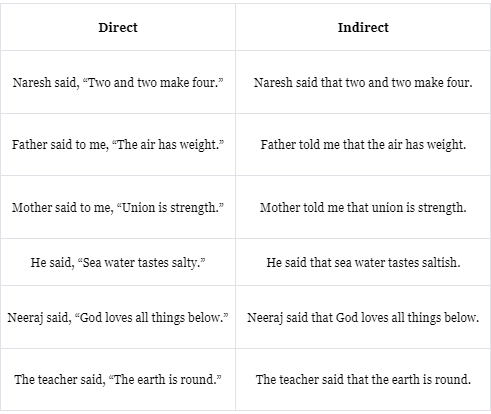
Direct Speech
Direct Speech records the exact words spoken by a person. The reported words are placed within inverted commas (" "). The structure shows clearly who said something and what was said.
- Quotation marks: The exact words of the speaker are enclosed in inverted commas (" ").
- Capitalisation: The first word of the reported speech usually begins with a capital letter.
- Punctuation: When the reporting clause comes before the quoted words, a comma is placed after the reporting verb to separate it from the quotation. Example: He said, "I will come tomorrow."
- Reporting verbs: Common reporting verbs are said, told, asked, replied, informed, answered, etc.
Indirect Speech (Reported Speech)
Indirect Speech (also called reported speech) tells what someone said without quoting their exact words. The reported words are not enclosed in inverted commas and the sentence is usually introduced by a conjunction such as that, if, whether, what, when, where, why, how, etc.
- No quotation marks: The speaker's exact words are not used and therefore inverted commas are dropped.
- No comma after reporting verb: The comma that usually separates the reporting verb and the quotation in direct speech is omitted in indirect speech because the quotation marks are not used.
- Use of conjunctions: The reported speech is often introduced by a conjunction such as that (for statements) or if/whether (for yes/no questions).
- Tense shift: When the reporting verb is in the past, the verbs in the reported clause usually shift one step back in tense (present → past, present perfect → past perfect, simple past → past perfect, will → would, etc.).
Rules for changing Direct Speech into Indirect Speech
- Change of reporting verb: If the reporting verb in direct speech is say/says/will say/shall say/said and it is followed by an object, it often becomes tell/tells/will tell/shall tell/told or other reporting verbs such as replied, informed, answered in indirect speech. Example: Direct: She said to him, "I am tired." → Indirect: She told him that she was tired.
- Use of conjunction "that": The conjunction that usually replaces the quotation marks when converting statements. Example: He said, "I am happy." → He said that he was happy.
- Capitalisation in the reported clause: The first word of the reported clause does not begin with a capital letter unless it is a proper noun or the pronoun I.
- Dropping the comma: The comma used in direct speech to separate the reporting clause and the quoted sentence is dropped in indirect speech.
- When reporting verb is present or future: If the reporting verb is in the present or future tense, the verbs in the reported clause usually do not change. Example: She says, "I am ill." → She says that she is ill.
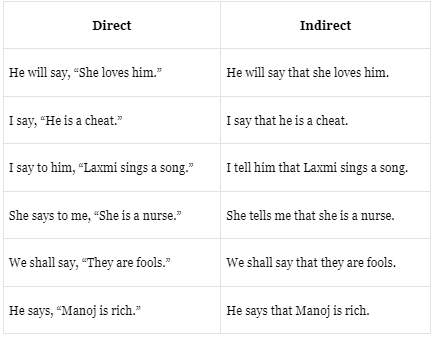
Exceptions to Tense Change
When the reported speech expresses a universal truth, a scientific fact, a habitual action, a historical fact or a general truth, the tense of the verb in the reported clause is not changed.
- Direct: He said, "The sun rises in the east." → Indirect: He said that the sun rises in the east.
- Direct: She said, "Water boils at 100°C." → Indirect: She said that water boils at 100°C.
More to know: Questions, Commands, Exclamations and other points
- Reporting questions: Yes-no questions are reported using if or whether. Example: Direct: He asked, "Do you like tea?" → Indirect: He asked if/whether I liked tea.
- Questions beginning with a question word: If the direct question begins with an interrogative pronoun or adverb (what, which, who, whom, when, where, why, how), the same word is used to introduce the reported question, and the sentence becomes assertive (word order changes to subject + verb). Example: Direct: She asked, "Where do you live?" → Indirect: She asked where I lived.
- Helping verbs do/does/did in reported questions: If a positive question in direct speech uses do/does, these are usually dropped in reported speech. Example: Direct: He asked, "Do you play cricket?" → Indirect: He asked if I played cricket.
- Imperatives (commands, requests, advice): These are reported using verbs like asked, ordered, requested, advised, followed by an infinitive. Example: Direct: He said to me, "Close the door." → Indirect: He told me to close the door.
- Exclamations: Exclamatory sentences are often reported with expressions such as expressed surprise that, exclaimed that, or by changing the exclamation into a statement. Example: Direct: She said, "What a beautiful painting!" → Indirect: She exclaimed that it was a beautiful painting.
- Reporting verbs change according to sense: Use suitable reporting verbs to reflect meaning: ask, warn, advise, suggest, promise, refuse, agree, admit, deny, etc. Example: Direct: "Please come early," she said. → Indirect: She requested me to come early.
- When the reporting verb is a question word or a modal: If the sentence begins with a helping verb or modal auxiliary, use if or whether as the conjunction for yes-no reports. Example: Direct: He asked, "Will you join us?" → Indirect: He asked whether I would join them.
Common Changes in Words while Reporting
- Pronouns: Change according to the speaker and the listener. Example: Direct: She said, "I am hungry." → Indirect: She said that she was hungry.
- Time expressions: Change when the reporting verb is in the past. Examples: now → then, today → that day, tomorrow → the next day / the following day, yesterday → the day before / the previous day.
- Place expressions: Examples: here → there, this → that, these → those.
- Modals: Some modals change: will → would, can → could, may → might, but must often remains must or becomes had to depending on meaning.
Table: Common tense changes when the reporting verb is in the past
| Direct Speech | Indirect Speech |
|---|
| Present Simple (I eat) | Past Simple (he ate) |
| Present Continuous (I am eating) | Past Continuous (he was eating) |
| Present Perfect (I have eaten) | Past Perfect (he had eaten) |
| Simple Past (I ate) | Past Perfect (he had eaten) |
| Will (I will go) | Would (he would go) |
Some Examples
- Direct: He said, "I am reading a book." → Indirect: He said that he was reading a book. (Present continuous becomes past continuous when reporting verb is past.)
- Direct: Mary said, "I will help you." → Indirect: Mary said that she would help me. (Will → would.)
- Direct: The teacher said, "Water freezes at 0°C." → Indirect: The teacher said that water freezes at 0°C. (No change because it is a general scientific fact.)
- Direct: John asked, "Where have you been?" → Indirect: John asked where I had been. (Question word remains; verb tense shifts to past perfect.)
- Direct: "Please don't make a noise," she said. → Indirect: She requested us not to make a noise. (Command/request → asked/requested + infinitive / not + infinitive).
Practical Tips for Converting Speech
- Identify the reporting verb and its tense first.
- Decide whether the reported clause expresses a fact, habit, or general truth (these may not require tense change).
- Change pronouns and time/place words according to the speaker and listener.
- Use appropriate reporting verbs to match meaning (ask, tell, request, advise, warn, promise, etc.).
- Convert questions into statements and reorder subject and verb as necessary.
If you practise converting a variety of sentence-statements, questions, commands, and exclamations, you will become confident in recognising which changes are needed and when exceptions apply.