Worksheet Solutions: Unseen Passage

Q.1. Read the following passage carefully:
Homeopathy
Homeopathy is a form of alternative medicine, first proposed by German physician Samuel Hahnemann in 1796, that attempts to treat patients with heavily diluted medicines. Homeopathic remedies are prepared by serial dilution with shaking by forceful striking, which homeopaths term succession after each dilution under the assumption that this increases the effect of the treatment. Homeopaths call this process potentization. Dilution often continues until none of the original substance remains. Homeopathic reference books known as repertories are then consulted, and a remedy is selected based on the totality of symptoms. Homeopathic remedies are considered safe but are criticised for putting patients at risk due to advice against conventional medicine such as vaccinations, antimalarial drugs, and antibiotics. Depending on the dilution, homeopathic remedies may not contain any pharmacologically active molecules, and for such remedies to have a pharmacological effect would violate fundamental principles of science. Modern homeopaths have proposed that water has a memory that allows homeopathic preparations to work without any of the original substance; however, there are no verified observations nor scientifically plausible physical mechanisms for such a phenomenon. The lack of convincing scientific evidence supporting homeopathy's efficacy and its use of remedies lacking active ingredients have caused homeopathy to be described as pseudoscience.
Choose the most appropriate option:
(i) Homeopathy treats patients with:
(a) Heavy medicine
(b) strong medicine
(c) diluted medicine
(d) concentrated medicine
Ans: (c)
Explanation: Homeopathy uses medicines that have been repeatedly diluted. The passage states that remedies are prepared by serial dilution and that dilution often continues until none of the original substance remains. Therefore, the correct choice is diluted medicine.
(ii) Homeopathic remedies are prepared by serial dilution with shaking by forceful striking, the procedure is known as
(a) succession
(b) potentization
(c) dilution
(d) convention
Ans: (a)
Explanation: The passage explains that the shaking by forceful striking carried out after each dilution is called succession by homeopaths. It also notes that homeopaths refer to the overall process of dilution and succession as potentization, but the specific action of shaking is named succession in the passage.
(iii) A report of UK states that homeopathy is not more useful than a placebo because after dilution the medicine doesn't contain any.
(a) chemical
(b) acid
(c) pharmacologically active substance
(d) vaccine against diseases
Ans: (c)
Explanation: The passage states that dilution often continues until none of the original substance remains and that remedies may not contain any pharmacologically active molecules. Because there are no active molecules left, the report concluded homeopathy is no more useful than a placebo.
(iv) Homeopathy is also termed as pseudoscience because:
(a) it is based on false notions effectiveness
(b) it lacks scientific evidence on its
(c) it has side effects
(d) it is a slow treatment
Ans: (b)
Explanation: The passage explains that homeopathy is described as pseudoscience because there is a lack of convincing scientific evidence supporting its efficacy and because many remedies lack active ingredients. This lack of evidence is the main reason for the label.
(v) The word in the passage which means the same as the facts /objects that make you believe that something is true:
(a) pharmacology
(b) placebo
(c) accredited
(d) evidence
Ans: (d)
Explanation: The word evidence means facts or objects that make you believe something is true. The passage uses the term to describe the lack of convincing support for homeopathy.
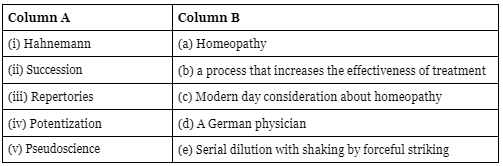
Q.2. Match the terms in column A with their meaning in column B.
Ans:
(i) Hahnemann - (d) A German physician
(ii) Succession - (e) Serial dilution with shaking by forceful striking
(iii) Repertories - (a) Homeopathy reference books
(iv) Potentization - (b) Process that is believed to increase the effectiveness of the treatment
(v) Pseudoscience - (c) Modern-day consideration about homeopathy
FAQs on Worksheet Solutions: Unseen Passage
| 1. What is the importance of solving unseen passage worksheets in class 7? |  |
| 2. How can solving unseen passage worksheets benefit students in their exams? | |
| 3. What strategies can students use to solve unseen passage worksheets effectively? | |
| 4. How can teachers make unseen passage worksheets more engaging for class 7 students? | |
| 5. Are there any online resources or websites that provide additional unseen passage worksheets for class 7 students? | |